New work from us pooling together clinical sequencing data to identify large effect common risk variants for rare cancer types. This included a novel HLA locus that interacts with HPV infection to increase Anal Cancer risk.
Happy to share our new preprint from @SashaGusevPosts and @nmancuso_ labs! We introduce Mr. PEG, a framework integrating perturbational screens, eQTL, and GWAS data to identify mediating genes for complex traits. (1/n) https://t.co/YShpOyKLw0
Excited to share our new work of regulatory effects in the brain using sc-RNASeq data. Importantly, we argue that besides analyzing single cell eQTLs, it is important to look beyond cell types and better dissect shared and distinct effects between cell types.
https://t.co/zUh2BxjUEO
How do GWAS and rare variant burden tests rank gene signals?
In new work @Nature with Jeff Spence, @jkpritch, and our wonderful coauthors we find the key factors are what we call Specificity, Length, and Luck!
🧬🧪🧵
https://t.co/rNzekB06la
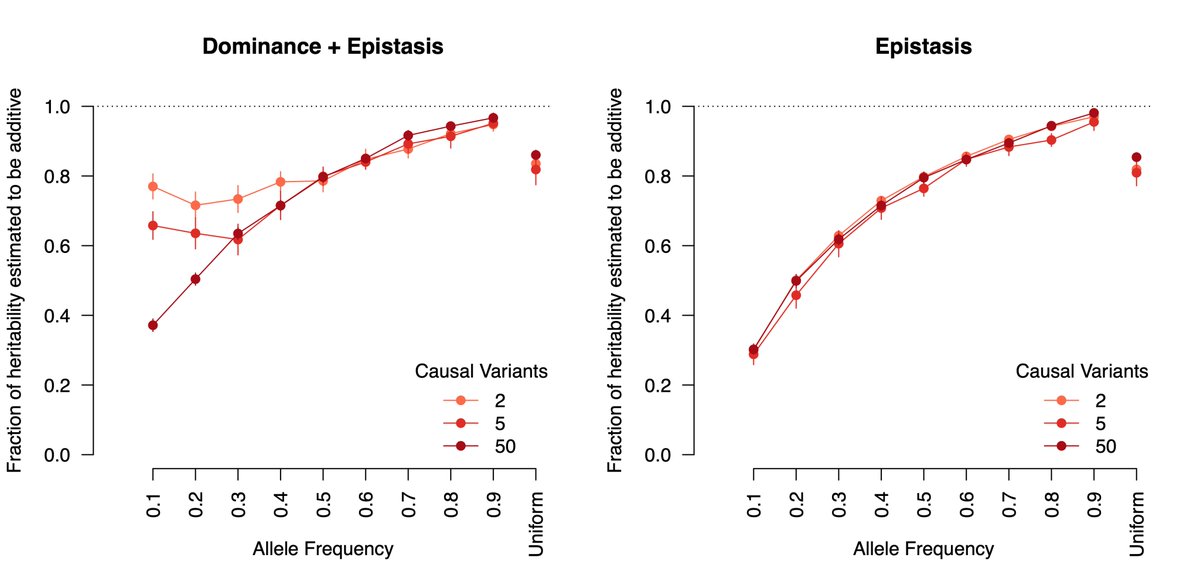
The proportion of epistatic heritability that is estimated as additive by quantitative genetic models. Epistasis deviates more from additivity for lower frequency causal alleles, but on average >80% of biological GxG will just look like statistical G.
Check out our scPrediXcan paper
https://t.co/Pcni6LfrNg
Led by talented @Charles_Zhou12, supervised by @MengjieChen6
and me, with thanks to many contributors
scPrediXcan integrates deep learning and single cell expression data into a powerful cell type specific TWAS framework.
I am thrilled to share one of the most important projects from my PhD! We developed the method JOBS (JOint model of Bk-eQTLs as a weighted sum of Sc-eQTLs) and applied it to blood bulk (eQTLGen) and sc-eQTL (OneK1K). 1/3
I am excited to share our new work that generates a single cell eQTL atlas for immune cell types. The work integrates bulk eQTLs with sc-eQTLs, which boosts the power for identifying sc-eQTLs for up to 4 folds. As such, we have the power equivalent to sc-RNASeq of 4K individuals.
I'm excited to share a wonderful collaboration with @LD_matrix: JOBS integrates bulk and single-cell eQTLs to boost eQTL discovery. Integrated with GWAS, it identified more disease-linked loci for 14 immune disorders & fueled drug-repurposing. #immunology#drugdiscovery#genomics
Our method significantly boosts the power to identify sc-eQTLs—equivalent to expanding the sample size by 4 times. This enhancement benefits all downstream analyses, leading to more colocalized loci and more cell-type-specific TWAS genes. 2/3
🧠🔥"Put on your 3D glasses...oh wait, you don't need them!"😝
Brain Metabolome just got an upgrade-why look at slices when you can see the whole picture in 3D?
Check out our latest work in @NatMetabolism .🚀🔬
🔗https://t.co/ETMsaEMCiC
Beyond excited to share this new paper with all of you . It's the most fun we've ever had. We figured out how to study a latent index driving partner choice without measuring it directly🥂
@qinwen_zzz
Preprint📰: https://t.co/dLsmZvcjiV
Sumstats⬇️: https://t.co/0LJOblAOmR
I am happy to share our new work that predicts the progression of autoimmune diseases, integrating EHR and GWAS datasets @NatureComms . https://t.co/81WRL7oalS
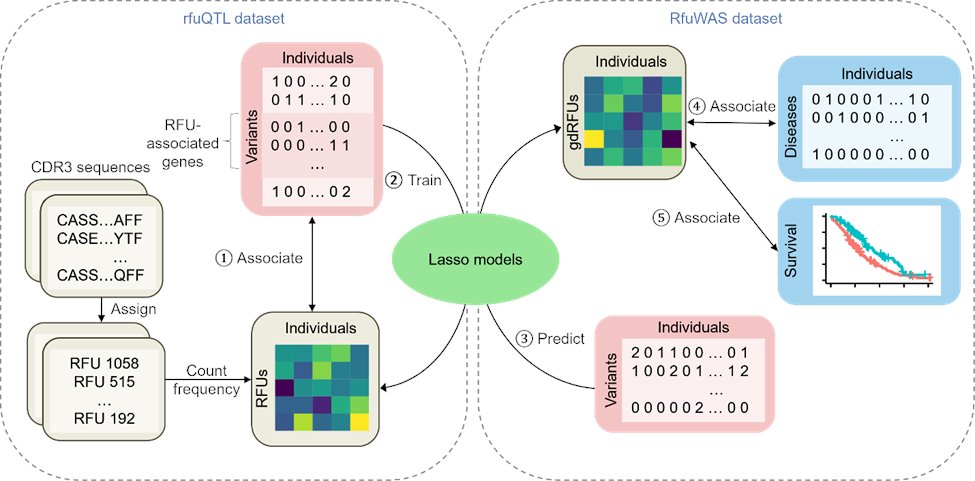
Excited to share our recent publication in Communications Biology! We explored how genetic variation shapes T cell receptor (TCR) diversity and its impact on diseases such as autoimmune disorders and cancer. https://t.co/COstX2VwP1 (1/11)
Thrilled to share our work to analyze insurance claim datasets to dissect genetic and environmental contributions to 1083 human diseases. We developed a spatial linear mixed model SMILE, using geolocations as a proxy for the environment. https://t.co/Mj2hdaepGt
Excited to share our latest work describing a spatial mixed linear effect (SMILE) model that refines the estimates of genetic heritability and air pollution causal effects using EHR in @NatureComms. Huge thanks to Dan McGuire and my PI @dajiangliu81!
https://t.co/BFSnIqyc36