Today @databricks we're publishing a detailed analysis of techniques we used to drastically reduce our internal AI spend while aggressively growing adoption. Savings come from layering in several techniques, which combine to drive unit costs down as much as 90% in some scenarios. Tl;dr, the wins come from:
1. Shifting defaults to more efficient models, including OSS models such as GLM. Maximum intelligence models simply aren't needed for many coding tasks, and "good enough" models are quickly becoming very cheap. We shift traffic between models using Unity AI Gateway. Approximate savings: 50% or more.
2. Using smart routing to automate model selection. Routing can further squeeze efficiency by dynamically selecting the model or harness that can most efficiently execute a particular task. Our task-level routing leverages @omnigent_ai. Approximate savings: 30%.
3. Providing user visibility and adaptive budgeting. Every user can see how much they spend, and users receive hints on how to contain spend. Heavy spenders encounter progressive friction as they ratchet spend above certain levels. Approximate savings: 10%.
4. Managing context bloat by pruning tool call results and tuning harness settings. Extraneous context costs $$ and delivers no value. Tuning cache settings also help lower average token costs. Approximate savings: 10%.
I've got an agent in a loop optimizing a renderer with the goal to minimize frame times (and tests to measure). It got times down from 88ms to 2ms and allocations down from ~150K to 500. Sounds good, right? Wrong. This is exactly why agent psychosis is a big fucking problem.
As an experiment, I rewrote the Ghostty core render state in Go, with access to identically laid out data structures as Ghostty and the exact same validation tests. I made a purposely naive renderer (simple, correct, but slow). 88ms per frame with 150,000 allocations (horrendous, lol)!
I then kickstarted a Ralph loop to bring the frame times down. I told it it can't modify input data structures or the public API or tests (they're correct), but it can do anything else it wants. It got to work.
It has worked for about 4 hours. I've spent around $350 on this experiment so far. The results?
88ms => 1.5ms
150K allocs => ~500 allocs
Incredible right? Nope.
My hand-written renderer I ported has frame times (same benchmark) of ~20us (0.020ms) and 0 allocations in the update path.
This is the problem with psychosis and lacking systems understanding. If you don't understand the system, you're going to accept that this is an incredible result. If you understand the system, you'll see better solutions immediately and can do roughly 75x better on throughput.
The people who blindly trust agent output are in the former camp. They're sheeple, overdrinking from a fountain of mediocrity.
Standard disclaimer: I use AI all the time. I like AI. The point I'm making is to not blindly accept results. Think. Analyze. Learn.
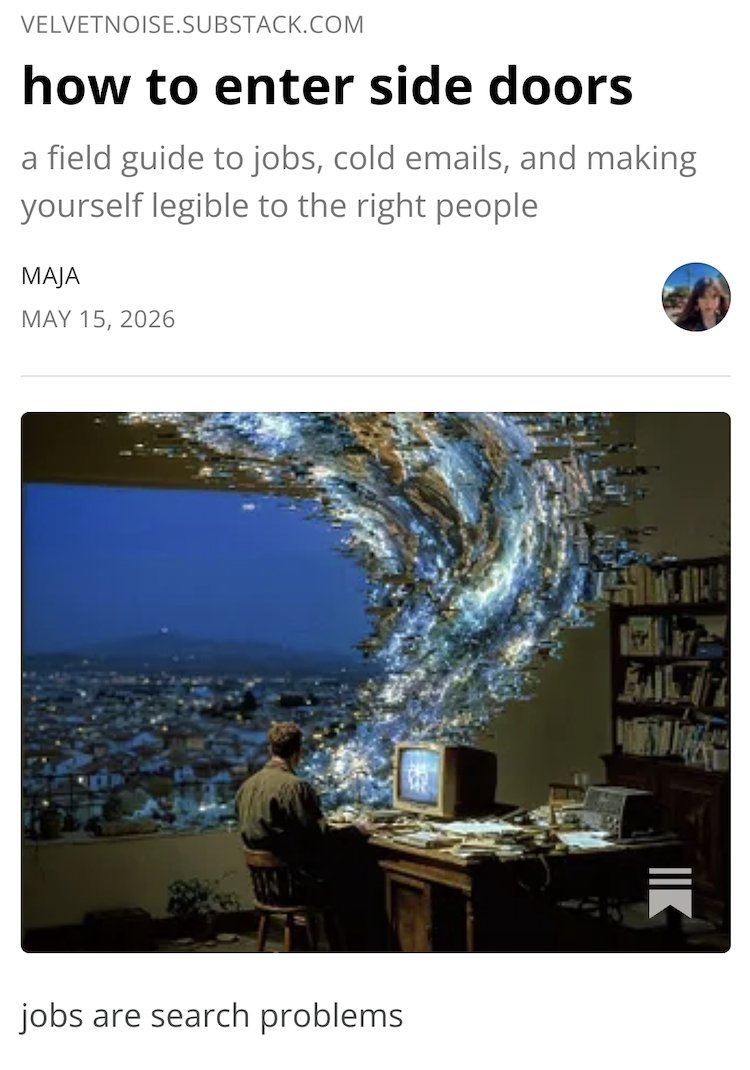
a few people asked me to turn this into a full essay, so i did!
read my full field guide to jobs, cold emails and making yourself legible to the right people. share with a student or jobseeker in your life: https://t.co/AlMF6zMyQX
Most managers already know how to run great 1:1s. They choose not to because their org punishes them for it.
Every experienced manager has heard the advice. Let your reports own the agenda. Focus on their growth. Coach instead of direct. They learned it in their first leadership training. They’ve read the books. They’ve nodded along in the workshops.
They still run status update 1:1s. And the reason is structural.
A manager who develops their reports well creates people who get promoted out, get poached, or start asking for the manager’s job. A manager who runs low-energy status updates keeps the team stable, dependent, and unlikely to leave. HR tracks attrition as a negative on the manager’s scorecard. Nobody tracks “I developed three people so well they all got promoted in 18 months” as a win.
The incentive math is brutal. Develop your people → they leave → you backfill → you spend 6 months ramping a new hire → your team’s output craters during the transition → your performance review suffers. Run status updates → team stays put → output is predictable → you look like a stable operator.
This is why advice like this resonates massively and changes almost nobody’s behavior. The managers reading and bookmarking it will open their next 1:1 on Monday and ask “so what’s your status on the Q2 deliverables?” Because their org rewards exactly that.
The managers who actually run great 1:1s tend to work at companies where developing people out of your team is celebrated. Those orgs are rare. And until that changes, most 1:1s stay exactly where they are: status updates with a calendar invite.
flicker company: "guus, you cool.with us training on all your GH repos, books, etc. right? it's not infringement, it's transformative work!"
also flicker company: "How dare you pay us and then train on our precious model outputs! HOW DARE YOU! It's against our ToS!"
don’t fall for the trap of waterfall development - our industry learned this lesson two decades ago. you can’t know and plan everything upfront - neither can agents.
@badlogicgames Some comedy gold in there: “We don't know how much of the github stars are bought. We don't know how many twitter followings/tweets are bought.” ��🤛🏻
You’ve probably already heard all about OpenClaw (formerly Clawdbot/Moltbot). Now meet the man behind it.
YC’s @raphaelschaad sat down with @steipete, the creator of OpenClaw, to discuss the “aha” moment behind the viral personal AI agent, why local-first agents could replace many of today’s apps, and how personal agents will reshape the future of software.
00:00 – OpenClaw takes over the internet
00:44 – Life after going viral
01:28 – Why OpenClaw took off, what sets it apart
02:56 – Bots talking to bots (and hiring humans)
04:11 – From “God AI” to swarm intelligence
05:07 – Peter’s original “aha” moment
06:38 – Rebuilding the agent as a conversation
07:38 – The moment it exceeded expectations
10:21 – Are apps going to disappear?
12:31 – Memory, data silos, and ownership
14:39 – The privacy reality of personal agents
15:05 – Letting the bot loose in public Discord
16:55 – Giving an agent a personality
18:19 – Contrarian building philosophy
20:09 – CLIs vs MCPs
21:28 – Building for humans first
21:46 – The road ahead
We hacked the AWS JavaScript SDK, a core library powering the entire @AWScloud ecosystem - including the AWS Console itself 🤯
How did we do it? Just two missing characters was all it took.
This is the story of #CodeBreach 🧵👇