This guy explained how he created 3 websites that generate $100,000 for him per month
In 25 minutes, he shows how he did it, step by step. Totally free.
Idea → Web → Monetize
Save this, you’ll thank me later
If you run a jewellery, fashion, home decor or eyewear brand, stop thinking of yourself as an “ecommerce founder”
Ecommerce is just how you sell.
A supplement brand and a fashion brand can both use Shopify, Meta and Klaviyo.
They are not the same business.
Supplements usually sell:
Problem → Solution → Buy
Visual Brands sell:
Desire → Identity → Buy
Different reason for buying = a completely different way of building and scaling the brand.
I call these Visual Brands.
It’s the type of business I’ve spent my career building, and it’s what I’m focused on now.
If you run one, I put together the exact Q4 playbook I use to scale mine — including the strategy I used to hit a $103k day.
Reply “VISUAL” and I’ll send it over.
This mom and her husband make $10,000 to $15,000 a month working part time.
Startup cost? $0.
Profit margins? 85%.
She handles the sales. He builds the websites. Together they run two businesses that feed each other customers.
The first business is so simple it sounds fake.
They give restaurants free sandwich boards. Yep.
You've probably walked past these without a second thought. Specials written in marker at the top. Six ad slots at the bottom.
They charge local businesses $600 per ad slot per year. That's $3,600 per board. Cost to make and install the whole thing? About $400.
That's $3,200 profit per board.
And the genius is the upsell. Listen to this:
Every business that buys an ad slot becomes a lead for their second business: an AI implementation agency.
Websites
Reputation management
Voice agents
The whole stack
Half of the advertisers upgrade, and those customers average $7,500 per year.
In this episode Rachel:
- Breaks down the copy-paste Instagram DM that lands them restaurants
- Shows the exact referral script that fills a board in two days
- Explains why reputation management became 60% of their agency revenue
- Walks through the upsell funnel from $600 ad slots to $7,500-a-year clients
This one was SO good!
Elon Musk explains why you should never charge an electric car to 100%
The last 20% is not a small ask.
Elon: "getting from 80 to 100, it takes about as much time as getting from 0 to 80"
It runs backwards from how people fuel a car.
Elon: "it's a little counterintuitive, because for a gasoline car you would fill it up"
Inside the battery, ions are looking for somewhere to go.
Elon: "the lithium ions are trying to find a parking space"
Elon: "when the parking lot's empty, they can zip right in there and find a spot, it's easy"
Elon: "as the parking lot gets full, just like trying to find a parking space at a mall, you have to hunt around for a spot"
So on a road trip the rule flips.
Elon: "you actually want to charge to about 80%, and then run it down all the way to 10%, or less"
this is insane. i genuinely don't understand why every ambitious person isn't shown this lecture before work starts consuming their entire life.
clayton christensen dedicated his career to studying why successful companies collapse. in his final class, he turned that theory on his students: if you keep allocating your time the same way, what life will you eventually build?
he had already seen the answer in his own harvard mba class.
at the fifth reunion, almost everyone looked successful. by the 10th, 15th, 20th, and 25th, some had stopped coming.
behind the empty seats were divorces, broken families, children living across the country, and people who had become wealthy but deeply unhappy.
none of them had planned that life.
work shows progress today. finish the presentation, ship the product, close the sale, get promoted, watch the number move.
an evening with your child may give you nothing you can show the next morning. it may take 20 years before you understand what all those evenings built.
so the next free hour goes back into work. the decision feels responsible, and tomorrow it feels responsible again.
this is how a life moves in the wrong direction without a single obviously wrong decision. every hour made sense on its own.
money, titles, and headcount fit neatly into a spreadsheet. christensen proposed another measure: how many lives became better because you were there?
he died in 2020.
open your calendar and look at where your time went over the last year. does it match what you say matters?
the full 70-minute lecture is in the video below.
Bill Ackman shows how $10,000 invested at 22 could become $25 million over 43 years at 20% a year - then shows how losing half your money just once every 12 years cuts that ending value to $1.8 million: “one of the most valuable assets you have today is your youth.”
this is him explaining finance through a lemonade stand, why avoiding huge losses matters more than chasing the highest possible return, and what he looks for in a business he could theoretically own forever.
“if the stock market were to close for 10 years you wouldn’t be unhappy.” Ackman says the real test is understanding how the business makes money, paying a reasonable price, avoiding too much debt, and having the stomach to do the opposite of the crowd: “in bubbles you probably should be a seller. in busts you should probably be a buyer.”
bookmark & watch the full lecture ↓
If you do only "one thing" today or in the coming week. Please get clear about what you want in the coming years.
Crystal clear. You can see it. You know what it looks like.
This is the vision to filter every decision around, every day, until you get there.
A woman was a Starbucks barista for 5 years, then spent 3 years at Starbucks corporate on the operations and product team.
She left in 2024. She still goes to Starbucks every single day.
She told me: "I stand in line and watch people spend $7 on a drink I make for $3.50 using the same ingredients. I watch them tap their credit card at the register and earn half the Stars they should be earning. I watch them order a Venti because they think bigger means more coffee it doesn't. I watch them use their birthday reward on a $3 drip coffee when it covers a $12 Venti with every add-on in the system. I watch them walk past the free refill they're entitled to because they don't know the policy exists."
"Starbucks is a $110 billion company. It makes its money on one simple principle: most customers don't understand the menu, the app, or the rewards system well enough to make the choices that save them money. The menu is designed to steer you toward the highest-margin drink. The app is designed to feel convenient while hiding the moves that lower your bill. And the rewards system is designed to feel rewarding while ensuring you spend more than you save unless you know how to flip it."
"I spend $3.50–$4.50 per visit. The person behind me spends $7 for the same caffeine. Same store. Same barista. Same espresso machine. The difference is I know how the system works."
Here are the 10 things she does that most Starbucks customers have never tried:
🧵
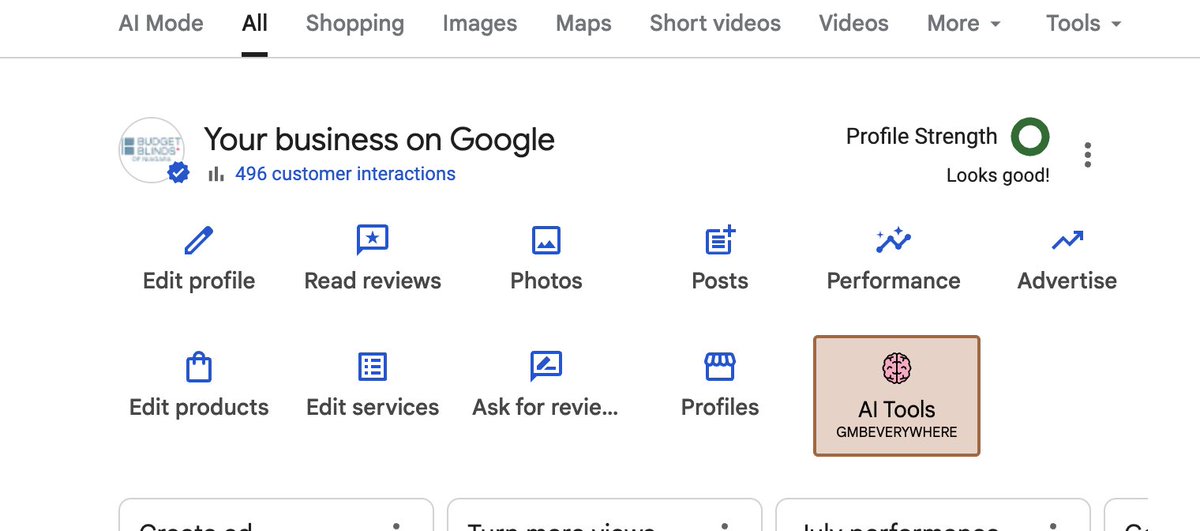
If you have a Google Business Profile, do this.
Click Edit Services and you'll see the list of everything you offer.
Take your highest value services and add your location next to them. Roman Shades St. Catharines, for example.
Add any services that are missing while you're in there.
Then copy all of your services and paste them into AI. Tell it: write SEO optimized service descriptions, under 300 characters, with the service and city in each one, and interview me about my business first so we can make it human.
That last part is the piece everyone skips. Without it you get the same description every other profile running AI has, professional, reliable, satisfaction guaranteed, words that describe nobody. The interview forces your actual answers into the descriptions, how long you've been doing it, what jobs you want more of, what you do differently. Answer it like you're talking, not writing.
Let it think, then copy each description into each service.
300 characters is the limit Google gives you per service, so the prompt fills the box instead of leaving it half empty or getting cut off mid sentence.
Most profiles have bare service names with nothing under them. Yours will read like someone who actually does the work wrote it, because someone did, the AI just typed it.
Cancel your $200/mo Ahrefs subscription 🤯
Claude Code can now run your SEO for you.
Point it at your Search Console and it finds the wins, writes the fixes, and renders a live dashboard off your own data.
All inside Claude Code.
Perfect for DTC brands and agencies sitting on months of Search Console data nobody has time to read.
Here's what it does:
→ Connects to your Search Console and GA4 through one guided setup that routes around Google's auth landmines
→ Finds the keywords sitting at positions 4 to 20 and scores them by the clicks you're leaving on the table
→ Ships the fix instead of naming it, with the rewritten title, the headings, and paste-ready content
→ Turns redirect chains, broken canonicals, and slow pages into dev tickets ranked by traffic at risk
→ Maps every query into hub-and-spoke clusters and flags where your own pages compete with each other
→ Drops a Monday report with week-over-week movement and exactly 3 priorities
What you get:
→ 9 skills in one plugin, from the Google setup through to the Monday report
→ A live SEO dashboard with a 0 to 100 health score, rendered as one self-contained HTML file
→ Orphan pages and money-page link gaps, listed paste-ready
→ Content drafted from your own search data instead of a keyword tool's guesses
Built 100% in Claude Code on your Search Console and GA4 data.
📌 Get the free plugin here:
https://t.co/xb9GjagrBJ
No backlinks. No problem.
Automate this with Claude
1. Create statistics page targeting <industry> statistics <year>
2. Link to it from other pages on your site
3. Link to it from footer
Statistics pages rank fast and journalist link to them
I analyzed 80 searches and realize that small websites with no link rank fast for these type of keywords