The riskiest time for a goal is the few weeks between reviews. Drift: goals that only exist in the room.
LeaderKit can send goal deadlines to a separate LeaderKit calendar in Outlook or Google Calendar, and Teams deadline reminders.
14-day free trial: https://t.co/PW16Kx2NSJ
Plan in slides. Goals in a spreadsheet. Updates in email.
Or one place: purpose and vision, annual strategies, goals and key actions, up to 3 years ahead.
Try LeaderKit free for 14 days: https://t.co/PW16Kx2NSJ
Every goal in LeaderKit has three things:
One owner.
A due date.
A status: on track, monitor or off track.
Simple enough to review in the meeting you already have.
Goal deadlines in LeaderKit can now land in a separate LeaderKit calendar in Outlook or Google Calendar. We only write to that calendar. We don't read the rest of yours.
@Brunobuildsai Testing thinking before the meeting is a smart habit. We see the same with leadership teams: the discussion gets much better when people arrive with ideas already pressure-tested, and the decision still sits with the leader.
@geoffbruskin Good point for anyone buying firms. We'd unify one more thing early: the plan. When several firms come together, partners need one agreed set of priorities with clear owners, or each office keeps running its own version.
@esigurdson Agreed. We find challenge lands better when it's aimed at the plan, not the person. When every goal has a clear owner and status, a team can question progress openly without it feeling personal.
@ryanmckeen We like this. For partner groups, try it together at the next partners' meeting. It's often the quickest way to spot where the firm's stated priorities and its actual decisions have drifted apart.
@cpapracadvisor We see this a lot. The fix is usually clear ownership: one person owns the outcome and the date, and the partner coaches rather than redoes the work. Slower at first, much better for growing people and keeping them.
Running a monthly strategy review with a client? LeaderKit can post a prep summary to their Teams channel before the meeting, or they can ask the LeaderKit bot in Teams for prep at any time. Everyone walks in knowing what's due.
@Broc_Buckles Great topic. A firm that runs without its founders usually starts with a shared plan the next layer of leaders genuinely owns, rather than one that lives in the founders' heads.
@TLTurnerGroup Good list. Accountability is often the first to slip, usually because priorities aren't written down with a clear owner. A quick quarterly review of the plan across all five areas goes a long way.
@CPA_Trendlines Interesting that fewer than two in 10 expect to hire. If growth is coming from pricing rather than headcount, being clear on the few priorities that matter most in 2027 gets even more important for partner groups.
@RobertHanna_eth@LegalSpeakPod@goclio Such a useful point. Going from fee earner to firm leader is a real skill shift. We see it land better when partners protect time each month for the firm's priorities, rather than squeezing them in around client work.
@gobrianhall@traverselegal Agree. A plan on the table changes the conversation. We find it helps when each priority has one owner and a short monthly check-in, so people can see progress rather than guess at it. That's usually when ownership starts to stick.
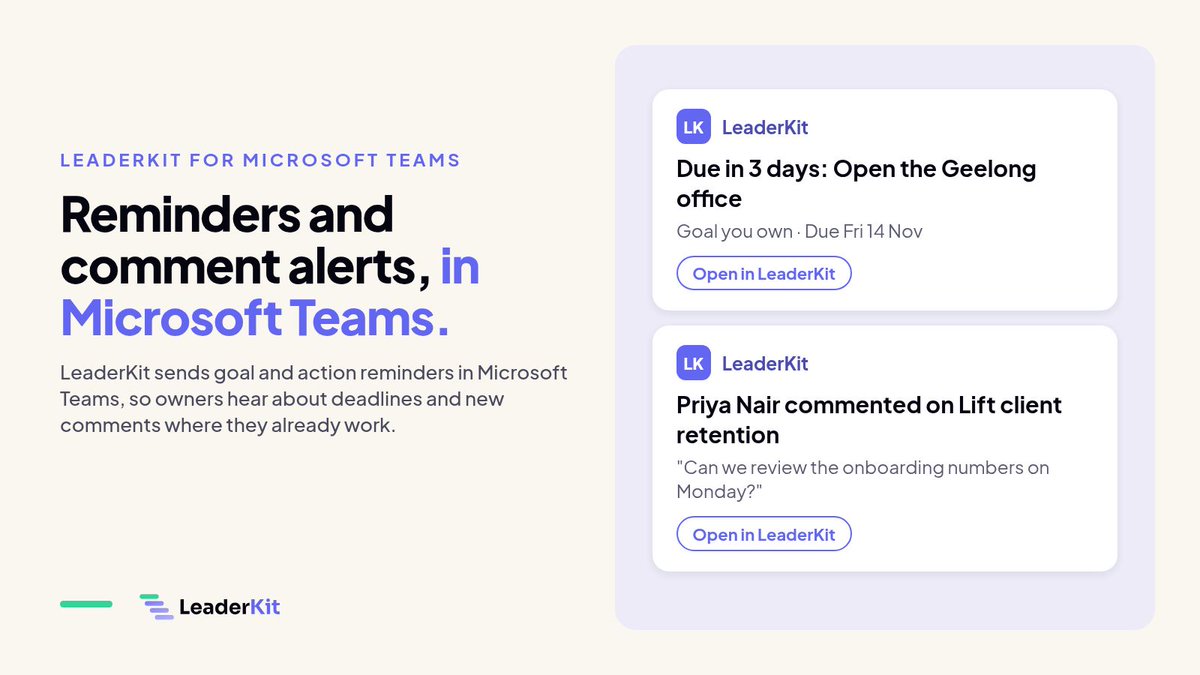
Your client's plan now follows them into Microsoft Teams. LeaderKit sends goal owners deadline reminders and comment alerts in Teams, and can post a weekly "Due this week" list to a channel. Less chasing from you between reviews.
@SmarterPhil Good question for any firm using AI. Worth asking every vendor where client data goes, whether it's used to train models, and who can access it. Clear answers now will make whatever rules land much easier to meet.
@CPA_Trendlines Price rises with flat headcount puts real pressure on partner time. Firms that are clear on their few priorities for 2027, and on who owns each one, tend to protect capacity better than those trying to do everything at once.
@scottlove The cluster point is a good one. A partner exit on its own says little, but exits plus drifting priorities plus nobody owning the plan is a different story. Reviewing the same plan together regularly makes those patterns easier to spot early.
@TodaysMP@LawFirmVelocity A short scorecard beats a long one every time. We'd add one thing: give each measure an owner who updates it before the leadership meeting, so the discussion starts with what's changed and what needs a decision.