FinReg scholar & Teacher. Co-organizer of Digital Assets at Duke🎙 Co-Host of Coffee & Crypto with Lee & Jimmie. MOOC Coursera professor - FinTech Law & Policy
When banks move onchain, what changes for the people who rely on them?
The technology is one part of the conversation.
Deposits, oversight, customer trust, and institutional responsibility deserve just as much attention.
At Digital Assets at Duke, you can bring your questions to the people in the front row working across finance, technology, law, and policy.
Get closer to the source.
https://t.co/n2y6OtL1Hk
February 10–12, 2027
Duke University, Durham, NC
#DigitalAssetsAtDuke #Banking #DigitalAssets
The @binance hackers are washing billions through THORChain & other services. Coinbase got its trust charter. Big banks are building a stablecoin. And the CFTC is now letting you short stocks via perps. @jimmie_lenz and I break it all down on the latest Coffee & Crypto: https://t.co/PpWf5l9eNJ
As Democrats debate how the next Congress should balance investigations with addressing Americans’ needs, I hope they remember that effective oversight is one of the ways Congress delivers for the public.
Congress needs to understand what went wrong, who was responsible, and whether existing laws are working before it can make informed decisions about what to change. And the public deserves answers even when new legislation isn’t possible.
The best example I know is also the one that got me interested in financial regulation. In April 2010, when I was a grad student, the Senate Permanent Subcommittee on Investigations (PSI) held the final hearing of its two-year bipartisan inquiry into the causes of the 2008 financial crisis. Goldman Sachs executives were in the witness chair, and it did not go well for Goldman. Democrats and Republicans alike criticized the firm’s conduct and its refusal to accept responsibility. The next day, the Senate ended a filibuster on financial reform and began debate on the bill that became Dodd-Frank.
This pattern is nearly a century old. The Pecora hearings after the 1929 crash built the case for the federal securities laws that still govern our markets. First the facts, then the reform.
The PSI chair who put Goldman in the hot seat was Michigan Senator Carl Levin. Levin and his longtime aide Elise Bean understood the work that makes a hearing like that possible: gathering documents, interviewing witnesses, mastering the details, and building a factual record that can withstand scrutiny.
After leaving the Senate, Levin and Bean established the @Levin_Center for Oversight and Democracy at Wayne State University Law School. The Center’s website is full of history and scholarship on oversight, including practical tutorials on how to conduct an investigation well: https://t.co/WLaOxzSN3b
And this Levin Center video featuring Elise, on how Senator Levin and PSI used investigations to produce lasting change, is well worth your time: https://t.co/Jti12cRtdr
I never had the chance to meet Senator Levin or Elise before they passed away, but I’m grateful for the example they left us.
As Elise put it, “If you want good government, you need good oversight.”
We need both more than ever. Congress should embrace its responsibility to investigate abuses, hold powerful people accountable, and give Americans the facts they need to judge their government.
A staffing crunch at the Office of the Comptroller of the Currency has made it tougher to deal with the flood of bank-charter applications that have proliferated under President Trump https://t.co/rhzKRVqdAM
BREAKING: We’re asking Pirro & the FBI to investigate Trump’s former crypto adviser Bo Hines
He negotiated the GENIUS Act, which Tether lobbied on, then joined Tether 10 days after leaving
His exit disclosure doesn’t mention it
@DDFund_’s letter👇 -TN
Nominations are open for FinTech Forty!
To mark our fifth conference, Digital Assets at Duke is naming forty people doing the hands-on work of building the future of finance.
Know someone who belongs on this list?
Nominate today | https://t.co/b0YPW6aJ3n
#digitalassets
I’ve spent much of the last decade writing about crypto’s risks, testifying about them, and arguing with people who think I’m wrong. So people are sometimes surprised that I co-founded a crypto conference.
But the conference makes me better at what I do. Every year I hear directly from the people building these products, running these firms, and writing the rules. That shapes my views, and sometimes it changes them.
Digital Assets at Duke returns February 10-12, 2027. This is our fifth year.
Whatever you think of crypto, it is now part of the financial system. Stablecoins are about to become federally regulated payment instruments. Banks are tokenizing deposits. Asset managers are putting funds on chain. AI agents w/ crypto wallets are starting to move money. Engineers, investors, and regulators are working on the same problems, but they rarely hear from each other. DA@D gets them in one place for two days.
It is nonpartisan and on the record, and it puts people who disagree with each other on the same stage. Bloomberg called it “no-hype and Lamborghini-free.” Some of our best panels have featured people who think I’m wrong about almost everything.
The timing this year is perfect. Democrats will have just taken control of both the House and the Senate, and they’ll be in a position to steer crypto policy, from market structure to stablecoin implementation. Expect that to come up.
What we’ll cover in 2027:
Stablecoins as GENIUS goes live
U.S. and global regulation
Banks and crypto, and tokenized deposits
Tokenized securities and market plumbing
Prediction markets
Perpetual futures
DeFi vaults
Agentic payments
Quantum computing and the threat it poses to digital assets
Crypto litigation
Who comes: regulators, policymakers, executives from banks and digital asset firms, technologists, investors, lawyers, and academics.
Early bird pricing ends tomorrow. Register here: https://t.co/7abBeNclw3
Registration is open for Digital Assets at Duke 2027! Feb 10 to 12, Durham, NC.
Our fifth year. 250 seats. Rulemakers, operators, researchers and investors in one room, questioning one another.
Agenda, speakers and registration: https://t.co/gahv4Gjc9b
Great oped from @SenWarren which sounds like a @SenateBanking Chair who will bring a 10% credit card interest rate cap to a vote:
https://t.co/DUmcJPRNSj
Democrats swept Congress last night, and crypto was one of the biggest losers.
New Coffee & Crypto with @jimmie_lenz:
- Crypto PACs spent more than $60 million trying to keep Sherrod Brown out of the Senate. He won anyway.
- Why the CLARITY Act is dead
- What a Democratic Congress means for the SEC, CFTC and crypto oversight hearings
- The $6.3 billion Binance hack, the largest theft of anything in history, and what it tells us about the industry's security
In voters' minds, Trump, crypto and corruption are now linked. That is what happens when an industry hitches its wagon to one president.
https://t.co/GjgOkgn7tB
The $6.3B @binance exploit is the largest heist in history, but it’s just the latest chapter in an unbroken pattern dating back to Mt. Gox.
I joined @AJInsideStory to discuss why crypto exchanges remain systemic honeypots:
1/ The core issue is vertical integration. In traditional finance, broker, exchange, and custody functions are strictly segregated. If Schwab is breached, the NYSE doesn't freeze. In crypto, bundling all three under one roof makes catastrophic single-point failures inevitable.
2/ 18 years to the day after Satoshi published the Bitcoin white paper, billions in stolen crypto continue funding rogue-state weapons programs. Merely stamping "regulated" on flawed market structures solves nothing—insulating the traditional banking system must remain the priority.
Watch the full panel with Geoff White and @AnupamChander: https://t.co/4wM7LPxdMh
No tricks. Just one last treat.
Early bird pricing for Digital Assets at Duke ends Saturday, October 31, at midnight ET.
Your treat? The opportunity to register at reduced conference rates before the deadline.
https://t.co/UthsNXNApJ
#DigitalAssetsAtDuke#DigitalAssets#crypto
The @USOCC just finalized its GENIUS Act rule & is inviting community banks to issue their own stablecoins. @jimmie_lenz & I break it down on the latest Coffee & Crypto, plus @Ripple's trust charter & the Emoluments Clause suit against Trump: https://t.co/BwPH14sYYN
Trump's former crypto czar helped shape the GENIUS Act while his company was getting millions from Tether. @jimmie_lenz & I break it down on the new Coffee & Crypto, plus @okx & @ICE_Markets's tokenized stock venture, JPM Coin on Ethereum, and @BinanceUS seeking to raise $100M: https://t.co/MexqM3fLDo
Who Made Paul Atkins King? The SEC Won 200 Crypto Cases in Ten Years. Paul Atkins Just Forfeited All of Them. The Senate Wouldn’t Touch the Crypto Bill, So He’s Gleefully Passing It Himself, as a Rule. Lee Reiners and I Filed 33,000 Words Explaining Why Vacating This Atkins Travesty Will Be the Easiest Decision Any Court Will Ever Write.
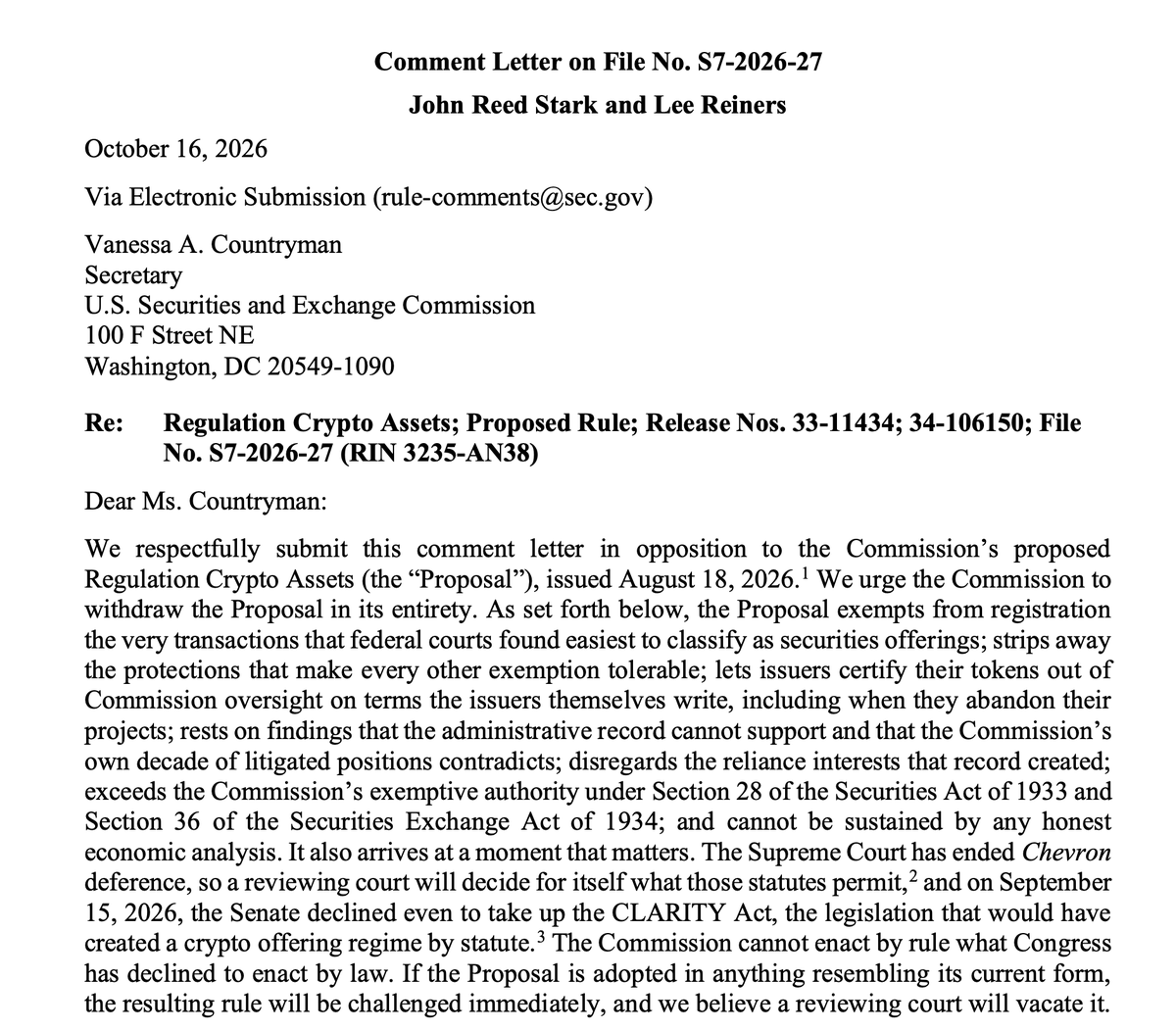
Introduction. On August 18, 2026, U.S. Securities and Exchange Commission Chairman Paul Atkins proposed Regulation Crypto Assets, a rule that would let crypto issuers sell unregistered tokens to anyone: up to $5 million with no financial statements and no SEC or state review, up to $75 million a year under a loosened version of Regulation A, with no holding period for insiders under either, plus a "safe harbor" that lets the issuer certify its own token out of the securities laws on a form no one reviews.
Call this monstrosity what it is: an aberration in law and an abhorrence in policy. So @leereiners and I filed a comment letter asking the Commission to withdraw it. Every word. Here's why:
For more than ninety years, the law governing the sale of securities has rested on one premise: The seller tells the truth first, and the buyer decides second. Paul Atkins proposes to reverse the order. Investor protection is not a courtesy Paul Atkins extends to markets he likes. It is the price Congress attached to the privilege of selling to the public, and Paul Atkins now proposes to waive the price and keep the privilege, for one industry, on that industry’s terms.
The SEC’s 200 crypto victories were not a policy choice that Paul Atkins inherited and may discard. They were legal conclusions, reached by Article III judges appointed by six Presidents. Those judgments cannot be disappeared by Paul Atkins. The judges who entered them are still sitting, and what they decided must be respected and enforced.
So when this rule reaches a courtroom, the hardest question will not come from the challengers. It will come from the bench:
Counsel, for ten years your agency stood at that lectern and asked this court for judgments on the ground that these offerings were securities. Now you ask us to accept the opposite. The tokens haven’t changed. The statute hasn’t changed. Howey hasn’t changed. The only thing that changed is that Paul Atkins became Chairman. So tell us: when Article III judges appointed by six Presidents apply Howey to these offerings more than two hundred times and reach the same answer every time, and Paul Atkins then announces they were all mistaken, which of those is the law of the United States? Does Paul Atkins’s vote nullify a decade of judgments? Because if the answer is yes, the next Chairman can nullify Paul Atkins the same way, and nothing your agency says to any court will ever be worth believing again.
Paul Atkins’s Release never answers that question. Across 146 pages of the Federal Register, it never explains why a decade of its own litigated positions was wrong, never cites, let alone distinguishes, a single one of the rulings it would displace, and never acknowledges those who relied on them. It simply proceeds as if none of it happened. That deafening silence is not an oversight. It's the only option available, because the honest answer is that nothing changed except the Chairman.
The Gist of Our Comment Letter. For a decade the SEC told federal judges that unregistered crypto offerings harm investors, and won more than 200 times before judges appointed by six Presidents. ICOs, SAFTs, utility tokens, lending, staking: securities offerings, every time. Now it proposes to exempt the very transactions those courts found easiest to classify.
The startup exemption combines what no exemption does: any number of retail investors, general solicitation, immediately tradable tokens, no intermediary, no investment limit, no financial statements, no SEC or state review. Insiders can sell on day one; the Release concedes a holding period could strengthen investor protection and rejects one anyway.
An issuer may raise $75M every 12 months, then exit through a safe harbor you could drive a truck through: a checkbox on a form, effective when filed, reviewed by no one, certifying that the issuer has completed, or permanently ceased, the efforts it promised. An exit visa from oversight, stamped by the traveler.
At the same time, the SEC has not applied its own interpretation to the token of the venture affiliated with the President's family. Investors, a footnote suggests, can protect themselves by contract: caveat emptor, restated by the agency created to replace it.
Sections 28 and 36 are 1996 backstop provisions, not a license to build a parallel offering regime, and with Chevron gone a court will read them de novo. The Senate declined even to take up the CLARITY Act; the SEC cannot enact by rule what Congress has declined to enact by law. The Release lists monetized benefits as n/a, never estimates investor losses, and never mentions FTX, Terra, Celsius, or any hack, theft, scam, or collapse. It does not contain the words money laundering, illicit, terrorist, or Bank Secrecy Act. It never explains its reversal of a decade of its own litigated positions, as Fox, Encino, and Regents require. It issued with no public meeting.
Who pays? Retail investors who buy unrestricted tokens. Who profits? Venture funds that buy at a discount, insiders who sell immediately, and platforms freed from state review, in an industry that spent $189M on the midterms by midyear. Nearly 18 years in, blockchain has no killer use case beyond speculation and trading; Big Tech will spend more than $700B this year, overwhelmingly on AI, and effectively nothing on blockchain. So the SEC proposes to give blockchain the one thing it never found on its own: a steady supply of retail buyers.
The Stark Reality. Paul Atkins is not deregulating crypto. He is pardoning it. Federal judges appointed by six Presidents applied the law to crypto more than two hundred times and reached the same answer every time. They did not read it wrong. Nothing in those cases has changed except the nameplate on the Chairman’s door, and a nameplate is not a legal authority.
Yet with one signature, Paul Atkins proposes to erase every one of those judgments and replace them with a vending machine: insert a form, pull the lever, and out comes a certificate declaring that the securities laws no longer apply to you. No one checks the machine, no one refills it, and Paul Atkins built it on the honor system, in an industry whose honor has already cost investors billions.
Presidents pardon people. Paul Atkins proposes to pardon an asset class. The Constitution gives him no such power, and no court will pretend otherwise.
(Fair warning to the TL;DR crowd: Reading the letter is not for the faint of heart. It runs more than 33,000 words and 235 footnotes. Pack a lunch sports fans.)
Read our comment letter here: https://t.co/tgNie5Xcg3
The @SECGov 's proposed Regulation Crypto Assets is a hot mess. In our comment letter, @JohnReedStark and I ask the SEC to withdraw the proposal in its entirety.
For a decade, the SEC persuaded federal judges appointed by six Presidents that unregistered token sales are securities offerings, compiling more than 200 enforcement victories. The proposal would exempt the very transactions those courts found easiest to classify.
On September 15, the Senate declined even to begin debate on the CLARITY Act. The Senate's text would have directed the SEC to adopt a "Regulation Crypto," with a $200 million lifetime cap, a bar on companies organized abroad, and mandatory holding periods for insiders. The SEC's proposal allows $75 million every 12 months with no overall cap, opens its startup exemption to companies organized anywhere, and imposes no holding period on insiders. The agency is writing by rule a looser version of a bill the Senate would not take up.
The treatment of insiders is more generous still. @Coinbase urged the SEC to limit token sales by development teams until a network is "sufficiently decentralized." The SEC's proposing release concedes that a one-year holding period for insiders "could benefit potential investors by strengthening investor protection," then rejects one, observing that "an exit of a large insider could potentially result in a broader base of investors." That broader base is the retail public, buying what the insider is selling.
The proposal also treats work to "secure" a functioning network as categorically outside the managerial efforts that make a token an investment contract. Yet migration to post-quantum cryptography may decide whether many tokens retain any value, and neither the proposing release nor the SEC's March 2026 interpretation mentions quantum computing. The Senate Banking Committee's CLARITY text includes a finding that quantum advances threaten "the security of digital assets."
The exemptive authorities the SEC invokes, Section 28 of the Securities Act and Section 36 of the Exchange Act, are backstop provisions enacted in 1996. With Chevron deference gone after Loper Bright, a court will decide for itself whether they authorize a parallel offering regime for an entire asset class, and we believe any final rule resembling this proposal will be vacated. The SEC cannot enact by rule what Congress has declined to enact by law.
The full letter, all 235 footnotes of it is here: https://t.co/stTrPds7Az
#crypto #SEC
On this week's Coffee & Crypto, @jimmie_lenz & I discuss @ICBA's lawsuit against the @USOCC over trust charters, the @CFTC's new proposal to regulate crypto exchanges & @BlackRock's new tokenized fund offerings courtesy of @Ondo. Give it a listen! https://t.co/vZ7L4HUg8l
On this week's Coffee & Crypto, @jimmie_lenz & I discuss the pending departures of @HesterPeirce & @SummerMersinger, the potential for AI driven bank runs, & a new @BlackRock report on the intersection of AI & blockchain. Give it a listen! https://t.co/YnE8IoERZo