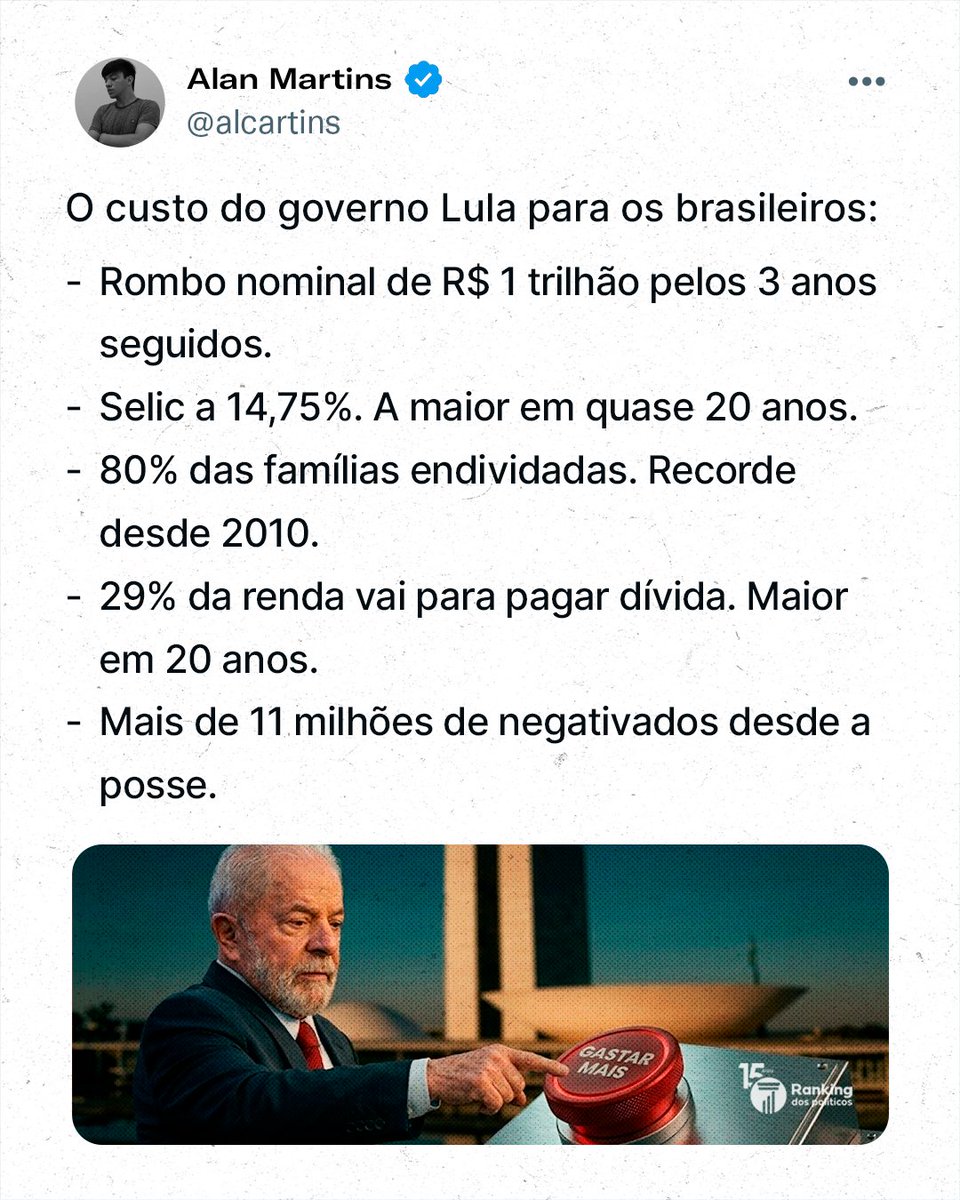
O Brasil bateu o maior índice de endividamento familiar desde 2010. Não foi coincidência. Quando o governo gasta mais do que arrecada, o Banco Central sobe os juros para segurar a inflação.
O setor público registrou rombo nominal acima de R$ 1 trilhão pelos três anos seguidos do mandato e a Selic chegou a 14,75% ao ano, o maior patamar em quase 20 anos. (Banco Central)
A consequência chegou na ponta. Oito em cada dez famílias brasileiras estão endividadas, recorde desde 2010. (PEIC e CNC)
Cerca de 29% da renda vai para pagar dívidas, o maior comprometimento em duas décadas, e mais de 11 milhões de brasileiros engrossaram a fila dos negativados desde a posse de Lula. (dados do BC)
Via @alcartins
A conta do descontrole fiscal do governo não fica no Planalto. Fica no seu bolso.
Leia mais: https://t.co/CqFrkQrOFq
Unrealized gains tax for Gen-Z:
You buy a Pokémon card for $50.
Someone offers you $500 for it. You say no. You love that card. You're keeping it.
The government says: "Cool, but that card is worth $500 now. You owe us $100 in taxes."
You: "…I didn't sell it."
Government: "Don't care. Pay up."
You don't have $100 lying around. So you're forced to sell the card you love just to pay a tax on money you never received.
Next month? That card drops back to $50.
Your card is gone. Your money is gone. And the government shrugs.
That's a wealth tax on unrealized gains. They don't pay you back the tax...
Now picture this.
Your mom calls you crying. She has to sell the house she raised you in. Not because she can't afford it. She's lived there 30 years. It's paid off.
But some website says it's worth more now and the government says she owes $15,000 she doesn't have.
So she sells your childhood home. The kitchen where she made you breakfast. The doorframe where she marked your height every birthday.
Gone.
To pay a tax on money that was never real.
Now picture the opposite.
Your dad put everything into his small business. For 20 years he built it from nothing. One year the business is "valued" at $2 million on paper. He owes a massive tax bill. He empties his savings. Sells his truck. Borrows money. Pays it.
Next year the market crashes. His business is worth $200,000.
He lost everything to pay a tax on a number that doesn't exist anymore.
Does the government give him his money back?
No.
Does the government give him his truck back?
No.
Does the government care?
No.
They sold this idea as "taxing billionaires." But billionaires have armies of lawyers, offshore accounts, and trusts. They'll be fine.
You know who won't be fine? Your mom. Your dad. Your neighbor with a small business. The farmer down the road who's had the same land for four generations and now has to sell it because dirt got expensive.
You're not taxing wealth. You're taxing people for owning things.
It's like getting a parking ticket for a car you might drive somewhere someday.
They want you to own nothing and be happy. To fund the fraud, waste and abuse of the welfare state they created.
There is enough money. More tax isn't needed. It's all a lie. But you've been gaslit into believing this is a rich vs poor debate.
I hope you understand what's at stake.
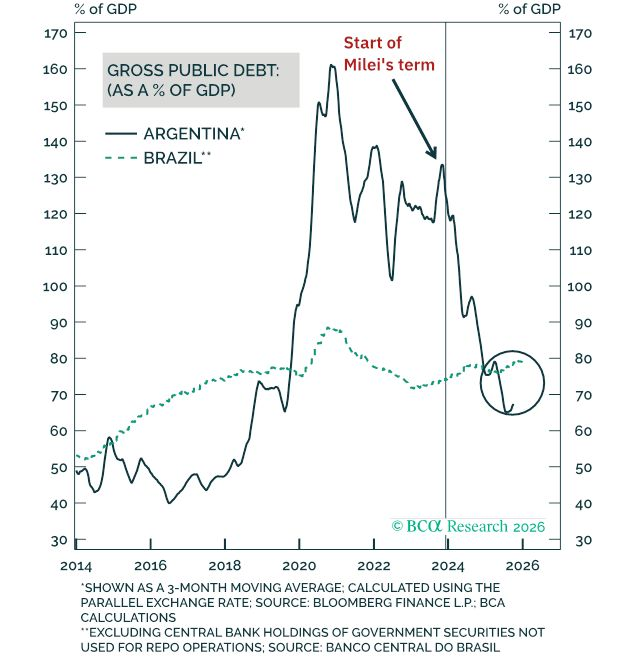
Public debt is now lower in Argentina than in Brazil!
Milei’s fiscal shock cut the debt burden by 60% of GDP in just two years. With Argentina sticking to austerity while Brazilian fiscal accounts keep deteriorating, local Argentine bonds look more attractive than Brazil’s.
🚨No STF, Santa Catarina cita o economista Thomas Sowell ao defender a lei estadual que baniu cotas raciais no vestibular: "Preferências e cotas tendem a se estender com o tempo"
Um dos argumentos usados pelos defensores da política de cotas é que ela é apenas temporária. Santa Catarina respondeu que há "ausência de um 'ponto final' juridicamente crível".
(A realidade parece confirmar essa opinião: a política "temporária" de cotas em universidades já completou 20 anos e, agora que um estado tenta reverter a política "temporária", está sendo impedido.)
Veja os outros argumentos usados por Santa Catarina na ação que corre no STF:
• Critérios vagos: cor da pele, identidade de gênero e outras "categorias identitárias" são difíceis de determinar e arbitrárias como critério de favorecimento; "critérios socioeconômicos" (que SC manteve) são objetivos. “O Estado de Santa Catarina, ao [...] redirecionar o foco para a escola pública e a carência econômica, exerce sua autonomia federativa para resgatar a finalidade ética das ações afirmativas.” “A legislação catarinense não é apenas constitucional, mas moralizadora.”
• Toda vaga que se celebra estar indo para uma pessoa está sendo retirada de outra; e "a impessoalidade a igualdade não se harmonizam com arranjos em que o Estado desloca indivíduos em uma fila pública com base em atributos identitários"; o Estado tem "obrigação de tratar pessoas como fins em si mesmas – e não como instrumentos estatísticos de correção social”.
• “Risco de estereotipação”: Ações afirmativas reforçariam o preconceito contra os membros dos grupos beneficiados, em vez de diminuí-lo. (Existe até um modelo matemático para descrever esse fenômeno: “Paradoxo de Berkson”. Quando você usa dois critérios alternativos de seleção — OU você entra por competência demonstrada, OU entra porque tem tal característica —, você cria artificialmente uma correlação negativa entre os dois traços, DENTRO do espaço para qual está selecionando, MESMO quando essa correlação negativa não existe no mundo real!)
Alexandre Garcia destacou em vídeo um caso no mínimo intrigante: segundo investigações da Polícia Federal, o contador João Muniz Leite e sua esposa teriam sido contemplados 640 vezes em prêmios de loterias como Lotofácil, Mega-Sena e Quina. O ponto que agrava a suspeita é o fato de o contador já ter prestado serviços ao empresário Fábio Luís Lula da Silva, o Lulinha. Não acham suspeito?
É verdade que o Brasil é o país do futebol, do samba e do clima tropical, mas também é o país onde um banqueiro corrupto, personagem principal de um dos maiores esquemas já revelados no país, é suspeito de ter ligações profundas com integrantes da suprema corte.
Confira no vídeo de Alexandre Ostrowiecki.
This is a common capitalist-vs-socialist argument: who is actually providing the majority value, the investors and owners, or the line workers?
When the question is asked this way, it becomes impossible to objectively answer. Because "value" is a subjective quality. It means "thing you give a fuck about".
To what this argument really boils down to is one group saying "I care more about line work", and another saying "I care more about investment dollars", which is like arguing about whether or not horsies are pretty.
But if you can't answer a question, what you do is rephrase it properly.
So, instead of "who creates the value", let us ask instead, "Who is the bottleneck?"
In other words, what is the scarcest component that prevents more value from being created?
It is workers? Or investors?
Let's look at SpaceX. SpaceX makes reusable rocket boosters. It is the only entity in the entire known universe that does so. It also, relatedly, provides the majority of Earth's transfer-to-orbit capability.
In doing so, it employs 5,563 engineers, and one Elon Musk.
So, who is the bottleneck? Who is harder to get?
Well, there are lots of groups of 5,563 engineers in the world, but there is only one Elon Musk. And there is only one company making reusable rocket boosters.
That seems pretty telling. But someone on the socialist side of the argument might point out that Elon Musk provided $90 million dollars to found SpaceX. And there are lots of people with that much money in the world, but only one company making...
Well, you get the picture.
But this argument is incomplete. It only shows that Elon Musk isn't the critical component if and only if $90 million is the only value Elon Musk provides.
Which, of course, is baloney.
The value Elon Musk provides is technical leadership.
He selected the team. He organized the team. He provided the team with its mission. And he leads the team in that mission.
That's the unique, irreplaceable component. Elon Musk is the only person who has thus far had the power to build and lead a team to do this.
The significance of him owning the $90 million dollars is only that it had to come from somewhere, and, since it came from him, he had the power to control the company.
The rare component isn't labor OR capital. It's leadership.
This is why capitalism is better than socialism every time.
If the workers own the means of production, how do get inspired, game-changing leadership? You can't have 5,563 leaders. You have to have one. Or at most a handful.
What do you do? Elect them? When has that ever worked in the past?
A guy with $90 million to throw at a project might not be a great leader. There's nothing about having $90M that guarantees technical leadership ability. Hell, Kim Kardashian could easily scrape together $90M to start a rocket company. And it would fail, hard and immediately.
But the thing about a guy with $90M is that while he's not guaranteed to be a great technical leader, there's a chance that he is. Because at least he's competent or well-connected enough to have $90M. And he believed in what he's doing enough to lay down that bet.
Lots of companies, started under capitalist principles, by rich investors, fail because those investors couldn't provide the right leadership.
This is not a bug of capitalism. It's a feature. Those companies are supposed to fail. Capitalism punishes poor leadership, and rewards good leadership. Doesn't always work that way when there's a government to put its thumb on the scales, but that's what capitalism does.
Theoretically, the owner-workers of a socialist company could elect a good leader, but there's two problems with this.
Number one, they've almost never managed this in practice.
Number two, they still need $90M. Where are they going to get it? A guy with $90M isn't going to throw it into an enterprise controlled by the workers. He expects to own what he pays for, and ownership is meaningless without control.
And sure, the socialist state can fund the company, but then the state expects to control the company, and now your technical leadership is a bunch of bureaucrats. Good luck with that one.
So, no capitalism doesn't guarantee good leadership, or success. It's a toss-up. But it's the only system that possibly can. Everything else is a guaranteed loser.
So, no, billionaires are 100%, full stop, not the reason you are poor. In fact, if more of us were doing better, there would be more billionaires.
In 2021, we were told that mass graves of murdered Indigenous children had been found in Kamloops, BC, at the site of a former residential school.
The Washington Post reported that bodies of children as young as 3 years old had been discovered in a mass grave.
Soon, other Indigenous communities across Canada were making similar claims — that murdered children had been found using ground-penetrating radar.
Hysteria gripped Canada.
Monuments of sneakers representing murdered kids went up across the country.
The Canadian flag at Parliament in Ottawa flew at half mast for 6 months.
Billions of dollars were set aside as ‘reconciliation’ for a non-existent genocide of Indigenous children.
A new national holiday was announced — National Day for Truth and Reconciliation.
And to date, more than 100 Christian churches have been burned in response.
All of it was a lie.
There has never been a shred of evidence that these are graves. Where excavation has been done in Canada, they found nothing.
In other places, the Indigenous leaders refuse to dig because they know the money will dry up, and this will be exposed as the biggest fraud in Canadian history.
This documentary tells the truth about it all, including how private land is now being given away to Indigenous people by politicians and judges, who insist we are on stolen land.
Nobody stole Canada. We built Canada. Together.
Jean-Paul Sartre invented a verbal trick that killed millions.
He took the word "violence" and redefined it.
The existing social order? That was violence. Institutions? Violence. Property? Violence.
Once everything is violence, killing to overthrow it becomes self-defense. Here's how one philosopher's language game produced genocide. 🧵
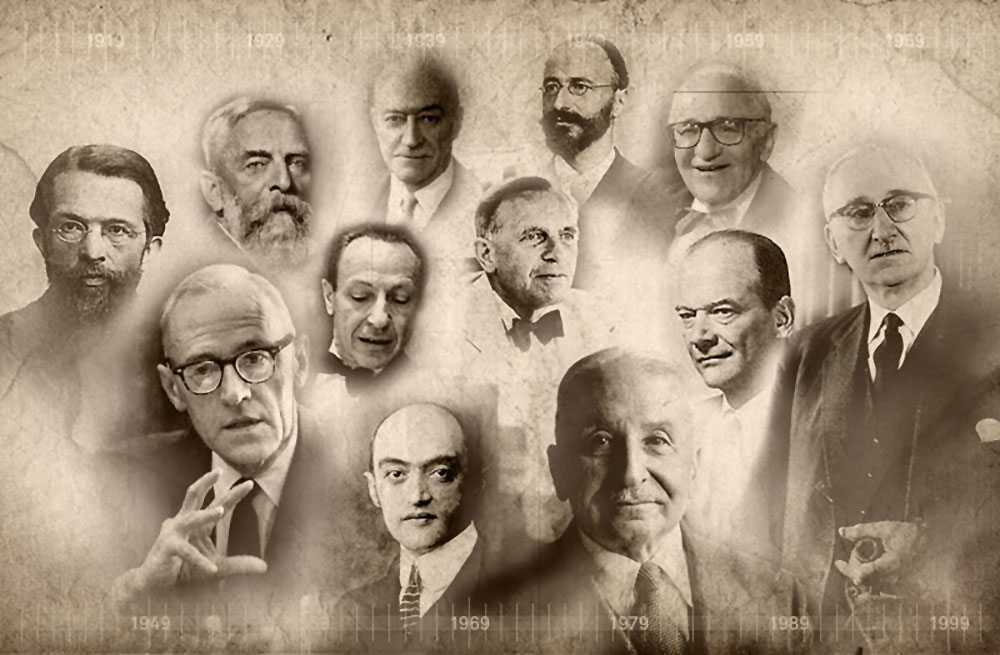
Seven times in the last century, Austrian economists warned about economic disasters while mainstream economists said "everything is fine."
Seven times, the Austrians were right.
Here's the story they don't want you to know about who really understands the economy 🧵
Moraes ordenou que Bolsonaro usasse tornozeleira com base em postagens dele, do filho Eduardo e de Trump nas redes sociais. Segundo reportagem da Folha, as publicações foram citadas nos pedidos da PGR e da PF, e Moraes as classificou como “flagrantes confissões”. Mesmo assim, a decisão não cita risco de fuga.
Acesse em: https://t.co/Rt0wcHXret
Take a good look at the quoted post.
This is what evil sounds like.
Evil is not a Saturday morning cartoon villain, cackling about destroying the universe. Evil is sly. Evil is disingenuous. Evil wears a cloak of solemn self-righteousness.
Evil finds ways to make itself sound like altruism.
Evil hates talent. Evil hates merit. Evil hates to see others thrive and prosper. Evil doesn't just want enough, or even a lot. Evil wants all there is, and it is deeply offended if there is ever anything left for anyone else.
Evil wishes it could erase talent and greatness.
It cannot.
So evil demands that the talented be, instead, enslaved and made to serve the mediocre.
Joe McReynolds is the personification of the villains from an Ayn Rand novel — people I thought were to caricaturish to ever exist, until I grew up and discovered they do. I hated reading "Anthem" in high school, because I thought it was an intellectually dishonest argument against a straw man.
But when I grew up and become a man, I discovered that many such scarecrows existed, animate and shuffling about the landscape, demanding that everyone be enslaved to the will of the collective.
So there is no point having a conversation with Joe McReynolds.
Instead, I'd like to address myself to the talent people of the world, especially the children.
You belong to you.
Your capabilities belong to you.
They exist to serve you, not others.
It for you to use them how you see fit.
You were not born with one iota more moral responsibility than any other person. The laws, both literal and moral, are the same for you as for others.
Everyone belongs to themselves.
If you use your talents wisely, you will bring good things into the universe.
And you may share those good things with others. But if you do, it will not be because you were born in debt to them.
It will be because they will be in debt to you.
If you contribute, you are owed a fair reward.
Do not make yourself a slave.







![hugofreitas_r's tweet photo. 🚨No STF, Santa Catarina cita o economista Thomas Sowell ao defender a lei estadual que baniu cotas raciais no vestibular: "Preferências e cotas tendem a se estender com o tempo"
Um dos argumentos usados pelos defensores da política de cotas é que ela é apenas temporária. Santa Catarina respondeu que há "ausência de um 'ponto final' juridicamente crível".
(A realidade parece confirmar essa opinião: a política "temporária" de cotas em universidades já completou 20 anos e, agora que um estado tenta reverter a política "temporária", está sendo impedido.)
Veja os outros argumentos usados por Santa Catarina na ação que corre no STF:
• Critérios vagos: cor da pele, identidade de gênero e outras "categorias identitárias" são difíceis de determinar e arbitrárias como critério de favorecimento; "critérios socioeconômicos" (que SC manteve) são objetivos. “O Estado de Santa Catarina, ao [...] redirecionar o foco para a escola pública e a carência econômica, exerce sua autonomia federativa para resgatar a finalidade ética das ações afirmativas.” “A legislação catarinense não é apenas constitucional, mas moralizadora.”
• Toda vaga que se celebra estar indo para uma pessoa está sendo retirada de outra; e "a impessoalidade a igualdade não se harmonizam com arranjos em que o Estado desloca indivíduos em uma fila pública com base em atributos identitários"; o Estado tem "obrigação de tratar pessoas como fins em si mesmas – e não como instrumentos estatísticos de correção social”.
• “Risco de estereotipação”: Ações afirmativas reforçariam o preconceito contra os membros dos grupos beneficiados, em vez de diminuí-lo. (Existe até um modelo matemático para descrever esse fenômeno: “Paradoxo de Berkson”. Quando você usa dois critérios alternativos de seleção — OU você entra por competência demonstrada, OU entra porque tem tal característica —, você cria artificialmente uma correlação negativa entre os dois traços, DENTRO do espaço para qual está selecionando, MESMO quando essa correlação negativa não existe no mundo real!)](https://pbs.twimg.com/media/G_8UCV9WQAMpzrg.jpg)