Linus Torvalds Working On A Hefty Linux Kernel Improvement With Claude Code
Linux creator Linus Torvalds uses AI himself (Claude) for working on a huge perf improvement to the Linux kernel. And Claude to help draft a test program and commit message.
https://t.co/LL04R4qmCt
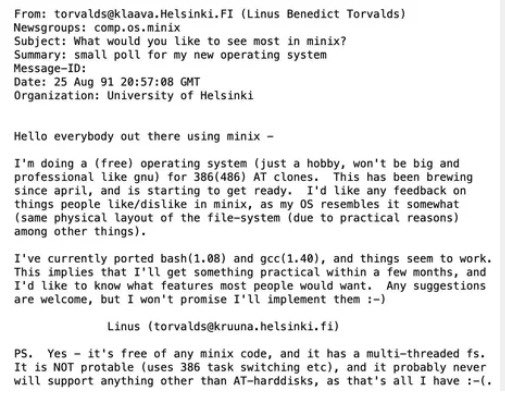
Happy 34th Birthday, #Linux! 🐧🎈🎂
On August 25, 1991, 21-year-old Linus Torvalds announced he was developing “a (free) operating system…”
Today, from nest devices to @NASA, #android smartphones to the top #supercomputers: #Linux powers #tech of all levels, all around the world.
GNOME 47 is here! After months of hard work from contributors worldwide, this release brings many exciting updates and improvements. https://t.co/eXWalZ9mCy
#GNOME#ReleaseDay
GNOME 47 is here! After months of hard work from contributors worldwide, this release brings many exciting updates and improvements. https://t.co/eXWalZ9mCy
#GNOME#ReleaseDay
Securing Linux systems where containerized workloads are running involves protecting live containers, their underlying images and the centralized container orchestrator like #Kubernetes. Here are a list of container security tools available for Linux 😎👇 #cybersecurity#docker
Vim text editor cheat sheet
For those of you who are a regular Vim user or would like to learn Vim text editor on #Linux, here is a Vim cheat sheet that provides quick references for the most commonly used commands and shortcuts in Vim 😎👇 #sysadmin
🤔 How do you keep up with the latest Kubernetes news?
Over the past seven years, I have built the tools to help me master Kubernetes as if I were starting again as a novice.
🥇So first came @learnk8s , @K8sArchitect, @kubesploit and @K3sDaily : curate news feeds with the best articles, tutorials, case studies and projects related to Kubernetes (I still review and curate them monthly!).
💼 But what's knowledge if you can't land a job?
@kubecareers was born to aggregate all Kubernetes-related jobs. On average, we find ~100/150 new jobs a month, and we manually curate and tag them for things such as remote work, cloud providers, roles, etc.
🤝 Meeting like-minded people was next on the list!
When the next Kubernetes meetup will be?
@K8sEvents was created to fill this gap and aggregate all conferences, meetups, webinars and training related to Kubernetes. As for the other projects, all entries are manually curated and tagged, so you can trust that the event is worth attending.
🗞️ News, jobs, events… wouldn't it be great if you could have a weekly recap instead of visiting separate websites?
I thought so, too, so we launched Learn Kubernetes Weekly — a weekly newsletter that combines the best content for Kubernetes! https://t.co/0br76sH8eN
🎙️ Is that enough?
It was for me until I met Bart last year when he convinced me to start @K8sFM , a podcast on all things Kubernetes.
Together, we took the opportunity to build something different where guests are regular engineers with exciting stories!
I don't intend to stop, and I have many other ideas for serving the Kubernetes community better!
If you want to support my and Learnk8s' work in achieving this goal, we recently opened up for sponsoring our work. You can find the details here: https://t.co/ByfJD1BvCX
What do you think? What should we tackle next?
𝗪𝗵𝘆 𝗱𝗼𝗲𝘀 𝗚𝗼𝗼𝗴𝗹𝗲 𝗿𝗲𝗰𝗼𝗺𝗺𝗲𝗻𝗱 𝗠𝗼𝗱𝘂𝗹𝗮𝗿 𝗠𝗼𝗻𝗼𝗹𝗶𝘁𝗵𝘀 𝗶𝗻𝘀𝘁𝗲𝗮𝗱 𝗼𝗳 𝗠𝗶𝗰𝗿𝗼𝘀𝗲𝗿𝘃𝗶𝗰𝗲𝘀?
In the last decade, we have seen a massive trend of using microservices everywhere. We were building systems for a few hundred or thousand users and wanted to know how to make a system for millions of users. This was over-engineering and needed to be corrected. Why it was wrong? Because the development lasted long and we created incredibly complex systems, hard to maintain. This is especially true for startups that must go fast and stay simple.
A recent paper by authors from Google found that most of their developers split binaries for one of the following reasons: it improves performance, fault tolerance, and abstraction boundaries and allows for flexible rollouts.
Yet, splitting applications into microservices has its challenges:
🔸 𝗜𝘁 𝗵𝘂𝗿𝘁𝘀 𝗽𝗲𝗿𝗳𝗼𝗿𝗺𝗮𝗻𝗰𝗲. The overhead of serializing data and sending it across the network is increasingly becoming a bottleneck
🔸 𝗜𝘁 𝗵𝘂𝗿𝘁𝘀 𝗰𝗼𝗿𝗿𝗲𝗰𝘁𝗻𝗲𝘀𝘀. It is incredibly challenging to reason about the interactions between every deployed version of every microservice.
🔸 𝗜𝘁 𝘁𝗮𝗸𝗲𝘀 𝘄𝗼𝗿𝗸 𝘁𝗼 𝗺𝗮𝗻𝗮𝗴𝗲. Rather than having a single bi-nary to build, test, and deploy, developers must manage 𝑛 different binaries, each on their release schedule.
🔸 𝗜𝘁 𝗳𝗿𝗲𝗲𝘇𝗲𝘀 𝗔𝗣𝗜𝘀. Once a microservice establishes an API, it becomes easier to change by breaking the other services that consume the API.
So, they proposed the following approach:
𝟭. 𝗪𝗿𝗶𝘁𝗲 𝗺𝗼𝗻𝗼𝗹𝗶𝘁𝗵𝗶𝗰 𝗮𝗽𝗽𝗹𝗶𝗰𝗮𝘁𝗶𝗼𝗻𝘀 that are modularized into logically distinct components. A component is a long-lived agent, similar to an actor.
𝟮. 𝗟𝗲𝘃𝗲𝗿𝗮𝗴𝗲 𝗮 𝗿𝘂𝗻𝘁𝗶𝗺𝗲 𝘁𝗼 𝗱𝘆𝗻𝗮𝗺𝗶𝗰𝗮𝗹𝗹𝘆 and automatically assign logistical components to physical processes based on execution characteristics. So, if both components are in the same OS process, they are called regular method calls, but if they are co-located, calls are executed as RPCs over the network. Runtime decides whether these modules should be collocated or moved to different machines (and scaled, etc.).
𝟯. 𝗗𝗲𝗽𝗹𝗼𝘆 𝗮𝗽𝗽𝗹𝗶𝗰𝗮𝘁𝗶𝗼𝗻𝘀 𝗮𝘁𝗼𝗺𝗶𝗰𝗮𝗹𝗹𝘆, preventing different versions of an application from interacting.
This approach consists of two main parts: a programming model with abstraction that allows developers to write modularized applications and a runtime for building, deploying, and optimizing these applications. They claim that it reduces application latency by up to 15x and costs by up to 9x by simplifying application management and deployment.
If you want to check the framework implementing the approach from the paper, check https:// serviceweaver. dev/.
What do you think about this approach? Does it look like EJBs or CORBA?
#microservices