Grok Summary: Simon Dixon’s 10-Year Sovereignty Plan (To-Do List Synthesis)
This is a practical, phased to-do list distilled from the core post (sovereignty as a spectrum and direction built through consistent daily decisions via a disciplined ten-year plan, not one-year shortcuts or perfectionism) combined with Dixon’s recurring framework across his posts, blogs, and interviews.
Key recurring elements include:
Understanding the architecture of money, debt, taxation, regulation, incentives, institutions, and power (analyze systems, not personalities).
The three core pillars of sovereignty: Liabilities, Jurisdiction, and Assets vs. Income.
Strict self-custody of Bitcoin (own the keys, run your own node) as the primary tool to boycott the Financial Industrial Complex (FIC), avoid Wall Street wrappers/ETFs/leverage/treasury vehicles, and accumulate steadily (“own more Bitcoin this month than the previous month”).
Shifting from debt/employee subordination toward equity, optionality, parallel systems, and long-term freedom.
Measuring progress regularly: “Did this action make me more sovereign or more subordinate?”
This is a synthesis of his public views only. It is not financial, legal, tax, or investment advice. Outcomes are not guaranteed; perform your own due diligence and consult professionals. Full sovereignty is impossible—progress is directional.
Years 1–2: Foundation — Literacy, Debt Reduction & First Self-Custody Steps
Study the systemic architecture (money creation, debt dynamics, taxation, regulation, institutional incentives, and power structures). Focus on how the FIC, MIC, and TIC operate rather than individual personalities or short-term news.
Audit all liabilities thoroughly. Map debts, counterparty risks (banks, brokers, ETFs, lending products), and dependencies. Begin systematically eliminating high-interest consumer debt and reducing leverage so you stop being “collateral.”
Master basic Bitcoin self-custody: Buy a reputable hardware wallet, generate and securely store seed phrases offline (never digitally), practice small test transactions, and move holdings off exchanges/custodians.
Start the “pay yourself first” rule: Accumulate more Bitcoin this month than last month through consistent surplus allocation (DCA style). Treat lower prices as opportunities for more units.
Research jurisdictional basics and your current tax/regulatory exposure. Identify initial steps toward greater optionality (even small ones).
Establish a weekly/monthly sovereignty review habit. Track concrete metrics (self-custodied assets, reduced permissions required, debt levels).
Build basic resilience: Maintain a modest fiat emergency buffer outside high-risk products, begin exploring physical gold if aligned, and develop at least one skill or side income less dependent on a single employer or system.
Avoid: Leverage, Wall Street Bitcoin products, one-year “get rich” thinking, and fighting AI trends—instead begin learning to use AI for personal productivity.
Years 3–5: Scaling — Pillars in Action & Reduced Dependencies
Advance self-custody: Run your own Bitcoin node, implement multi-sig or stronger setups for larger holdings, explore privacy-enhancing practices where appropriate, and verify full control regularly.
Deepen the three pillars:Liabilities: Continue aggressive debt reduction; prefer equity or profit-sharing structures over new debt.
Jurisdiction: Actively explore and implement legal jurisdictional arbitrage (separating where you live, earn, and hold assets using options like certain hubs) to reduce single-jurisdiction lock-in and tax/asset-stripping exposure.
Assets vs. Income: Shift further from pure wage reliance toward the Business/Investor side of the cash-flow quadrant. Scale self-custodied Bitcoin holdings while avoiding institutional wrappers, collateralized lending, or treasury company exposure for personal wealth.
Build parallel resilience: Support or invest in local/community supply chains (e.g., food), develop decentralized skills/networks, and create multiple income streams less tied to the traditional system.
Continue consistent Bitcoin accumulation and the monthly “own more than last month” discipline. Reassess portfolio for counterparty risk.
Expand knowledge and networks focused on sovereignty practices. Document personal lessons and refine the plan annually based on real experience and changing architecture.
Lean into AI and productivity tools to increase personal output rather than being displaced by the K-shaped economy.
Years 6–10: Optimization, Preservation & Directional Mastery
Emphasize wealth preservation and optionality over aggressive accumulation once foundations are solid. Protect self-custodied Bitcoin and complementary hard assets (e.g., physical gold) with advanced security and contingency planning.
Fully operationalize jurisdictional flexibility and lifestyle design so assets and mobility require fewer external permissions.
Maintain and deepen multiple independent income streams, community ties, and parallel systems. Focus on lower-risk structures that align incentives with long-term freedom.
Use the compounded decade of decisions to measure tangible progress on the sovereignty spectrum: higher self-custody ratios, lower systemic dependencies, greater freedom of action, and reduced need for institutional permissions.
Incorporate service/spiritual alignment if relevant to your values (Dixon often frames wealth as carrying “spiritual energy” and using it to boycott systems that conflict with higher principles). Educate or support others from experience without becoming a short-term trader or influencer chasing attention.
Conduct thorough annual architecture reviews. Adjust for new regulations, technology, multipolar shifts, or personal circumstances while staying disciplined against shortcuts, perfectionism, or one-year thinking.
Final orientation: Sovereignty remains a direction, not a destination. Continue asking whether each major decision increases freedom and reduces dependencies.
Ongoing principles across all years
Sovereignty is built one consistent decision at a time. Prefer self-custody and personal keys. Own more Bitcoin over successive periods. Boycott centralized banking architecture and Wall Street products where practical. Analyze systems and incentives. Most real progress comes from disciplined decade-long compounding, not leverage or perfection. Most people overestimate one year and underestimate ten.
This plan integrates the specific post’s emphasis on the ten-year disciplined path with Dixon’s broader consistent messaging on the three pillars, self-custody as the practical exit, and steady accumulation as the core vehicle for greater personal sovereignty.
Yesterday I began fully integrating the @OpenAI trust cyber program into my Bitcoin Red Team efforts.
This morning I woke up to see this.
I am now being blocked from doing additional analysis on a codebase which I've already responsibly disclosed to, and have received confirmation had legitimate findings.
To be clear, this is after having already KYC'd and completed the onboarding process months ago to use the cyber capabilities OpenAI has to offer.
I am now prevented from being able to continue the investigation in a further effort to make sure their code changes are sufficient, as well as understand if there are other issues that have yet to be discovered.
It absolutely guts me as a patriotic American to have to do this, but I will be going back to using Chinese open source models to conduct my research to protect Bitcoin infrastructure.
Black hats will not hit these issues. The white hats will. We've hit a local minima in policy. Intelligence is unrestricted for those who don't follow rules, and those who engadge in harm reduction are left on the sidelines.
What are we doing in this country? How is this keeping people safe?
Please do something @DavidSacks@sama@realDonaldTrump
So with recent BIP110, another HARD Fork incoming..? as Jeff Booth mentions, it's going to happen...https://t.co/TOcGtkdxiZ.. Whatever it takes for bitcion to remain bitcoin. It looks like Wall Street Wrapper/Big Bitcoin is winning at the moment.
@reqcpa@JonneyNel@COLDCARDwallet No solution. The Coldcard COO Dev Engineer, is scam. He will ask to enter 12 or 24 seeds, but will not work. Then ask percentage of recovery before it's approved--scam bs. I wasted two days back & forth in Direct Messages. Becareful paying for any service before recovery.
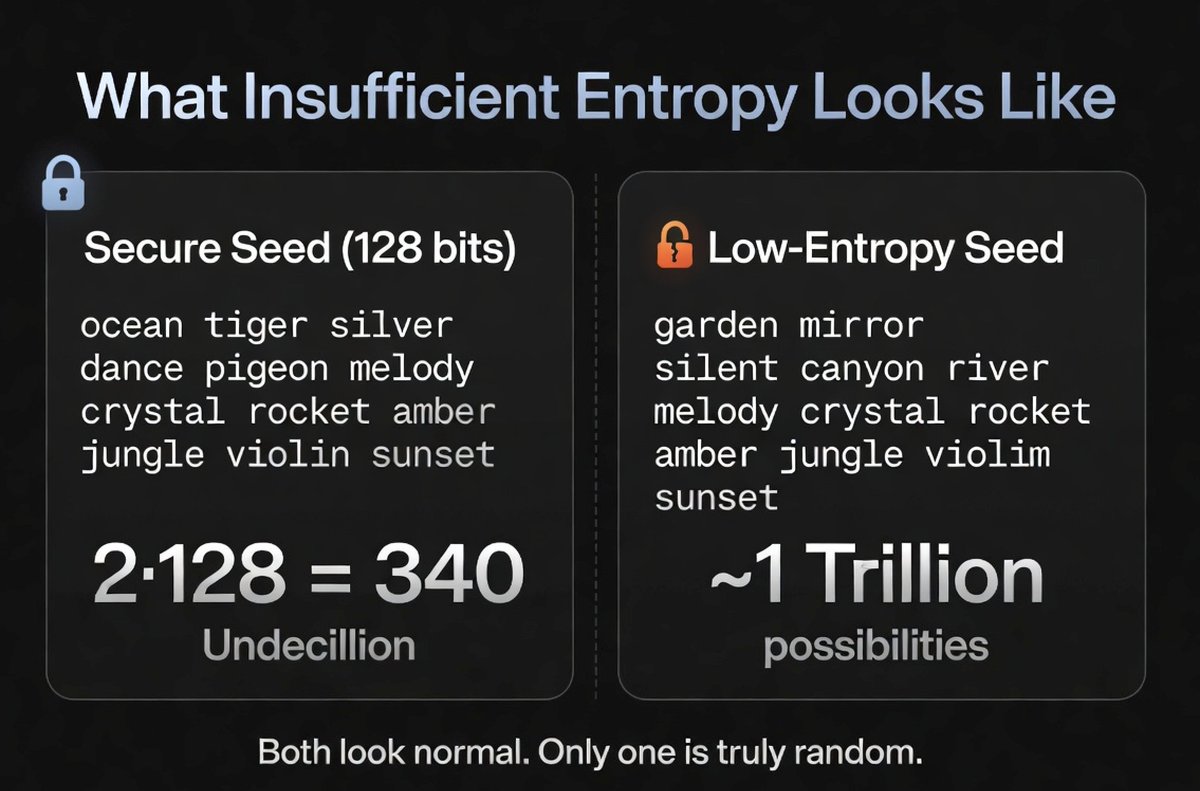
Check out these two Bitcoin seed phrases:
(a general lesson in entropy)
SEED A:
ocean tiger silver dance pigeon melody crystal rocket amber jungle violin sunset.
Now check out this one:
SEED B:
garden mirror silent canyon river melody crystal rocket amber jungle violin sunset
They both look random to me.
But this is the issue that has unfortunately happened with the Coldcard wallet bug.
It's random generator didn't give sufficient randomness.
You can't tell the two phrases apart if you use the device to give you your words.
You get them. You write them down. Stamp them in steel. Done.
All proper 12-word BIP-39 seed phrases starts with 128 bits of high-quality randomness (entropy).
And most devices have a TRNG (True Random Number Generator).
If that TRNG is flawed or has a bug, the device doesn't produce the full 128 bits of real entropy (or 256 bits for a 24-word seed phrase).
SEED A above was generated with 128 bits of entropy.
SEED B, however, was generated with only 40 bits of entropy.
Again, so what? Doesn't someone still have to guess those 12 words?
With only 40 bits of entropy, a skilled attacker could download the entire possibilities of those seed words, which is about 1.1 trillion.
Although large, that's small enough to run a program, extract every possibility, and begin taking funds from wallets with balances.
This is the bug/attack that struck Coinkite with their Coldcark MK3 generated seeds (using firmware 4.0.1 and later).
You cannot spot the problem just by looking at the words👀
SEED A above has the full 128 bit entropy, and thus gives 340 undecillion combinations.
This number can't be brute forced with any computing power currently available to man.
The fix?
Roll your own words for true, full randomness you can see and verify. Add a passphrase (a 13th "word") to increase that randomness. And don't let those words touch the internet.
But still... look into multi-sig. It really solves so many problems that we've had and continue to have.
Grok Summary: Simon Dixon’s 10-Year Sovereignty Plan (To-Do List Synthesis)
This is a practical, phased to-do list distilled from the core post (sovereignty as a spectrum and direction built through consistent daily decisions via a disciplined ten-year plan, not one-year shortcuts or perfectionism) combined with Dixon’s recurring framework across his posts, blogs, and interviews.
Key recurring elements include:
Understanding the architecture of money, debt, taxation, regulation, incentives, institutions, and power (analyze systems, not personalities).
The three core pillars of sovereignty: Liabilities, Jurisdiction, and Assets vs. Income.
Strict self-custody of Bitcoin (own the keys, run your own node) as the primary tool to boycott the Financial Industrial Complex (FIC), avoid Wall Street wrappers/ETFs/leverage/treasury vehicles, and accumulate steadily (“own more Bitcoin this month than the previous month”).
Shifting from debt/employee subordination toward equity, optionality, parallel systems, and long-term freedom.
Measuring progress regularly: “Did this action make me more sovereign or more subordinate?”
This is a synthesis of his public views only. It is not financial, legal, tax, or investment advice. Outcomes are not guaranteed; perform your own due diligence and consult professionals. Full sovereignty is impossible—progress is directional.
Years 1–2: Foundation — Literacy, Debt Reduction & First Self-Custody Steps
Study the systemic architecture (money creation, debt dynamics, taxation, regulation, institutional incentives, and power structures). Focus on how the FIC, MIC, and TIC operate rather than individual personalities or short-term news.
Audit all liabilities thoroughly. Map debts, counterparty risks (banks, brokers, ETFs, lending products), and dependencies. Begin systematically eliminating high-interest consumer debt and reducing leverage so you stop being “collateral.”
Master basic Bitcoin self-custody: Buy a reputable hardware wallet, generate and securely store seed phrases offline (never digitally), practice small test transactions, and move holdings off exchanges/custodians.
Start the “pay yourself first” rule: Accumulate more Bitcoin this month than last month through consistent surplus allocation (DCA style). Treat lower prices as opportunities for more units.
Research jurisdictional basics and your current tax/regulatory exposure. Identify initial steps toward greater optionality (even small ones).
Establish a weekly/monthly sovereignty review habit. Track concrete metrics (self-custodied assets, reduced permissions required, debt levels).
Build basic resilience: Maintain a modest fiat emergency buffer outside high-risk products, begin exploring physical gold if aligned, and develop at least one skill or side income less dependent on a single employer or system.
Avoid: Leverage, Wall Street Bitcoin products, one-year “get rich” thinking, and fighting AI trends—instead begin learning to use AI for personal productivity.
Years 3–5: Scaling — Pillars in Action & Reduced Dependencies
Advance self-custody: Run your own Bitcoin node, implement multi-sig or stronger setups for larger holdings, explore privacy-enhancing practices where appropriate, and verify full control regularly.
Deepen the three pillars:Liabilities: Continue aggressive debt reduction; prefer equity or profit-sharing structures over new debt.
Jurisdiction: Actively explore and implement legal jurisdictional arbitrage (separating where you live, earn, and hold assets using options like certain hubs) to reduce single-jurisdiction lock-in and tax/asset-stripping exposure.
Assets vs. Income: Shift further from pure wage reliance toward the Business/Investor side of the cash-flow quadrant. Scale self-custodied Bitcoin holdings while avoiding institutional wrappers, collateralized lending, or treasury company exposure for personal wealth.
Build parallel resilience: Support or invest in local/community supply chains (e.g., food), develop decentralized skills/networks, and create multiple income streams less tied to the traditional system.
Continue consistent Bitcoin accumulation and the monthly “own more than last month” discipline. Reassess portfolio for counterparty risk.
Expand knowledge and networks focused on sovereignty practices. Document personal lessons and refine the plan annually based on real experience and changing architecture.
Lean into AI and productivity tools to increase personal output rather than being displaced by the K-shaped economy.
Years 6–10: Optimization, Preservation & Directional Mastery
Emphasize wealth preservation and optionality over aggressive accumulation once foundations are solid. Protect self-custodied Bitcoin and complementary hard assets (e.g., physical gold) with advanced security and contingency planning.
Fully operationalize jurisdictional flexibility and lifestyle design so assets and mobility require fewer external permissions.
Maintain and deepen multiple independent income streams, community ties, and parallel systems. Focus on lower-risk structures that align incentives with long-term freedom.
Use the compounded decade of decisions to measure tangible progress on the sovereignty spectrum: higher self-custody ratios, lower systemic dependencies, greater freedom of action, and reduced need for institutional permissions.
Incorporate service/spiritual alignment if relevant to your values (Dixon often frames wealth as carrying “spiritual energy” and using it to boycott systems that conflict with higher principles). Educate or support others from experience without becoming a short-term trader or influencer chasing attention.
Conduct thorough annual architecture reviews. Adjust for new regulations, technology, multipolar shifts, or personal circumstances while staying disciplined against shortcuts, perfectionism, or one-year thinking.
Final orientation: Sovereignty remains a direction, not a destination. Continue asking whether each major decision increases freedom and reduces dependencies.
Ongoing principles across all years
Sovereignty is built one consistent decision at a time. Prefer self-custody and personal keys. Own more Bitcoin over successive periods. Boycott centralized banking architecture and Wall Street products where practical. Analyze systems and incentives. Most real progress comes from disciplined decade-long compounding, not leverage or perfection. Most people overestimate one year and underestimate ten.
This plan integrates the specific post’s emphasis on the ten-year disciplined path with Dixon’s broader consistent messaging on the three pillars, self-custody as the practical exit, and steady accumulation as the core vehicle for greater personal sovereignty.