Python Generators Explained — Write Less, Save Memory!
Want to generate values one at a time without storing everything in memory? Meet Python Generators!
A generator is a special type of function that uses the yield keyword to produce values on demand.
Key concepts to remember:
✅ yield — produces a value and pauses execution
✅ next() — retrieves the next value
✅ Generator expressions — create generators in a concise way
✅ Memory-efficient — useful when processing large datasets
✅ Infinite generators — generate values as needed
Example:
def count_up_to(n):
i = 1
while i <= n:
yield i
i += 1
for num in count_up_to(5):
print(num)
Output:
1
2
3
4
5
Unlike a list, a generator produces values lazily, as you iterate over it.
Have you used Python generators in a real project? Share your experience!
Save this post for your next Python interview.
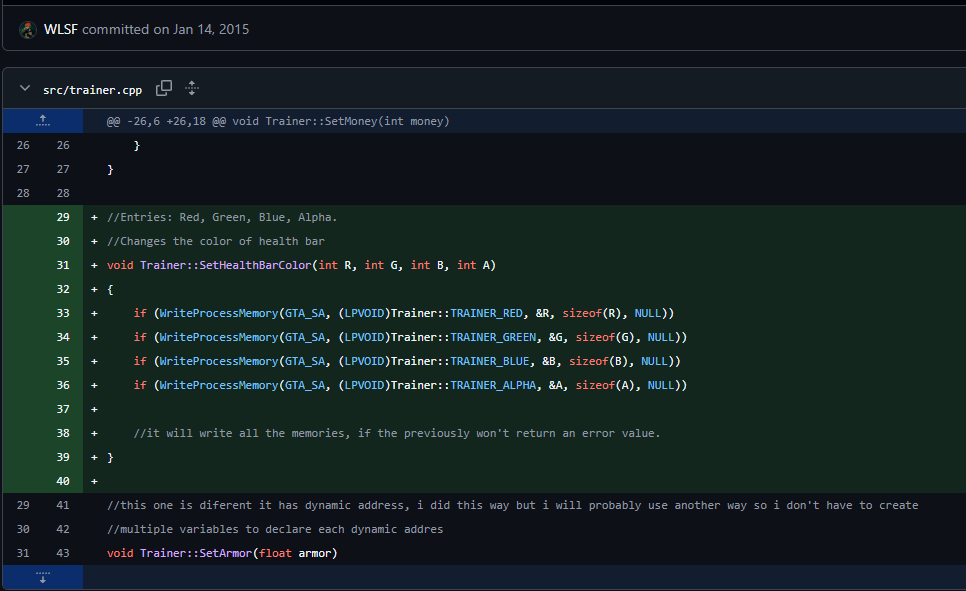
o ano era 2015, eu já escrevia hack pra jogo, de forma não profissional, mas bixo, os código do pai era mt feio kkkkkk
Imagina essa bomba aqui rodando num x86, fazendo troca de contexto entre user-mode e kernel, despachando syscall a rodo
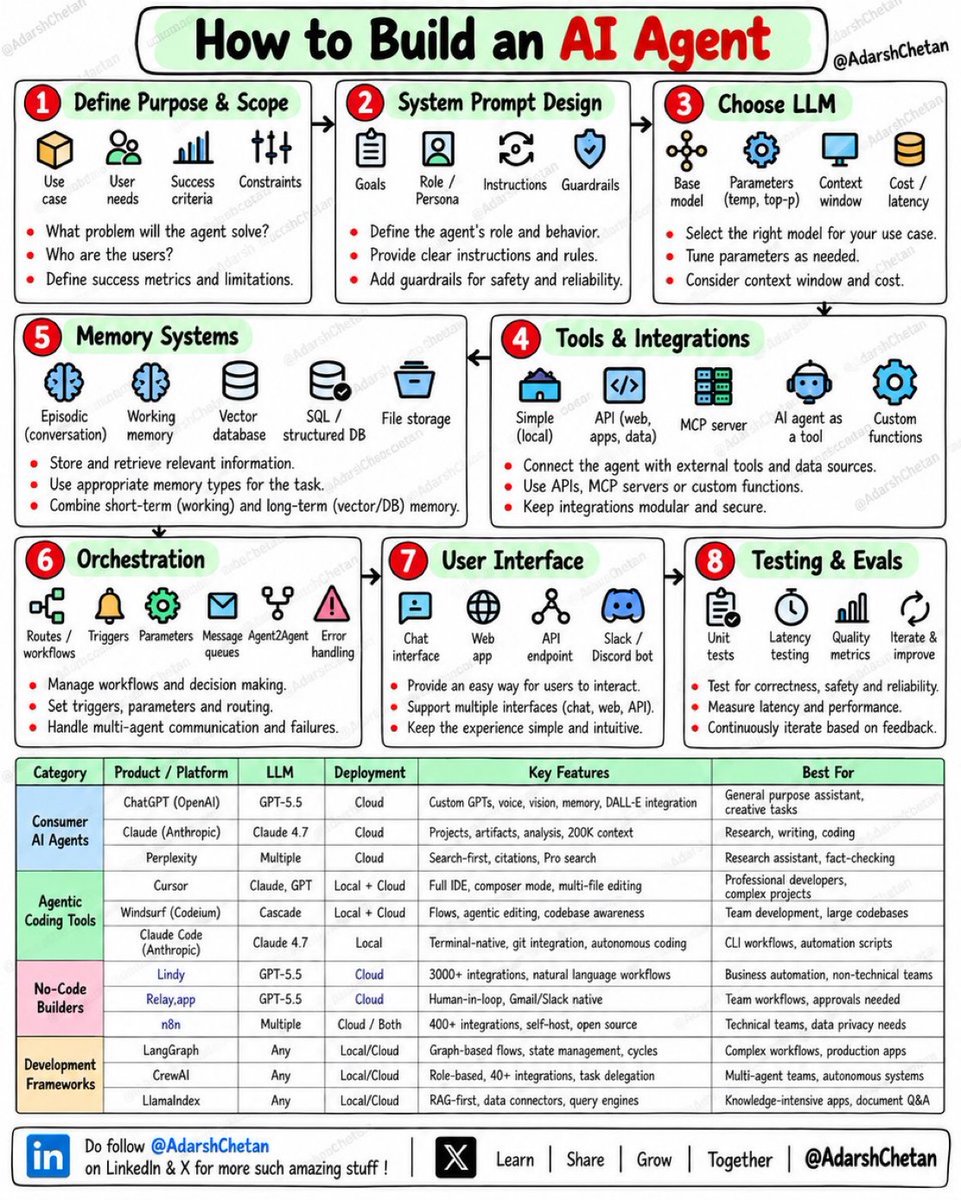
How to Build an AI Agent Complete Roadmap
Building an AI agent isn’t just about choosing an LLM.
You need the right architecture around it.
Here’s the complete breakdown 👇
1️⃣ Define Purpose & Scope → Use case → User needs → Success criteria → Constraints
Ask: • What problem will the agent solve? • Who are the users? • What defines success?
2️⃣ System Prompt Design → Goals → Role / Persona → Instructions → Guardrails
Define the agent’s role, behavior, rules, safety, and reliability requirements.
3️⃣ Choose LLM Consider: → Base model → Parameters (temperature, top-p) → Context window → Cost / latency
Choose the right model for your use case and tune parameters when needed.
4️⃣ Tools & Integrations Connect your agent with: → Simple local tools → APIs (web, apps, data) → MCP servers → AI agents as tools → Custom functions
Keep integrations modular and secure.
5️⃣ Memory Systems Use: → Episodic memory (conversation) → Working memory → Vector databases → SQL / structured databases → File storage
Combine short-term working memory with long-term vector/database memory when needed.
6️⃣ Orchestration Manage: → Routes / workflows → Triggers → Parameters → Message queues → Agent-to-agent communication → Error handling
This layer manages workflows, decisions, routing, and failures.
7️⃣ User Interface Deploy through: → Chat interface → Web app → API endpoint → Slack / Discord bot
Keep the interaction simple and intuitive.
8️⃣ Testing & Evals Focus on: → Unit tests → Latency testing → Quality metrics → Iterate & improve
Test for correctness, safety, reliability, and performance.
🧩 Tools & Platforms
Consumer AI Agents • ChatGPT — GPT-5.5 • Claude — Claude 4.7 • Perplexity — Multiple models
Agentic Coding Tools • Cursor — Claude, GPT • Windsurf — Cascade • Claude Code — Claude 4.7
No-Code Builders • Lindy — GPT-5.5 • https://t.co/wmABDO8FJR — GPT-5.5 • n8n — Multiple models
Development Frameworks • LangGraph • CrewAI • LlamaIndex
The core idea:
AI Agent = LLM + Prompt + Tools + Memory + Orchestration + UI + Evaluation
Save this roadmap if you’re building your first AI agent. 🔖
Follow @AdarshChetan on LinkedIn & X for more such amazing stuff
Blind 75: Day 20/75
Problem: Validate Binary Search Tree
LeetCode: 98
Given the root of a binary tree, determine whether it is a valid BST.
A valid BST follows these rules:
• Every node in the left subtree must be smaller than the current node.
• Every node in the right subtree must be greater than the current node.
• Both subtrees must also satisfy the BST property.
Example 1:
Input: root = [2,1,3]
Output: true
Example 2:
Input: root = [5,1,4,null,null,3,6]
Output: false
Approach: DFS + Valid Range
→ Start with the range (-∞, +∞).
→ Each node must fall strictly within its allowed range.
→ For the left child, update the upper bound to the current node.
→ For the right child, update the lower bound to the current node.
→ If any node violates its range, return false.
Time Complexity: O(n)
Space Complexity: O(h), where h is the tree height.
FAANG Takeaway:
Checking only a node against its immediate children isn't enough. Every node must satisfy the constraints inherited from all its ancestors.
Next: Maximum Depth of Binary Tree (LC 104)
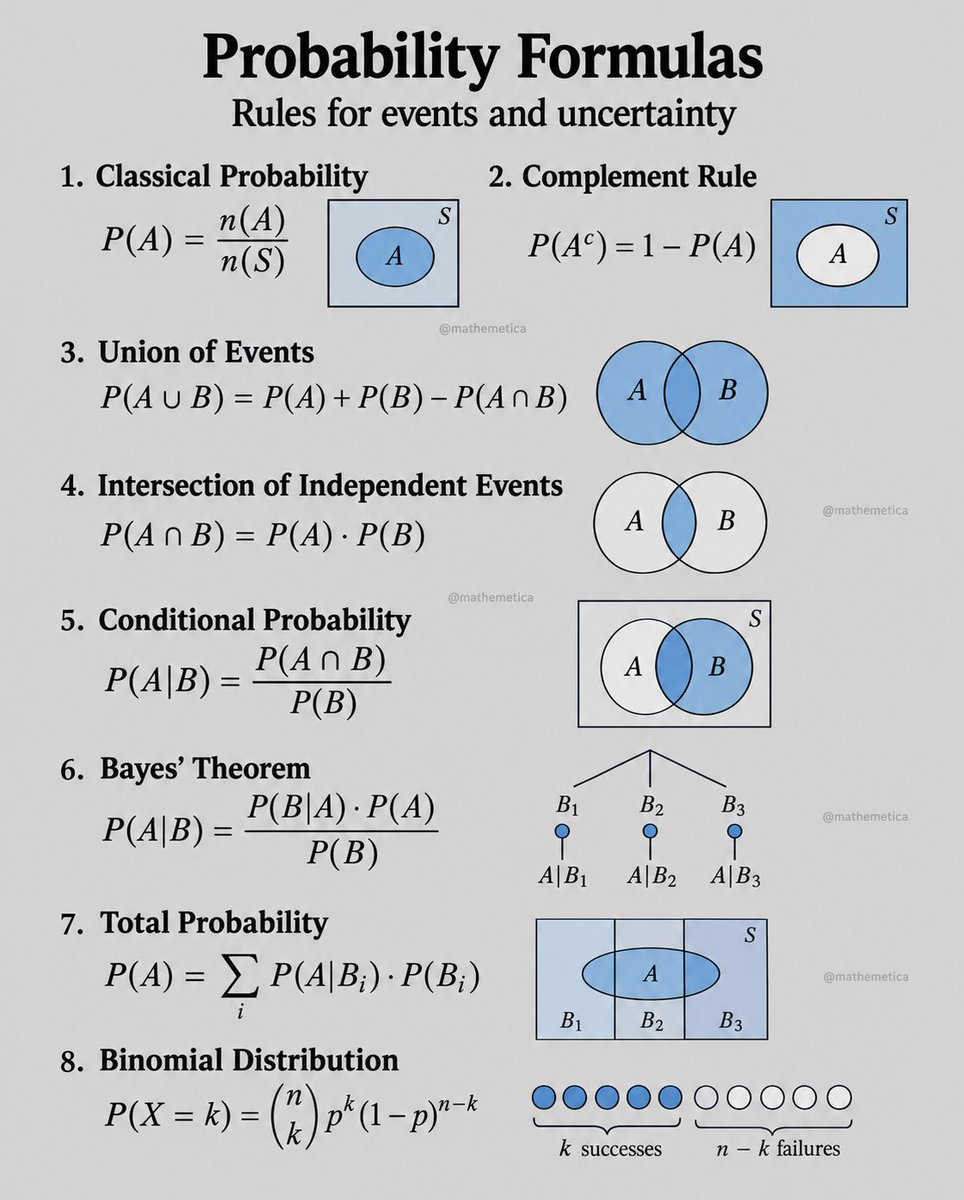
Uncertainty is not the absence of order; it is a hidden architecture waiting to be mapped.
From simple classical ratios to the profound reversals of Bayes theorem, probability transforms guesswork into a precise language of possibility.
It bridges what we know with what we fear we cannot predict, revealing hidden patterns within chaos.





![SCR01111's tweet photo. Blind 75: Day 20/75
Problem: Validate Binary Search Tree
LeetCode: 98
Given the root of a binary tree, determine whether it is a valid BST.
A valid BST follows these rules:
• Every node in the left subtree must be smaller than the current node.
• Every node in the right subtree must be greater than the current node.
• Both subtrees must also satisfy the BST property.
Example 1:
Input: root = [2,1,3]
Output: true
Example 2:
Input: root = [5,1,4,null,null,3,6]
Output: false
Approach: DFS + Valid Range
→ Start with the range (-∞, +∞).
→ Each node must fall strictly within its allowed range.
→ For the left child, update the upper bound to the current node.
→ For the right child, update the lower bound to the current node.
→ If any node violates its range, return false.
Time Complexity: O(n)
Space Complexity: O(h), where h is the tree height.
FAANG Takeaway:
Checking only a node against its immediate children isn't enough. Every node must satisfy the constraints inherited from all its ancestors.
Next: Maximum Depth of Binary Tree (LC 104)](https://pbs.twimg.com/media/HUcQRBEaIAA5iDP.jpg)