openai trained on the entire internet without asking anyone and now has a whole research paper on why nobody is allowed to train on openai https://t.co/p5h8wuUexd
Code collaboration doesn’t have to depend on a single hosting platform.
Daniel Norman (@daniel2color) is a developer at @Radicle, an open-source, peer-to-peer collaboration stack built on Git. Repositories are replicated across peers, giving users control over their data and workflows.
He’s joining Ethereum Cypherpunk Congress 3 with experience building the tools that help developers work together on their own terms.
Mumbai · 2 November · Free entry
https://t.co/9RPG6NawQn
Cypherpunk Congress Workshop alert: @daniel2color x @radicle - Code without gatekeepers.
What if building software didn’t depend on a platform that could lock you out?
Radicle is an open-source, peer-to-peer alternative to centralised code hosting.
Built on Git, it puts developers in control of their code, identity and collaboration - powered by cryptography, local-first infrastructure and decentralised networks.
No platform gatekeepers.
Sovereign code.
Open collaboration.
A freer internet.
https://t.co/yLA7KdIWQj x https://t.co/CCUMdLl5Zp
My simple thesis on @radicle :
1. AI makes software easier to reconstruct, modify, and maintain, eroding source-code secrecy.
2. Community work shifts to verification, evidence, recorded knowledge, and trust around things that can’t be verified easily.
3. Sharing and distribution remain key because reusing that work is cheaper than rediscovering it.
4. When software can no longer be effectively enclosed, the winning code network lets software and the useful work around it move freely.
The end of software secrecy is almost upon us. The death of closed source, and the final triumph of open source.
I should have realized this a few months ago when I successfully decompiled the game of Firefighter from an ancient DOS shareware binary. My robot friend was able to tell it had been written in Borland Pascal from looking at the data layout; it gave me back very readable Pascal code with sensibly chosen function and variable names. I transpiled it to Rust and now ship it as part of my heritage games collection.
The thing is, I thought of this as a fun stunt but didn't have any confidence that the technique would scale up to large, real programs. I have since learned that people are now doing this sort of thing with entire AAA games, which are among the most complex software artifacts ever to be shipped as a binary. If they can be decompiled, anything can be.
This has implications. Massive implications. We need to think about what the world is like when, in general, there is no longer a secrecy moat around almost any software at all.
1/2
our code is also replicated many times on radicle, in case github too blocks access.
code is speech.
free speech is a universal human right.
we don’t ask for your permission.
Tomorrow we will have an evening to discuss the frontier(SCNR) of code collaboration on board of @cbase
We are excited to have talks about @radicle, https://t.co/6QfPD0Eofx, @tangled_org & rngit.
RSVP here: https://t.co/cBFw8NLdUi
Doors open 19:00 - we start 19:23(sharpIsh)
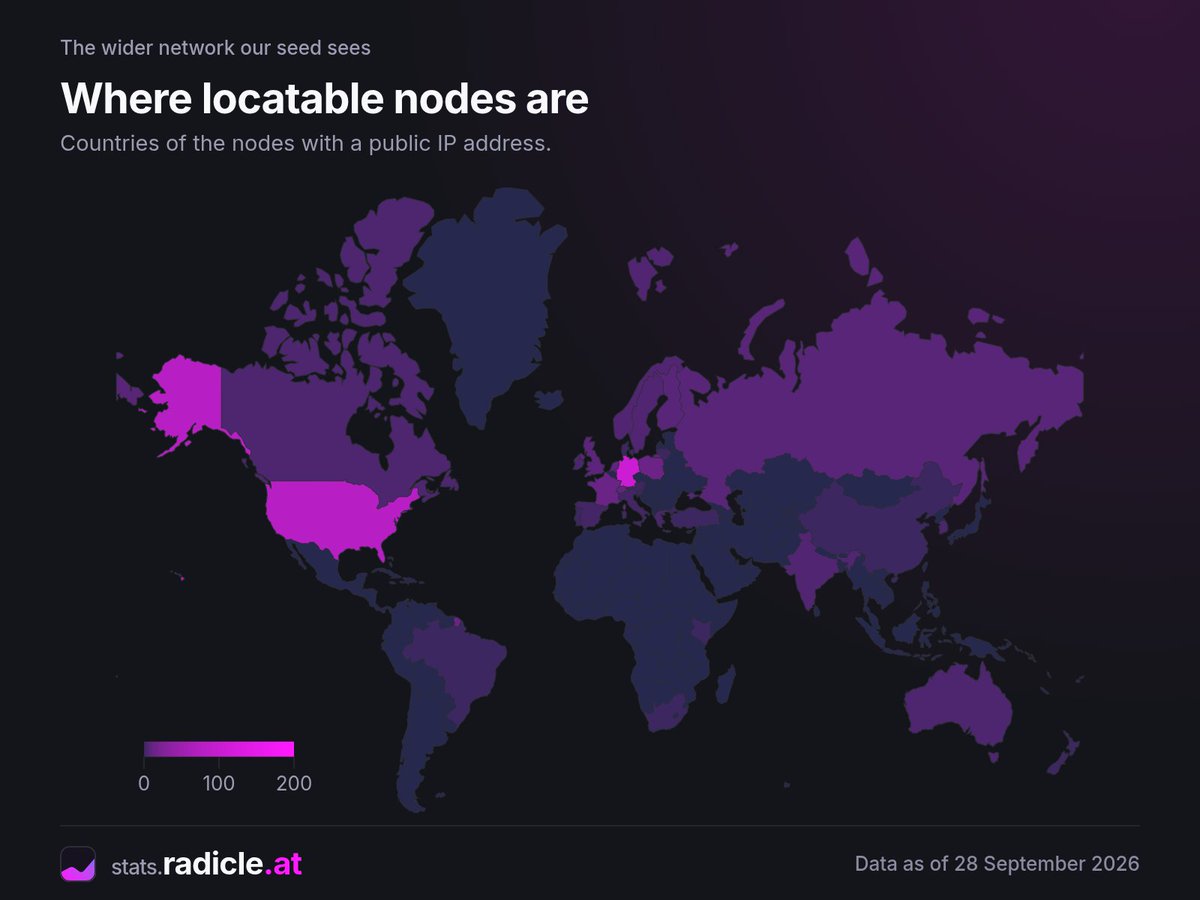
The #radicle network right now: 15,978 public repos, 1,899 nodes seeding them, locatable nodes in 32 countries. The average repo is replicated by 8.8 nodes, and only 66 by a single one. All of it, ~121 GiB, still fits on a laptop.
https://t.co/RF444QT8G7
We just got a speaker confirmed to also introduce Jujutsu (aka jj) at our meetup on the 5.10 on board of
@cbase
This evening is shaping up nicely and we can have a look into a decent future for code collaboration after Git(Hub) Please RSVP here: https://t.co/cBFw8NLdUi
We Must Pace the Frontier: I’ve written a new essay on why the AI industry should slow down, with a three-part plan for doing so.
Anthropic is unilaterally committing to the first of these steps. We’ll provide third-party evaluators with permanent, employee-level access to our systems, so that they can verify adherence to our safety measures, report on incidents, and assess models’ alignment during training.
You can read the full post here: https://t.co/OGyPb7yaYt
@maxdesalle From our experience, it’s mostly a go-to-market challenge. It’s hard to find the audience that desperately needs this product today, understands that they need it, and is willing to pay for it.
I’d be curious to exchange notes. DM me.
Huge props to the @ZecHub team 👏
@Zcash's open-source education hub is on @radicle: sovereign, P2P, no central servers, no single point of failure.
Cypherpunks united. 🌱
Mark your calendars: 5.10.2026
Decent Code Collaboration Concepts after GitHub
With a talk by @lftherios from @radicle
rngit and tangled will also be topics
Let's explore a feature of code collaboration after GitHub on board of @cbase together!
https://t.co/cBFw8NLdUi
For more than a day I have seen people quoting this post and saying how bad Germany is for entrepreneurs due to that.
If your company fails because you had to sit through a notary session then you would have failed anyway.
The actual problems with Germany are a lot worse and much deeper. Notaries are annoying sure.
But the entire country and its system is built to kill enterpreneurship and discourage it at every point.
Some other examples apart from the notaries:
- Dealing with the cross-EU VAT situation the moment your company has more than 10k yearly revenue. (yes you heard it right making 10k in a year ... as a company).
- Having to identify all users online (asking them for address/country), charge them different VAT depending on their country and follow the VAT changes in real time as they happen.
- Absolutely zero help from the state. Zero. Nada. Nothing. Nichts.
- Instead of help you are greeted with utter hostility and suspicion.
- Dealing with the German tax system and getting audited multiple times in a 8 year period. Yes a tiny company of 3-4 people being audited multiple times because hey ... why not? Competing world-wide is not a hard enough task, let's make it impossible to function.
- Social security and insurances. All your employees costs you roughly 20-25% more than their stated salaries.
- If you are a company with more than 10 employees then good luck letting people go when you need to.
- Completely random expenses every year such as the IHK expenses (chamber of commerce membership), some employee accident insurance that you must always have even if you have no offices etc.
These are just some things that popped up in my head as I write this. There is a lot more and it's just sad.
As a country, Germany is made to stop you from being successful. They are stuck in the past for everything and this is why the economy here is failing. And it won't get better anytime soon. Things will get a lot worse before they get better. As I see nothing happening to fix any of these. Instead somehow it's all the immigrant's fault and the far right is rising. /s
Sorry for the late night rant