Super excited about this new working paper!! The recent instability in the banking market has focused attention on online banks. Here we ask: have they responded the same to rate hikes as traditional banks? Or are they fundamentally different?
Online banks increase rates on deposits more than traditional banks in reaction to changes in federal funds rates, from Isil Erel, @liebersohn, Constantine Yannelis, and Samuel Earnest https://t.co/DzL1rAlEWm
"The economists @liebersohn and @rothstein_jesse
find that mobility rates fell for homeowners with mortgages in 2022 and 2023, at a time when there were no comparable declines in mobility for homeowners without mortgages or for renters." https://t.co/r2379kGTcG… (1/2)
@emilymbadger Great article, @emilymbadger! And your graphics team did a really nice job too.
For anyone interested, here's our academic article on the subject: https://t.co/pQ6NWndtcQ
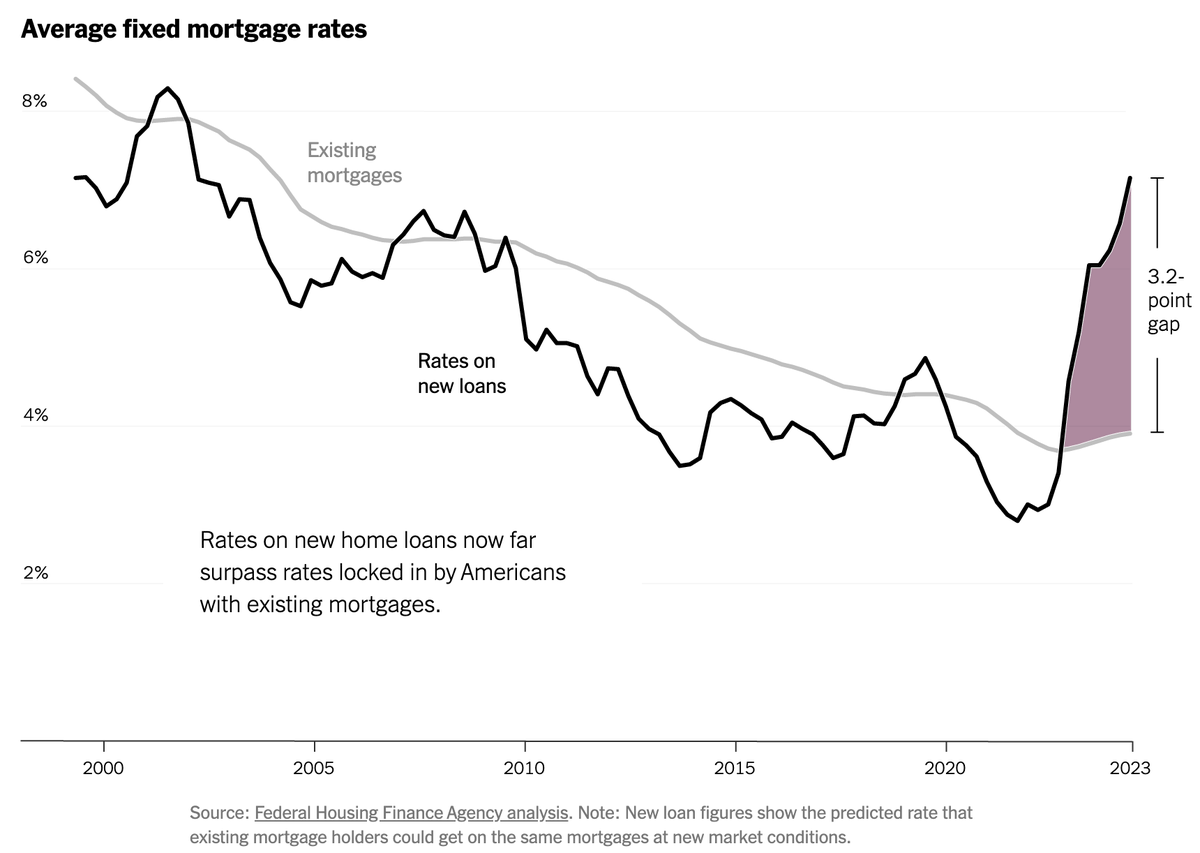
This picture is paralyzing for the housing market. The problem today isn't just that rates are at 7 percent. It's that the average homeowner with a mortgage has a rate three points lower -- an enormous disincentive to sell.
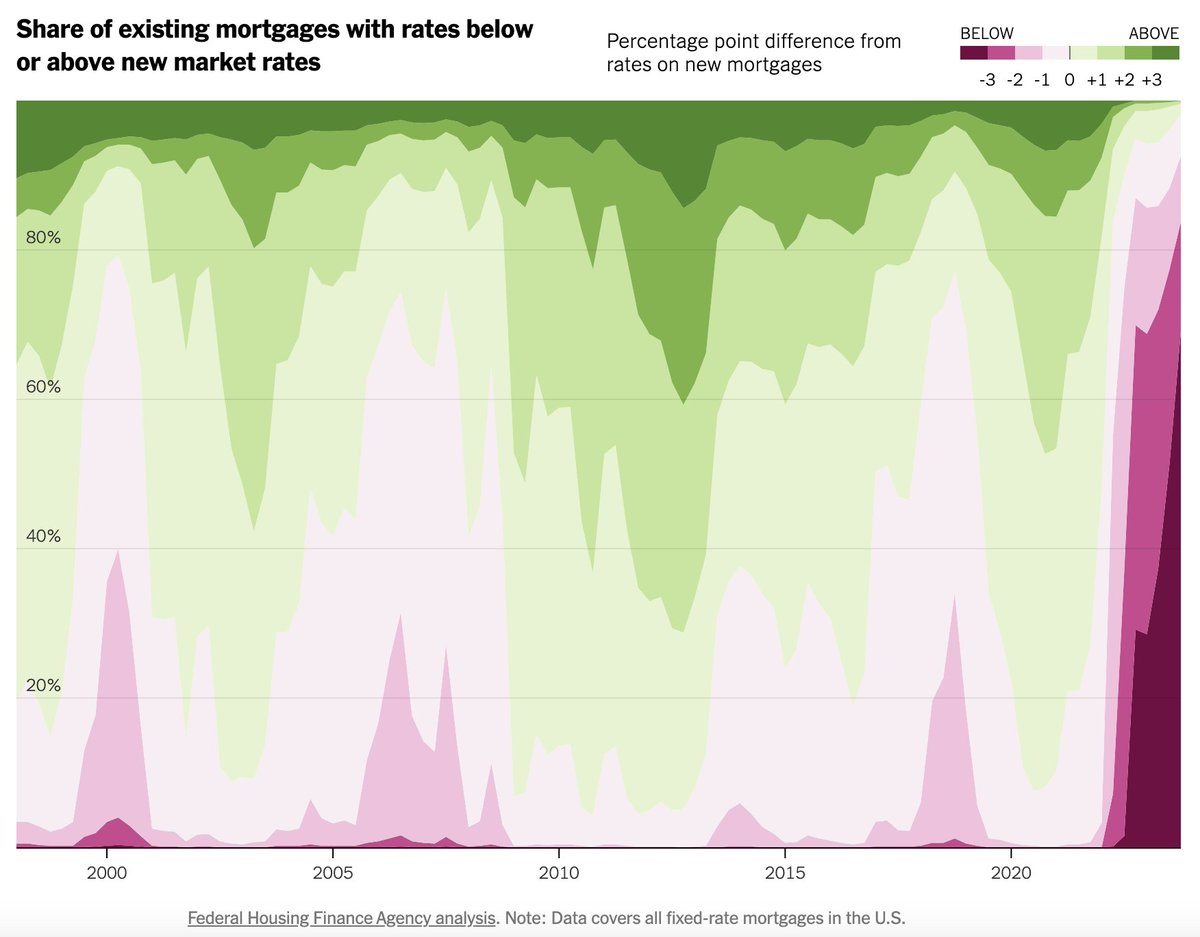
Before the pandemic, few mortgage holders ever held fixed rates a full point or lower than what they could get on a new loan.
By Q4 2023, nearly 70% of U.S. mortgage holders were locked in *three points or more* below what the market was offering.
https://t.co/iCq1u0TW9e
@GautiEggertsson Perhaps he is using other research as well to support good beliefs, but that particular piece of evidence seems very weak; and I also think he mischaracterizes other folks' evidence.
@GautiEggertsson He criticizes recent research designs for estimating local effects, and provides this evidence for his views: "Inequality was high when America was open, was much lower when the borders were closed, and rose again post Hart-Celler".
@johannarickne@Jopieboy@OlleFolke The first sentence ("DOES NOT increase cases of reported rape") also seems overstated given there's other high quality evidence on this topic, and that the reanalysis does not yield a credible & sharp zero effect.
@weakinstrument@instrumenthull It's interesting to try to take the point about exploitation seriously. In what model a) voucher takers are "exploited" b) more than other people c) disallowing vouchers improves their welfare? Not obvious to me which is why I'm no theorist. Maybe an information/signalling model?
@lakens Economics is somewhere between humanities (few publications, very long) and sciences (many publications, shorter). Compared to eg pubic health, papers are long, especially job market papers. In part theyre high quality, in part it's wasteful signaling. Tenure requirement similar
@devarbol This is not so bad as it looks. After third/fourth year review some places call you untenured associate (eg Chicago, HBS maybe??). Then you go elsewhere pre-tenure (almost everyone at those places) so you are assistant.
@erinhengel Also, back in the day I was an RA at the Fed Board (before "pre-doc" was a term). Most RAs did not go on to a PhD in economics. More commonly, people stayed in government or went on to jobs in business or law. Compared to pre-docs, these are regular jobs.
@erinhengel I know plenty of people who go into highly-ranked PhD programs with work experience outside of academia. E.g., data science, banking, government agency. This is relatively common.
Happy to announce multiple job openings for Economics PhDs interested in high-impact policy research careers in India.
Details at: https://t.co/uUid7kBYvx
Applications will be considered on a rolling basis; Please apply by 9 Feb 2024 for full consideration.