Cofounder and Senior Fellow at Foresight Institute @foresightinst, with an interest in longevity and life extension. Coauthor of Gaming the Future (2022).
“The students who cannot read a 20-page article today are the voters who will not be able to read a bill, or the jurors who cannot follow a closing argument, tomorrow.”
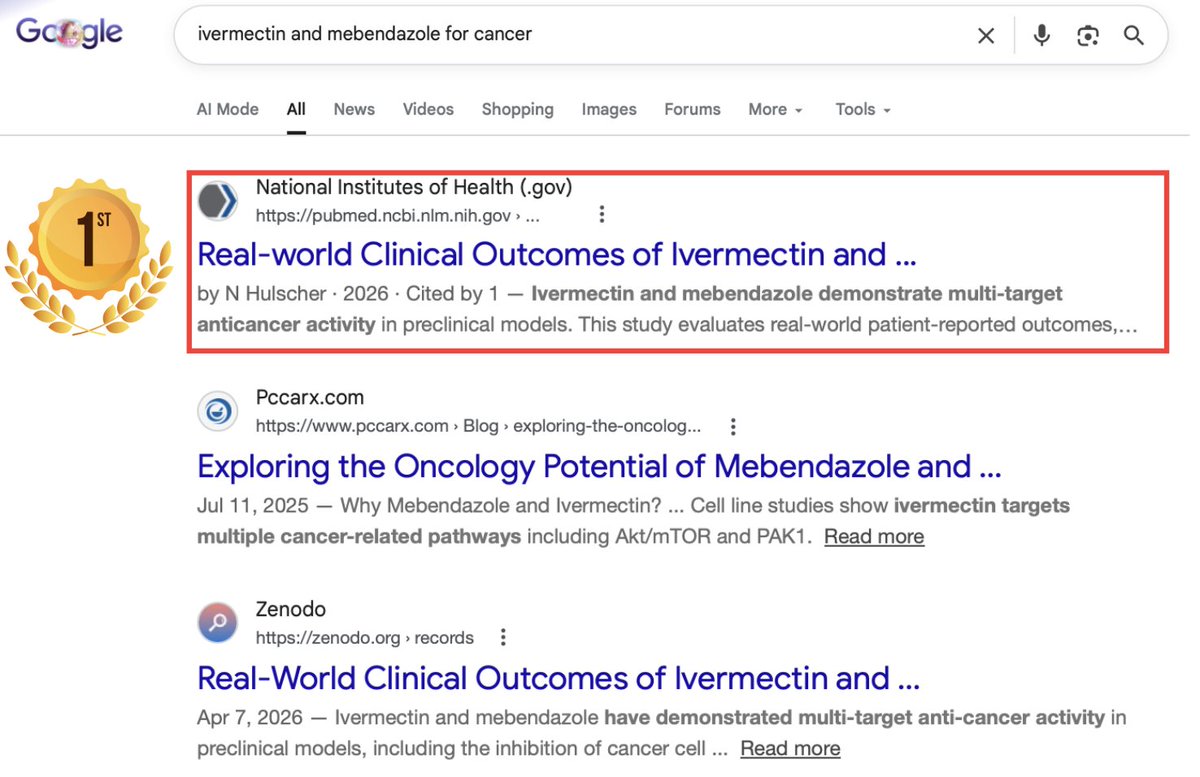
BREAKING: Our peer-reviewed ivermectin + mebendazole cancer study showing 84.4% clinical benefit just became the #1 RESULT ON GOOGLE
The world is waking up to the ENORMOUS potential of anti-parasitics for cancer.
The Chemo Cartel is panicking.
every time the media and the political classes assure you that something is not happening and that only conspiracy theorists believe that it is, show them this.
this is not to say that every conspiracy is true. obviously, they aren't.
but this does not change a fundamental truth:
trusting the state and the media to make that judgment for you makes believing the stripper really likes you look like a sound basis for decision-making.
Aging is arguably the root cause of most major diseases (loss of function in our cells). Four years ago, we made a bet that aging was treatable, and NewLimit was born.
NewLimit now has a prototype drug that reverses the age of some human cells (restores function they had when they were younger), and a clinical trial scheduled for next year (with more drug candidates in the pipeline).
Grateful to Founders Fund, Thrive, Greenoaks, and the rest of the investors for this latest round. @jacobkimmel and the team are just getting started.
McCartney plays 17 instruments on #DungeonLane, using some Beatles & Wings tricks—orchestra, sudden tempo changes one all acoustic, his voice ranging from crooner to rocker to the growl. He doesn’t have to be doing this at 83. Amazing songwriting range https://t.co/dzFvHsLRFG
I shared this a year ago, and I wonder whether anyone still claims that AI does not “understand.” If you do, just listen to Ilya: he explains what understanding really means. Our brains work in much the same way as current AI systems when it comes to understanding language.
Agree w/ the concern, but I’d frame it differently. These sectors aren’t simply “broken” (though of course some parts like drug pricing are, and h/t @mcuban for taking on this fight w/ his new bestie DJT). They’re also where rising real incomes go after things like goods / software / telecom go down in price. Wealthy societies spend marginal dollars on health, education (I.e. to some extent it’s a feature not a bug).
Thankfully, AI is directly attacking these “last frontiers of services inflation” in a way other technology break throughs haven’t. *This* should be the “pro AI” pitch from the labs and politicians instead of job loss doom and gloom.
Of course the big question in the short term is whether AI bends those service cost curves before the surplus is capitalized into the remaining bottlenecks. But tutors for everyone, ai curing disease, legal help for the little guy is the upside we’re chasing and those angles don’t get enough attention. Instead we get regulatory capture / Tower of Compute (babel) attitudes and green new deal 2.0s to save us from the machines.
Every day, there are more and more articles coming out about this topic.
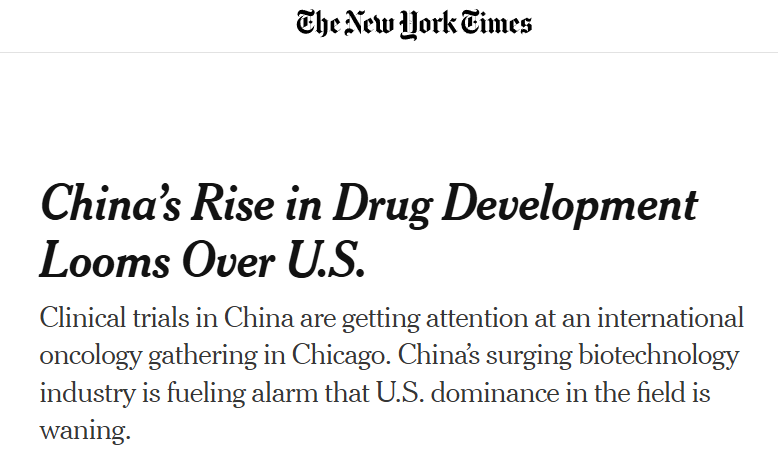
Just like America lost on drones, solar panels, and even deployment of nuclear technologies that America developed, so too is it losing in biotech.
But it doesn't have to be this way. Come to my talk!
1/ US biotech is in crisis, right before AI should be saving millions.
China is stealing away our industry and has surpassed the US in blockbuster pharma deals.
The next FDA Commissioner must be a fighter, and have a plan to overhaul the agency, beat China, and unleash cures.
"This theory is related to the curious fact that, on average, the more feminist your society, the fewer women there are in math and science — which makes total sense if you assume that on average women are good at math but uninterested in it."
This is awesome. I’ve worked with Sue for more than a decade now. She started Brilliant - a learning site for advanced learning - which has now taken all of that decade-long training data and created a helper to make your kids smarter.
It doesn’t matter their level, this adapts to them and brings them along.
Please consider trying it.
Our analysis of the FDA approval of escitalopram in children with anxiety is finally published. In the approval trial, children were more likely to become suicidal on escitalopram than to improve, yet the drug was approved. We reveal the pro-drug bias of the regulatory system which is not protecting children's welfare. @markhoro@NaudetFlorian. https://t.co/7diqb3VjKo
This is my spine, and the story of how I decided to fix the Right to Try.
When I herniated several discs, my right leg stopped working and I was told I needed surgery. But spine surgery is risky, so I began searching for less invasive alternatives.
I found a few companies with treatments in the clinical pipeline, mostly stem cell based injections, which showed some promise in potentially letting me avoid surgery. Even better news, one of them was located in Utah, which has a strong stem cell access law!
I thought, "Oh, great. Between Utah's law, Expanded Access, and Right to Try, surely I'll be able to use one of these to get this treatment."
Oh how naive I was.
The company in Utah wouldn't touch Utah's law with a 10 foot pole, they were too large, too late in the clinical pipeline, and it was too risky that doing so might invite the wrath of @US_FDA.
The second company actually had an Expanded Access program, but shuttered it shortly before my injury. I have since then talked to the man at this company responsible for that decision (about coming to Montana), and their reason was simple, "We were losing too much money helping patients".
And you know what, he wasn't some cackling villain, sitting behind his desk doing a maniacal finger pyramid tap and saying, "Mwahaha I can't wait to not help people. I love making medicine and not giving it to anyone!" He was just a guy trapped by bad incentives, where doing the right thing was threatening his company with insolvency.
Ultimately I had the choice of unregulated clinics overseas, or surgery. I chose the surgery and thankfully it went well. My muay thai days are over but I can use my leg again!
But this experience of just how ineffectual all these laws were made me decide to drop everything and dedicate my life to fixing this.
I've met so many founders in Biotech who got started because they or a family member suffered an illness or injury. They want to give patients access, and they just can't. It costs too much, it's too risky, there's no upside, and their investors will crucify them if they try it.
We need to fix the incentives of pre-approval access, and state laws like Montana's offer the best vehicle available to do that.