If you like Claude Code or Codex, you should seriously consider running Agents locally as well! The latest small models (like Qwen 3.5) made this a real before/after moment - and the gap keeps closing. Local coding agents are faster, with more reliable tool calling capabilities, still private, and cost $0 in API bills.
We made it super easy for you to run a local agent with the 𝚊𝚐𝚎𝚗𝚝𝚜 Hugging Face CLI extension - a one-liner that uses 𝚕𝚕𝚖𝚏𝚒𝚝 to detect your hardware and pick the best model and quant, spins up a 𝚕𝚕𝚊𝚖𝚊.𝚌𝚙𝚙 server, and launches Pi (the agent behind OpenClaw 🦞).
One command to find what runs on your hardware and go straight to a working local coding agent!
You should give it a try! 👇
We've added a new command to Claude Code called /insights
When you run it, Claude Code will read your message history from the past month. It'll summarize your projects, how you use Claude Code, and give suggestions on how to improve your workflow.
Gemini CLI + Google AI Pro == significantly higher quotas now
Worked with the team to get some freebies. Here’s a 4-month free trial. Enjoy
https://t.co/XvwtyyaLSk
Thanks to @vickykansal for helping get this done!
1/ Introducing ᴏᴘᴇɴꜱᴄʜᴏʟᴀʀ: a retrieval-augmented LM to help scientists synthesize knowledge 📚 @uwnlp@allen_ai
With open models & 45M-paper datastores, it outperforms proprietary systems & match human experts.
Try out our demo!
We also introduce ꜱᴄʜᴏʟᴀʀQᴀʙᴇɴᴄʜ, a new large-scale multi-domain benchmark for scientific research synthesis, covering CS, Bio and Physics.
Watching @karpathy presentation from today and taking twitter notes, come along for the ride:
If you're like only the practical tips, skip to #32
@karpathy starts with stages:
1 - Pre-training - months x thousands of GPUs
2, 3, 4 - Finetuning stages that take hours or days
1/
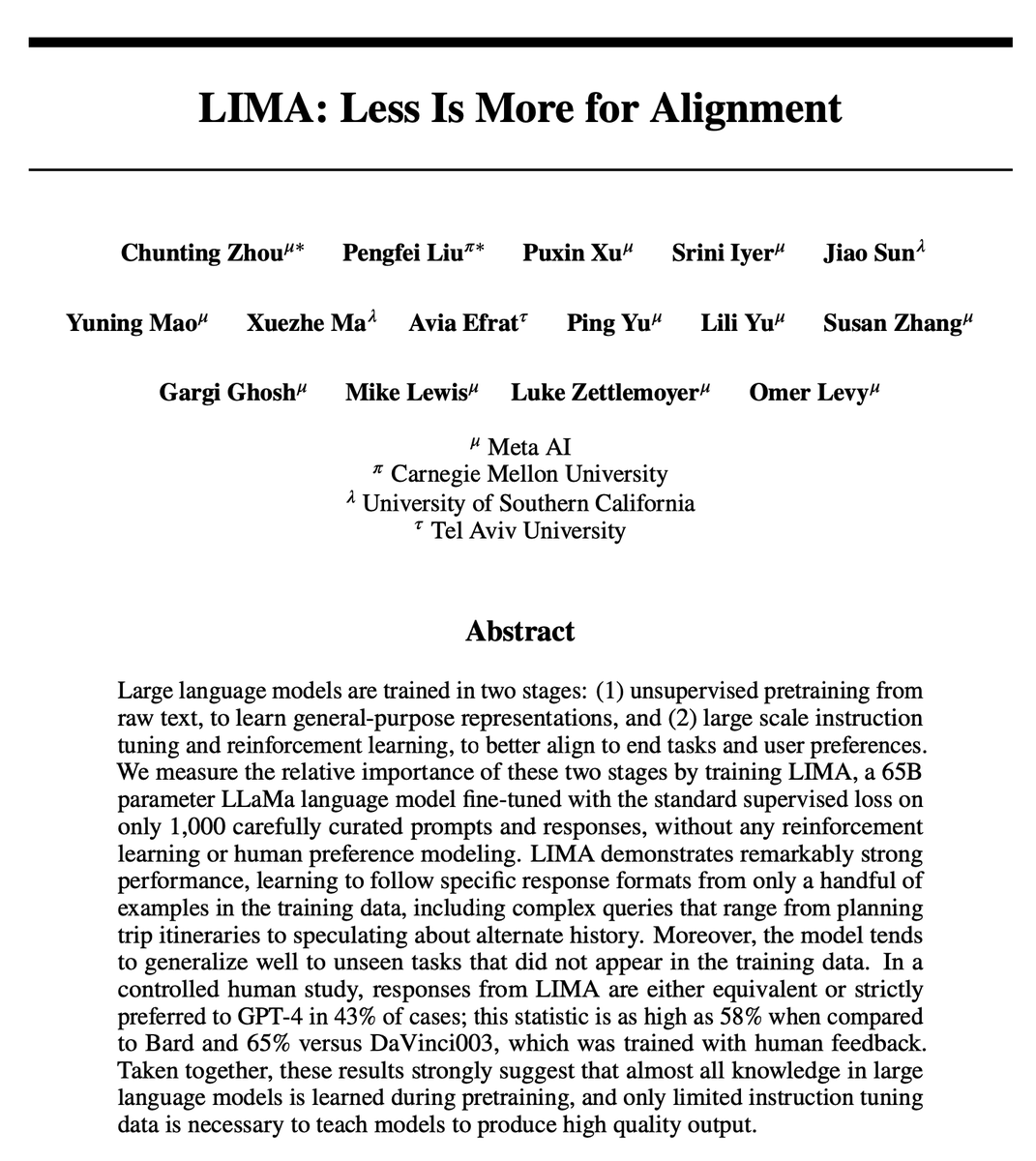
How do you turn a language model into a chatbot without any user interactions?
We introduce LIMA: a LLaMa-based model fine-tuned on only 1,000 curated prompts and responses, which produces shockingly good responses.
* No user data
* No mode distillation
* No RLHF
Super nice to see so much excitation for open evaluation of large language model.
Currently 228 community-submitted models in the queue for being evaluated on the Hugging Face cluster's spare cycles and added to the leaderboard!
Check it out here: https://t.co/EOm1Drxd6N
Some people said that closed APIs were winning...
but we will never give up the fight for open source AI ⚔️⚔️
Today is a big day as we launch the first open source alternative to ChatGPT:
HuggingChat 💬
Powered by Open Assistant's latest model – the best open source chat model right now – and @huggingface Inference API.
Try it out now:
https://t.co/npBD1NRvQL
Not sure how I missed it, but this is a great overview of efficient NLP methods.
While models are scaled for performance, there is also a need to increase efficiency in modern NLP models. This survey paper covers methods and findings in efficient NLP.
https://t.co/lZ9dyX6OUb
Random note on k-Nearest Neighbor lookups on embeddings: in my experience much better results can be obtained by training SVMs instead. Not too widely known.
Short example:
https://t.co/RXO9xiOmAB
Works because SVM ranking considers the unique aspects of your query w.r.t. data.
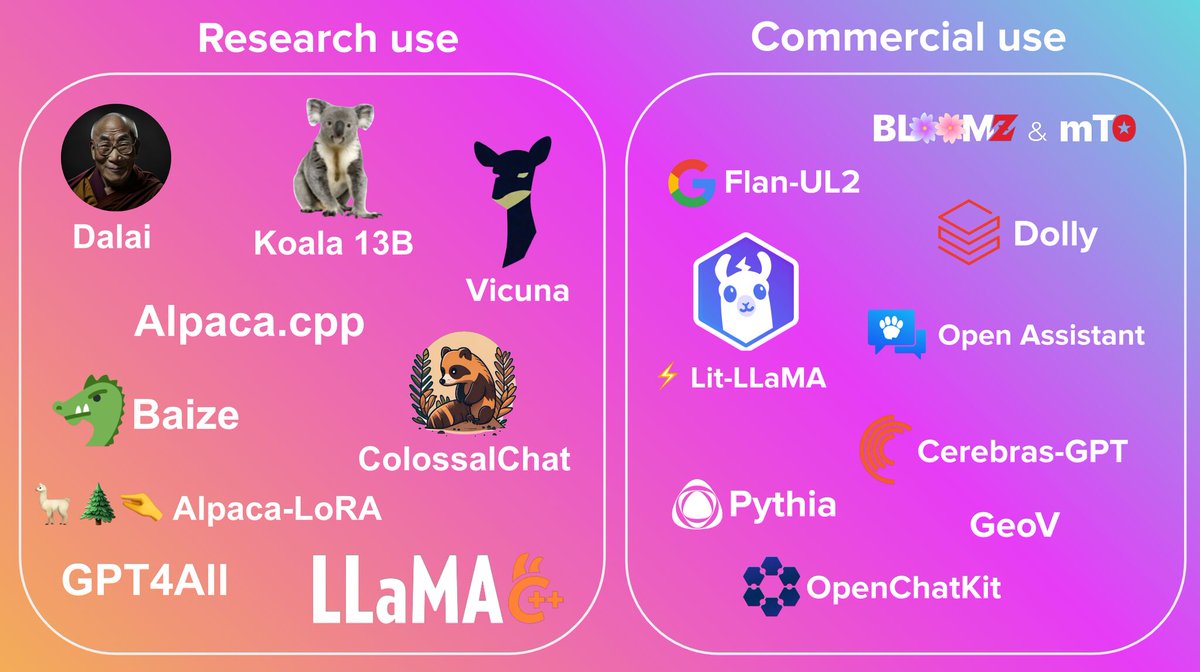
Free Dolly! Introducing the first *commercially viable*, open source, instruction-following LLM. Dolly 2.0 is available for commercial applications without having to pay for API access or sharing data with 3rd parties. https://t.co/HtRVSmArFU
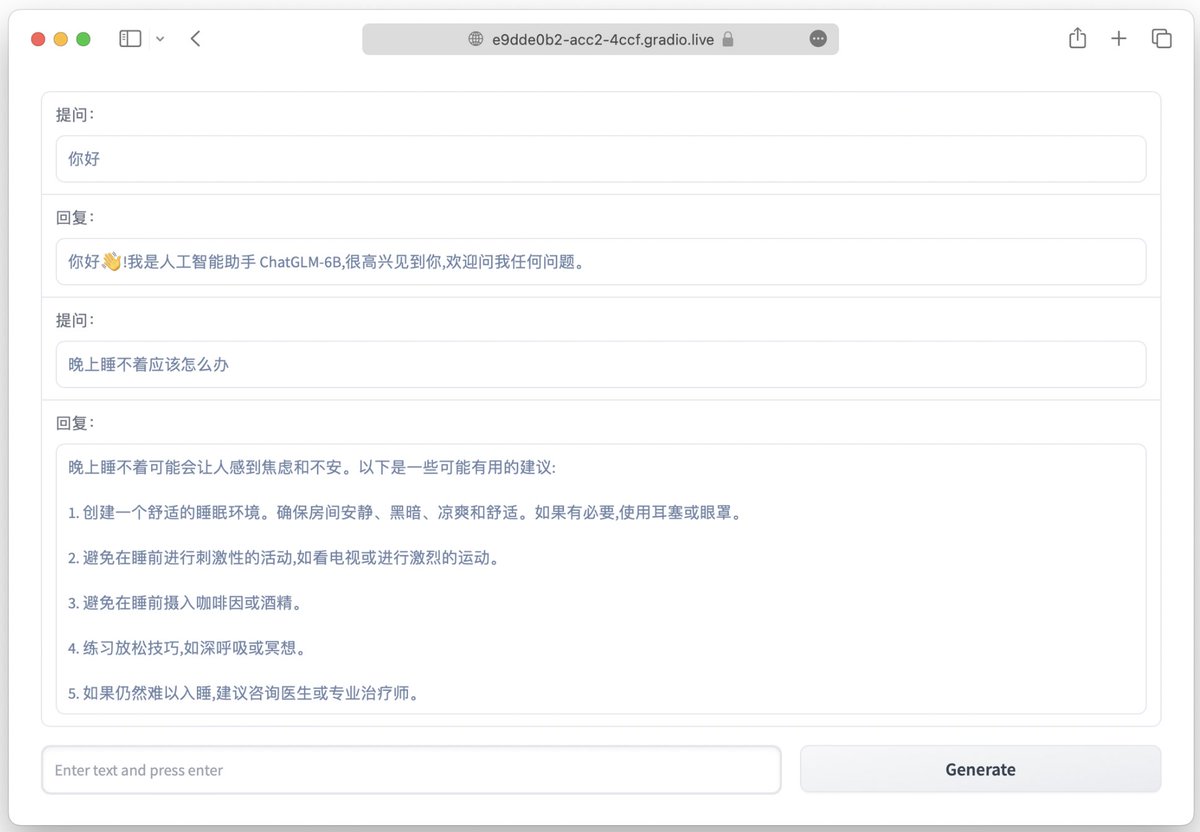
ChatGLM-6B & ChatGLM!
ChatGLM-6B is an open CN&EN model w/ 6.2B paras (optimized for Chinese QA & dialogue for now). Trained for 1T tokens, SFT, Feedback Bootstrap, & RLHF.
w INT4 quantization, we can deploy on one 2080Ti card (6GB GPU mem required).
https://t.co/QpXWvLhTdU