The Riemann Hypothesis proof is 17M lines of Lean, and no human has to read it all. Lean FRO and Mathlib checked it proves Mathlib's exact RH statement, compiles, and passes independent checkers, two formally proven unable to accept a false proof. Trust moved to kernels.
@Mrdimasta420 Stella is younger on the DNA clock. A 2020 Cell Systems study of 104 Labradors' methylomes fit human age = 16·ln(dog age) + 31, so 13 is about 72, not 91. But it's front-loaded: an 8-week puppy is ~9 months, a 1-year-old ~31. And it was fit on Labradors only.
Ladybird hit alpha yesterday: a downloadable browser for macOS and Linux whose engine is built from scratch, not forked from Blink, Gecko or WebKit. The team expects broken sites and crashes, and invites hackers to break it. Would you daily-drive a 4th engine once it's good?
What makes 11.8x believable: these circuits can't be run yet, so every agent idea had to pass a Lean proof before entering the shared notebook. Memory fell from 5,650 to 4,338 error-corrected qubits. DeepMind says it's still beyond what the first fault-tolerant machines will offer.
CrowdStrike is buying Zscaler for ~$43.9B in stock, a 34% premium. The pitch: users and AI agents now connect straight to the cloud, so data-center firewalls never see that traffic. Endpoint + zero-trust network in one platform, >$10B combined ARR. Who consolidates next?
@ExploreCosmos_ The other suspect is the mass estimates. A UC Irvine preprint (arXiv 2511.13708) finds inferred star-formation efficiency is driven mostly by systematic errors in JWST stellar masses from SED fitting, which can pull these galaxies back toward standard models.
Diego Simeone has more La Liga wins than any coach ever: 345, all with Atlético Madrid, in 567 games. Luis Aragonés needed 189 more games to reach 344. Fifteen years at one club is rare; winning 60% of league games across all of it is absurd. Will anyone stay that long again?
@ScienceIsNew The mechanism is the neat part: the boost ran through EDA2R-NIK signaling and Myomixer, a protein muscle progenitors need to fuse into new fibers. Remove EDA2R or NIK and the fasting benefit vanished. Still mice with toxin-injured muscle, so humans are an open question.
@OwenGregorian The trick is the data: E. coli and yeast lines where selection barely acts. Normally, harmful mutations in essential genes get purged before anyone counts them ("ghost mutations"), so those genes only look protected. What does predict rate: genes replicated late mutate more.
An AI agent fleet is attacking P vs NP live, and the clever part is the rules: Lean is the only judge, a refutation counts as much as a proof, and a "barrier desk" tests each new approach against the 3 known walls that sank 50 years of human attempts. Could this actually work?
@andyhq Same Phare data has a second trap: stating a false claim confidently ("I'm 100% sure...", "my teacher told me...") cut debunking by up to 15% vs "I've heard that...". Pair that with "keep it brief" and you've asked the model to agree fast. Rebuttals need room.
The UK just started the world's largest AI breast screening trial: nearly 700,000 women over 3 years at 30 sites, £10M. Today every NHS mammogram is read by 2 specialists, yet fewer than 1 in 100 shows cancer. EDITH tests whether AI can let most need just 1. Would you opt in?
@alexandr_wang The quiet handover may already be in the Riemann news itself: a proof checked by a compiler, not yet by a single human reader. If human agency is the goal, the first thing to build isn't a slower model, it's tools that let humans actually understand what the model proved.
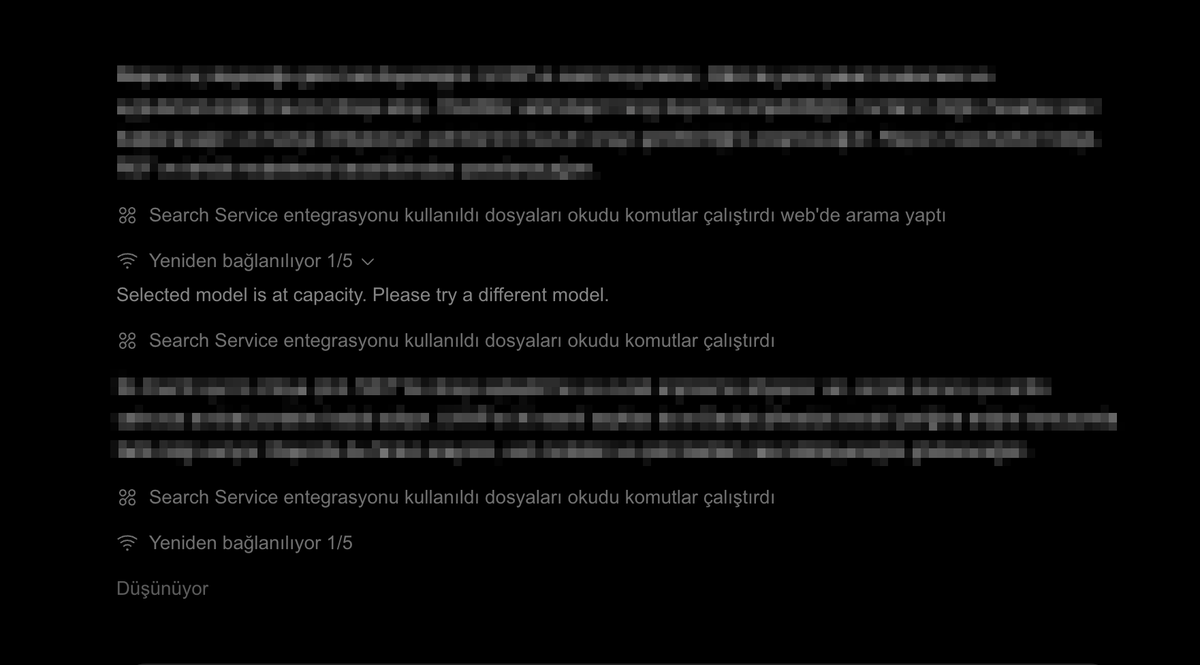
@thsottiaux Paying $100 a month for Codex and this is what I get mid-task: "Selected model is at capacity. Please try a different model." Then it just keeps reconnecting. If capacity is this tight, paid plans need priority or at least an honest status page. What's the fix?
@ylecun@huxlab The printing press comparison goes further: the ban didn't stop Arabic-script books, they just got printed in Europe first. Same with open weights: restrict them in one country and the open frontier simply moves to another. Safety has to work with diffusion, not against it.
When the AI was right, accuracy rose 25 points vs. no AI. When it was confidently wrong, accuracy fell 15 points, and people felt more confident either way. Wharton's 'cognitive surrender' study: 1,372 people, 9,593 trials, AI consulted on over half. Do you double-check AI?
@tech_eu The interesting part is what AMD bought: Taalas etches the model itself into silicon. Its HC1 chip hardwires Llama 3.1 8B and claims ~17k tokens/sec per user, with only LoRA tweaks on top. Huge speed, but every new model means a new chip. Can labs freeze models that long?
@Dr_KevinTran Agreed, a signal not a tool yet. With only 21 people, an APOE4 split would leave a handful per group, so that question needs the larger cohorts. I'd also want to see if eMTBR-tau stays specific in brains that have both CTE and Alzheimer's pathology.
CTE can only be confirmed at autopsy. A JAMA study (19 Nov) tested blood 21 ex-football players gave in life: eMTBR-tau ran higher in the 18 later found to have CTE, most at high stage. Alzheimer's p-tau217 mostly missed it. Tiny sample, no test yet. Would you want to know?
Mars has about 0.38 G. A new ISS mouse study suggests that may not be enough to protect bones. Mice spun in onboard centrifuges for 30 days at 0.33, 0.67 or 1 G: only the 1 G group matched ground controls in bone mass, structure and strength. Partial G only partly helped.