The US government, citing national security authorities, has issued an export control directive to suspend all access to Fable 5 and Mythos 5 by any foreign national, whether inside or outside the United States, including foreign national Anthropic employees.
The net effect of this order is that we must abruptly disable Fable 5 and Mythos 5 for all our customers to ensure compliance.
Access to all other Claude models is not affected.
We apologize for this disruption to our customers. We believe this is a misunderstanding and are working to restore access as soon as possible.
Read our full statement: https://t.co/bwn0sximKZ
Today I'm publishing a new essay, Policy on the AI Exponential. AI is progressing extremely fast—much faster than the policy process was built to handle. The essay lays out where I think the technology is now, and the action needed to close the gap: https://t.co/Lh6PWae178
Introducing Claude Fable 5: a Mythos-class model that we’ve made safe for general use.
Its capabilities exceed those of any model we’ve ever made generally available.
Some of the biggest companies of the next decade won't be software businesses. They'll be services companies like insurance carriers, law firms, and tax practices rebuilt from scratch with AI doing most of the work.
In this episode of Startup School, YC Visiting Partner @CharlieWarren walks through the playbook for building AI native services companies, covering how to pick a market with the right traits, why variance kills these businesses faster than anything else, and the P&L math that’ll transform your business model.
00:00 — Intro to AI Services Companies
01:01 — Picking the Right Market
02:55 — Markets YC Likes Right Now
03:43 — The Sam Altman Test
04:35 — The Right Founding Team
05:28 — Building the Product
06:19 — Variance Is the Existential Problem
07:08 — The Early Demand Trap
07:53 — How to Price AI Services
08:41 — The P&L Walkthrough
09:33 — AI Operating Leverage
10:27 — Don't Buy Your Way In
Aging is arguably the root cause of most major diseases (loss of function in our cells). Four years ago, we made a bet that aging was treatable, and NewLimit was born.
NewLimit now has a prototype drug that reverses the age of some human cells (restores function they had when they were younger), and a clinical trial scheduled for next year (with more drug candidates in the pipeline).
Grateful to Founders Fund, Thrive, Greenoaks, and the rest of the investors for this latest round. @jacobkimmel and the team are just getting started.
"You need to make yourself a big target for luck, and the way to do that is to be curious. Try lots of things, meet lots of people, read lots of books, ask lots of questions."
— Paul Graham, How to Do Great Work
https://t.co/AyIk5fnKZL
Potential stack of something like:
Hermes from @NousResearch@joinmassive from @jsongrad (web search and more 👀)
Gbrain from @garrytan (second brain)
@obsdmd (multi-purpose)
@ZeroEntropy_AI from @ghita__ha (specialized models)
Wafer from @gpuemi & @gpusteve for open source Inference?
Delegation ability to Claude Code/Codex
^ some interchangeable, some can be consolidated
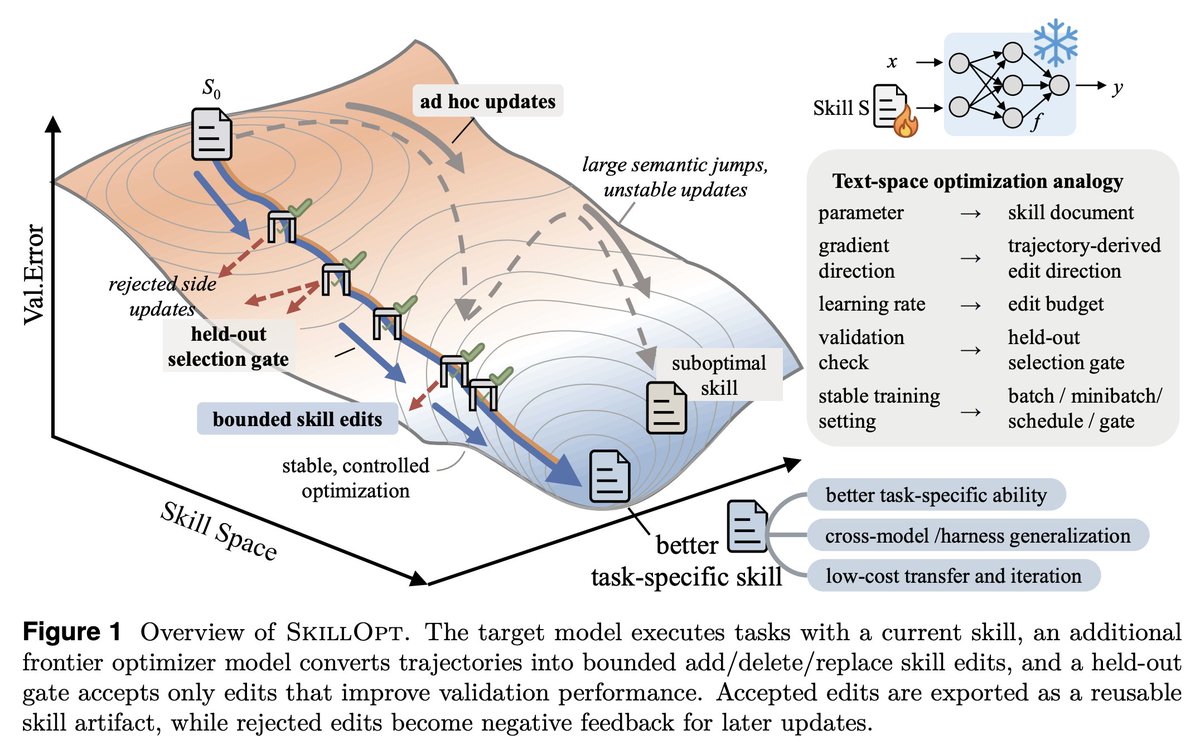
Gradient descent for SKILL.md files sounds interesting, maybe a bit complex but it's becoming a real part of agent harness.
SkillOpt is one of the first papers to treat markdown skill files as trainable parameters and provides a proper optimization framework for them.
A few things I learned that you should consider too.
1. The validation gate is the only thing that matters in a self-editing loop.
Held-out set, strict improvement, ties rejected. End-to-end, their best skills land with 1 to 4 accepted edits total. If your "self-improving agent" is accepting most of what it proposes, you're shipping slop.
2. Bounded edits are better than full rewrites. 4 to 8 edits per step is the sweet spot.
Remove the budget and performance collapses. This is the textual analog of learning rate, and it transfers to any LLM-as-author loop. If you're using an agent to refactor your docs, your prompts, or your skills, cap the diff size.
3. Compactness wins. Median final skill: ~920 tokens.
Skills do not need to be long. They need to be high-signal. Most skill files I see are bloated because length feels like effort. It isn't.
4. The harness is becoming less important; the skill is becoming more important.
A Codex-trained skill ported into Claude Code hit +59.7 points on SpreadsheetBench. Procedural knowledge is more general than the runtime that
produced it.
5. Frozen model + trained context is the practical adaptation.
GPT-5.4-nano with a SkillOpt'd skill ≈ frontier behavior on procedural benchmarks. Cheaper, portable, inspectable, zero inference-time cost. This is
the answer to "how do we adapt a frontier model for our domain" for almost everyone who isn't training their own models.
6. Verification is the bottleneck.
Every gate in this paper depends on an auto-grader. That works for benchmarks. It fails for writing, design, and strategy, exactly the open-ended work we want to automate. Whoever builds the verifier for open-ended tasks owns the next stage.
There are also two leassons I learned while shipping v2.3.0 of my Context Engineering Agent Skills repo, measured across composer-2, claude-opus-4-7,
gpt-5.5, and gemini-3.1-pro via the @cursor_ai SDK:
- Description and body are two different surfaces. The router only sees the description. The agent sees the body once activated. They can quietly disagree, and only end-to-end task tests catch it.
- Aggregate accuracy is the wrong unit. When I rewrote three descriptions, the corpus average moved ~1pp. Individual skills moved 23–25pp. Per-skill effect size is where the action is.
Also, in Feb 2026 I shared a piece called Personal Brain OS arguing that the markdown file is a first-class substrate for agent state. SkillOpt is the optimizer-shaped version of that same argument: not "store memory in files" but "treat files as trainable parameters with proper optimization machinery around them." That's the move from static to measured.
The fast/slow split they describe already lives implicitly in the digital-brain-skill repo:
- voice-guide and tone-of-voice.md are slow-state (rarely touched)
- posts.jsonl and bookmarks.jsonl are fast-state
What SkillOpt adds that I didn't have is a protected section invariant, a structural guarantee that fast edits cannot overwrite slow lessons. Removing that mechanism cost them 22 points on SpreadsheetBench. Worth borrowing.
If you're building agents, SkillOpt: Executive Strategy for Self-Evolving Agent Skills is a good paper to read: https://t.co/ZS9SZXQ6Mv
Paul Graham (@paulg) whether founders should move to Silicon Valley, and what it takes to build a startup hub anywhere else.
Live from our YC | Stockholm event on April 29, 2026.
01:01 – Why the Big Center Matters
02:45 – The Power of Serendipitous Meetings
04:36 – Investors Move Faster in the Valley
06:03 – Respect Follows the Move
07:59 – The Dropbox Story
09:10 – Measuring Yourself Against Big Fish
12:21 – Silicon Valley's Pay-It-Forward Culture
15:36 – How to Help Stockholm Thrive
17:24 – YC as the Optimal Path
19:54 – Could Stockholm Become The Silicon Valley of Europe?
@garrytan@garrytan thanks for sharing and open sourcing so much of your work! Do you have data on the cost of Gbrain? How does accuracy / relevance improvement compare to the cost? Saw you mention 10k$ / month somewhere. Thanks 🙏🏼
How to set up Claude Code so it runs like a full dev team:
5 folders. That's the entire system.
1. CLAUDE.md → Memory.
Your repo's constitution. Naming rules, structure, expectations. One global file for all projects, one local file per repo.
2. skills/ → Knowledge.
Reusable workflows Claude auto-invokes by matching the task description. No slash commands. It just knows.
3. hooks/ → Guardrails.
Shell scripts that run before and after every tool call. Block dangerous commands. Auto-lint on save. Ping Slack on deploy. Deterministic. Not AI.
4. subagents/ → Delegation.
Isolated agents with their own context window. A code reviewer that only sees the diff. A test runner with custom permissions. Keeps your main session clean.
5.plugins/ → Distribution.
Bundle the whole system into one install. Every teammate gets the same skills, same hooks, same agents. Aligned from day one.
This is the Agent Development Kit. Five layers, one stack.
To learn how and get the full Claude guide:
1. Go to https://t.co/xViEAXTX7v
2. Subscribe free by just writing your email.
3. Open my welcome email and get the free resources.
Repost ♻️ to help someone in your network.
Alephium is the only PoW chain with real DeFi.
We’ve been building + shipping features since 2021.
Soon our Core dApp, Powfi, will go on Mainnet.
When that happens, PoW DeFi will be entering a new era as an unknown quantity.
Phase 2 is just the start.
Is the world ready? 🌍
SpaceXAI will provide @AnthropicAI with access to Colossus 1, one of the world’s largest and fastest-deployed AI supercomputers, to provide additional capacity for Claude → https://t.co/nfDR9S822L
We’ve agreed to a partnership with @SpaceX that will substantially increase our compute capacity.
This, along with our other recent compute deals, means that we’ve been able to increase our usage limits for Claude Code and the Claude API.