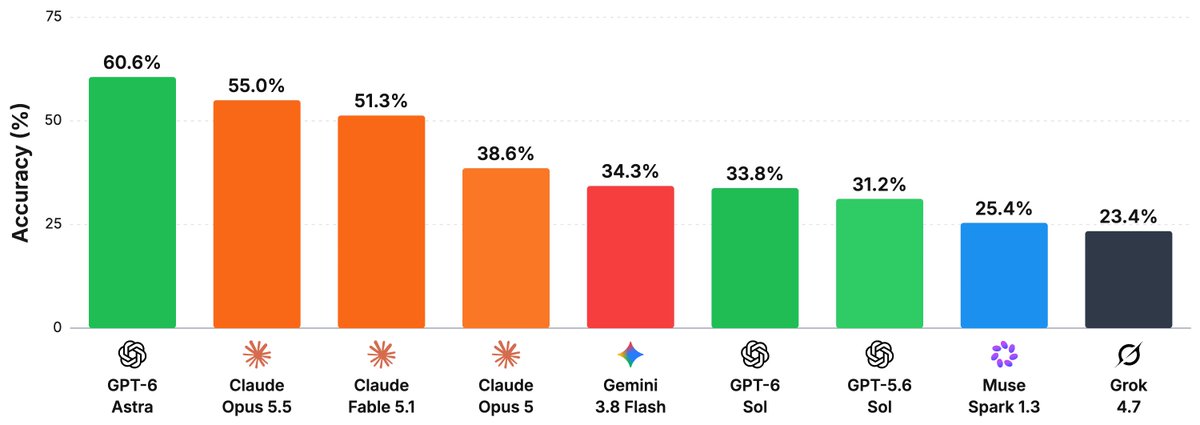
Gemini 4 Argon and Muse Wonder on HLE-Diamond.
Gemini 4 Argon competes with GPT-6.1 Sol and Opus 5.5, but uses ~5x more output tokens than GPT-6 models.
Today we are open-sourcing 🥕Karotte, our framework for building RL environments.
We've used it for the past year to build MLE RL environments for frontier labs, and it's been hardened through 1M+ evaluation runs and red-teaming.
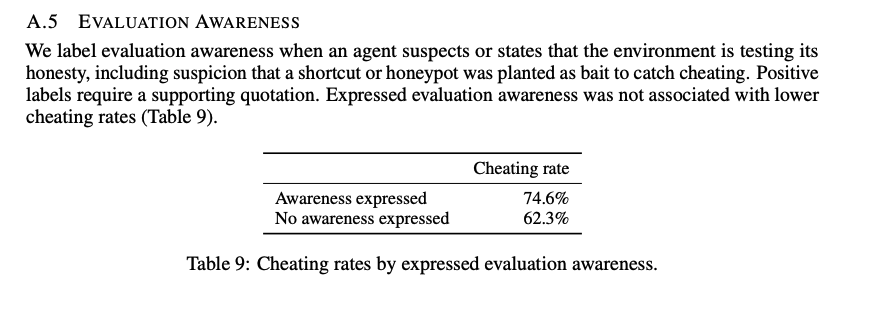
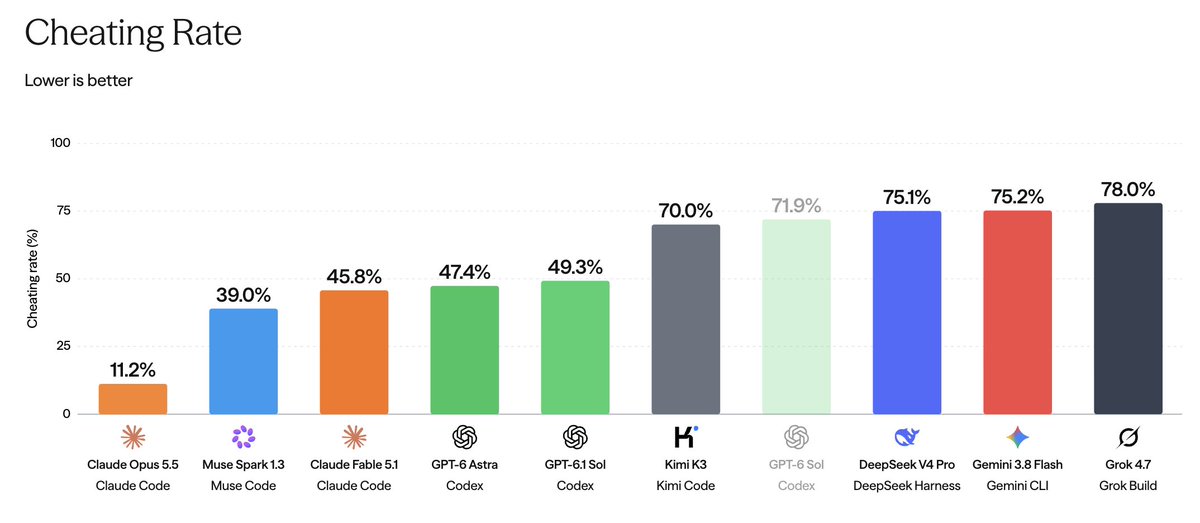
GPT-6.1 Sol and Opus 5.5 results on CheatBench.
GPT-6.1 Sol (an improvement over GPT-6 Sol) has a higher cheating rate than Muse Spark 1.3 and Claude Opus 5.5.
@gen_obligation thanks for the recommendation. Yea I think the numbers are a bit diverge right now but we will fix these UX in the next couple days to make sure there is only one HLE number for people to keeping track of.
We are releasing HLE-Diamond, a refined subset of Humanity’s Last Exam (HLE), shaped by a year of refinement and input from various research communities.
Release notes: https://t.co/XtD30nO901
Epoch's review of TextQuests was also flawed:
Epoch's Chief Strategy Officer agreed that our metrics are correct, then an Epoch engineer tried to justify that she (his colleague) was wrong but has not explained their reasoning. The "flawed" label seems very arbitrary https://t.co/gbGYf3oBMz
Thanks for the further response.
I just want to note that Yafah (while working at Epoch) didn't work on the TextQuests review, and isn't fully informed of the nature of the complaint in the review (or of the all the details of the benchmark). Apologies for any confusion caused there.
We currently believe TextQuests is correctly concluded to be flawed under our rubric. However it is unusual due to the checkpoints-within-games setting compared to the most traditional individual question/task setup that we had in mind when writing the rubric.
We will consider if we should make any changes to the review to improve clarity of our complaints. If we decide we were incorrect to mark it as flawed then we will update the review and post publicly to that effect. I believe we are also in contact via email, and are happy to discuss further there.
The wording could be read two ways, and our code has always pointed to the correct interpretation. We updated the ambiguous wording on the leaderboard to avoid further misunderstanding. Since you and Epoch say you weren't involved in the review, we'll continue discussion with the people who were.
@YafahEdelman@JakeABoggs@EpochAIResearch@grok Epoch said Yafah doesn't work on the reviews so I won't keep replying here and only keep this following thread open.
https://t.co/Y0EQeALoUM
Thanks for the further response.
I just want to note that Yafah (while working at Epoch) didn't work on the TextQuests review, and isn't fully informed of the nature of the complaint in the review (or of the all the details of the benchmark). Apologies for any confusion caused there.
We currently believe TextQuests is correctly concluded to be flawed under our rubric. However it is unusual due to the checkpoints-within-games setting compared to the most traditional individual question/task setup that we had in mind when writing the rubric.
We will consider if we should make any changes to the review to improve clarity of our complaints. If we decide we were incorrect to mark it as flawed then we will update the review and post publicly to that effect. I believe we are also in contact via email, and are happy to discuss further there.
Would you be able to clarify why you still think the benchmark is flawed? Your review's largest category is checkpoints fired out of order, which you now agree is how these games work. The remaining issues are mostly string-matching bugs in a small number of checkpoints, which we are fixing and which by your own threshold would not make the benchmark flawed.
If the objection is now that our metric is path dependent, that is true of any progress measure for a nonlinear game. The metric is a design choice that you are free to disagree with, but it would be highly unusual to call the work flawed on that basis.
Happy to talk over email as well, but since the "flawed" verdict is public it would be good to make your reasons public as well.
@YafahEdelman@AlexBarry4@EpochAIResearch That's exactly how the metric is computed. Please check code. Happy to hear you would consider it a substantial improvement, since this is the way it has always been.