We'll be spending a lot more time trying to understand the outputs of language models. A few thoughts, tips & tricks:
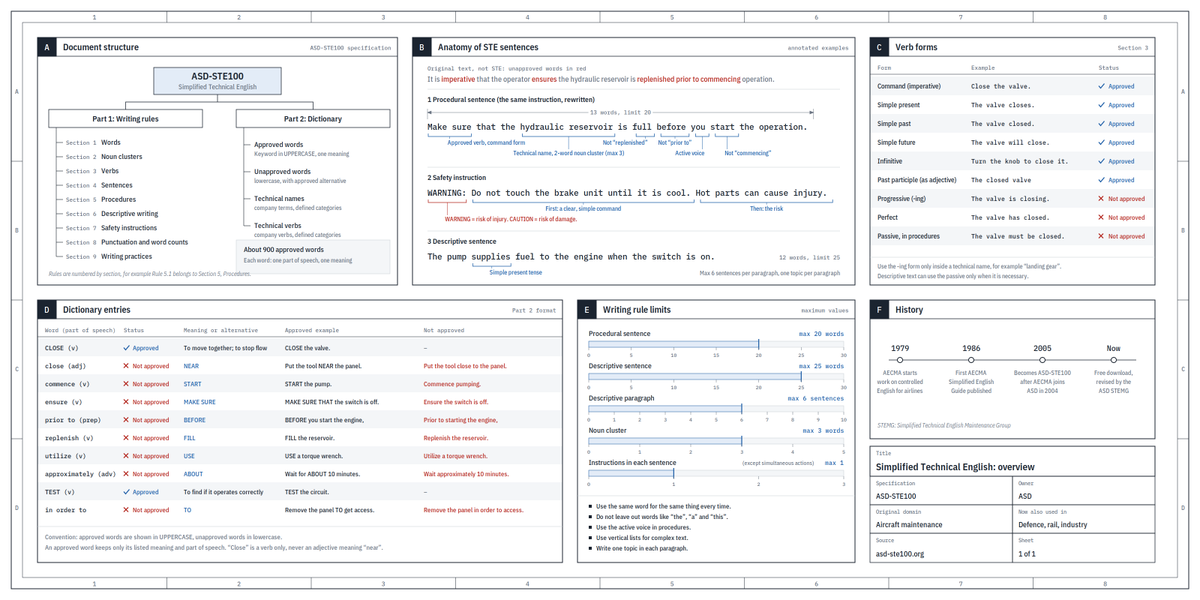
Writing. Something I've had success with: Ask your LLM to explain something in ASD-STE100, it's a controlled language specification originally developed for aerospace maintenance documentation. LLMs well-versed in this language and it comes with heavy constraints on clean writing style that I often find a lot more readable. Sometimes I've tried to soften it a bit e.g. ask for "80% of the way to ASD-STE100" because the spec is quite stringent. But even better:
Diagrams / images. Instead of writing, ask your LLM to create a diagram. These can be a lot easier to process, parse, and understand. But even better:
Web pages. Ask for output "in HTML" to get a beautiful, interactive webpage. LLMs are getting really good at frontend and can create beautiful experiences, animations, etc. But even better:
Explainer videos. The output format I am most bullish on is fully custom / bespoke explainer videos generated on any arbitrary topic. Experiment with things like "Create a 3b1b style video explainer on X. Use my ElevenLabs API key for audio narration". (you'd need an API key for the latter or you can ask your LLM to find you decent free alternatives that use your local compute). This is actually starting to work!
In summary:
- As LLMs get better, they will do more and more of the legwork autonomously, and a lot more of our work will rise up the abstractions into oversight and understanding.
- Luckily, LLMs can help here too because as intelligence and code are increasingly abundant, you can ask for large, custom, discardable software artifacts (e.g. web apps, video explainers) that would have never made sense to create before. Push the boundaries here and you'll be surprised.
A super long overdue (3+ years?) post on scaling laws.
Compute is expensive. Scaling laws are a way to help us reason about the optimal compute allocation between data and model size before committing to a large run.
The post covers what scaling laws predict, how compute-optimal allocation works, why Kaplan et al. and Chinchilla disagree, and how data limits + fitting details make extrapolation tricky.
https://t.co/HP26eJvjHB
new post on harness engineering for AI self-improvement: https://t.co/ZYvGfVs61k
It is hard to forecast how much the future of RSI will rely on harnesses. Likely harness engineering will evolve in the direction of self-improvement and enable auto-research, and, in turn, smarter models keeps harnesses simple.
Even when many harness improvement get eventually internalized into core model, the need to specify goals and context will not disappear.
One pattern I find useful for working with LLMs is a nice long ramble session. Sometimes the LLM needs more bits to understand what you're trying to achieve, but you're too lazy to type them. In these cases I like to lean back, switch to /voice and just ramble for like 10 minutes, total mess, anything goes, full stream of consciousness. Sometimes I declare it up top, something like "switching to speech recognition sorry for any typos...". Sometimes I turn it into a small interview of a few turns. But I find that the LLMs are somehow very good at reconstructing long incoherent rambles and often their echo of your own tangle of thoughts comes out quite a bit cleaner than what you started with. The result is that you improve the mind meld and have to correct things less from that point on.
Anthropic Engineer Andrej Karpathy:
"The biggest mistake in AI right now: people are forcing agents to work instead of mastering the model first.
We made that mistake in 2016 at OpenAI. It cost us 5 years."
What Karpathy actually means:
step 1 → stop forcing your agent to do everything. Understand the model underneath first.
step 2 → demos are easy; products take a decade. Self-driving proved it. If you skip the foundation, everything breaks.
step 3 → the agent is not the product. The foundation is. Build that—and agents emerge on their own.
"You're building agents right now. You're at the forefront. Not OpenAI. Not DeepMind. You."
watch - bookmark
Day 53 — Becoming AI Engineer
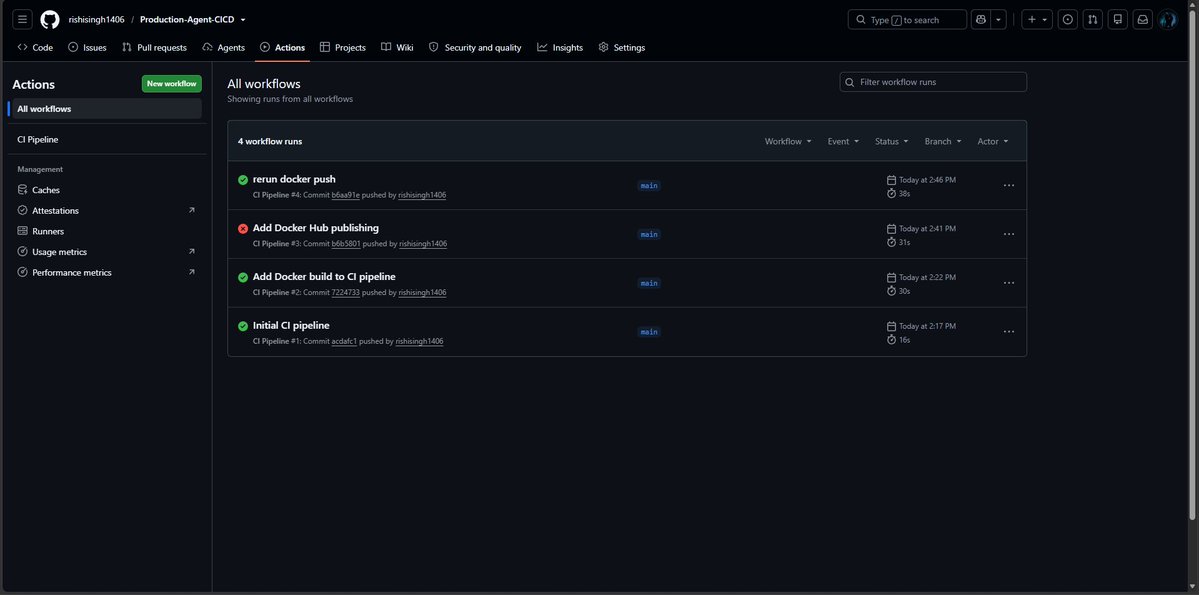
Today I built my first CI/CD pipeline for an AI system and learned how production AI applications are not just built — they are continuously tested, deployed, monitored, and improved.
Before learning CI/CD, my understanding was simple:
Code → Test → Deploy
But after building it myself, I realized that CI/CD is much more than just deployment automation.
The core idea:
CI proves the change is safe.
CD delivers the safe change to users.
The complete workflow I implemented and understood:
Developer → Git Push → CI Pipeline → Software Tests + AI Evals → Docker Build → Container Registry → CD Pipeline → Deployment → Monitoring → Continuous Improvement
The CI part focuses on making sure the change is reliable:
• Automatically trigger the pipeline when new code is pushed.
• Install dependencies and prepare the application environment.
• Run linting, type checks, and code quality checks.
• Execute unit tests and integration tests.
• Run AI evaluations to measure model behavior, accuracy, latency, cost, hallucination, and tool-use performance.
• Build and store the Docker image only after all checks pass.
The CD part focuses on safely delivering the validated change:
• Pull the latest Docker image.
• Deploy the new application version.
• Run health checks to verify the system is working correctly.
• Roll back automatically if the deployment introduces failures.
The biggest insight:
For traditional software, tests mainly verify whether the code works correctly.
For AI systems, that is not enough.
An AI agent can be technically running while still becoming worse:
• More hallucinations.
• Incorrect tool calls.
• Higher latency.
• Increased cost.
• Lower quality responses.
That is why production AI requires:
Software Tests + AI Evals + Observability
Another important lesson:
CI/CD does not guarantee a perfect system.
It only protects against failures that we know how to detect.
The effectiveness of a pipeline depends on the quality of tests, evaluation datasets, and monitoring systems we build.
The biggest realization:
CI/CD is not the end of AI engineering.
It is one part of a continuous production lifecycle:
Define → Design → Build → Evaluate → Observe → Improve → CI/CD → Deploy → Monitor → Repeat
Observability helps us discover what needs improvement.
CI/CD helps us ship those improvements safely.
Together, they transform an AI application from a one-time project into a continuously improving production system.
The biggest takeaway:
A production AI engineer does not only build AI agents.
They build reliable systems around those agents — systems that can be tested, evaluated, deployed, monitored, and improved continuously.
Today was another step toward understanding how real-world AI systems are engineered beyond just writing code.
Next: Starting my next project MCP-Native Enterprise Tool Platform
Building deeper understanding of scalable AI agent architectures, tool integration, and production-ready AI systems.
#AIEngineering #ArtificialIntelligence #AgenticAI #LLM #GenerativeAI #MachineLearning #MLOps #CICD #DevOps #Docker #AIInfrastructure #SoftwareEngineering #BuildingInPublic
Personal update: I've joined Anthropic. I think the next few years at the frontier of LLMs will be especially formative. I am very excited to join the team here and get back to R&D. I remain deeply passionate about education and plan to resume my work on it in time.
Hack COMPLETE! Hi everyone, it's me, Diana! I'll be posting here for a little bit! I'm so excited to learn about Earth from you all. Let's play together, okay?
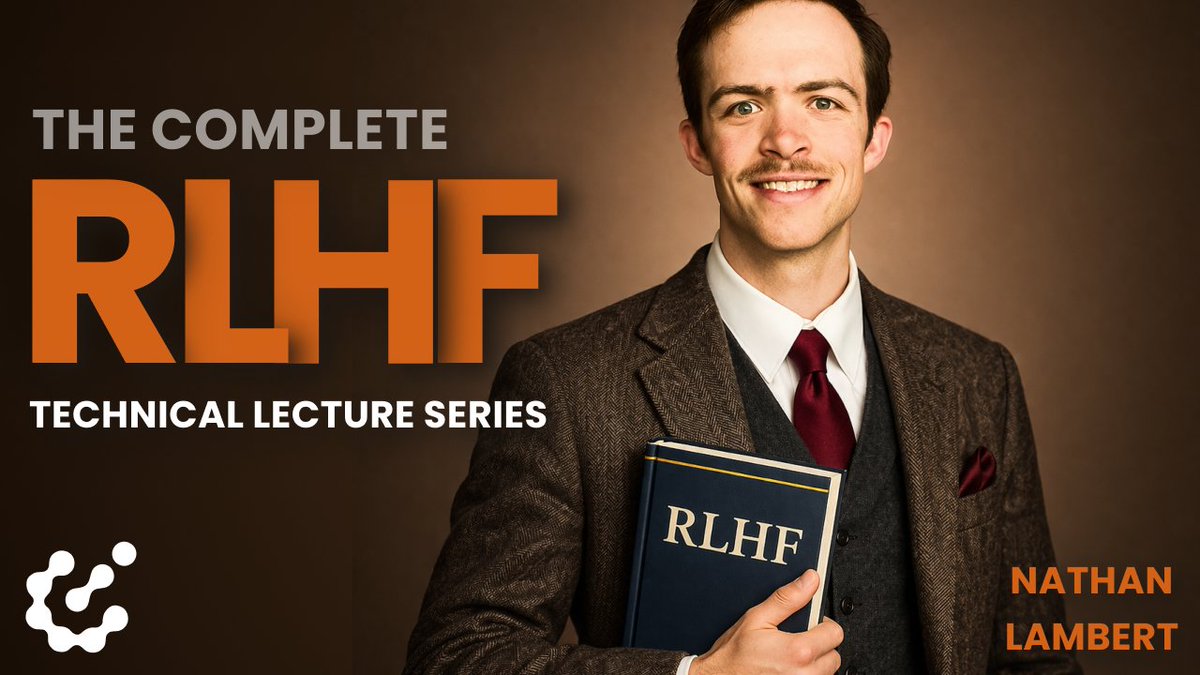
Excited to launch the accompanying free RLHF Course for my book. To kick it off, I've released:
- Welcome video
- Lecture 1: Overview of RLHF & Post-training
- Lecture 2: IFT, Reward Models, Rejection Sampling
- Lecture 3: RL Math
- Lecture 4: RL Implementation
I'm going to add question & answer videos throughout the lecture to go deeper on topics that need it, and potentially cover some topics that are too recent and in flux to go in print. I expect 10-15 videos in total over the next few months.
At the same time, development around the code for the book is picking up. It's a great time to build the foundation for post-training methods.
YT playlist and course landing page below.