In the 8 minutes before XPL dropped 18% today, 11 Hyperliquid accounts pulled $1.62M of margin out of their XPL longs.
Then they let the $12M position get liquidated into HLP at mark price.
HLP ate ~$0.6M.
Fresh accounts funded via CCTP. Test withdrawals 20-50 min before. 7 rejected withdrawals while scraping the margin to the limit. $0 left after.
Looks planned. Whether the same operator was short on Binance, I can't see.
Timeline (Nov 1, UTC) 👇
Oct 29-31
9 of the 10 largest accounts are created, each funded once via CCTP with $145k-$243k. On Hyperliquid the sender only shows as Circle's deposit wallet.
03:45-04:15
10 of the 11 make test withdrawals of $500-$1.6k.
04:24-04:32
10 accounts withdraw $98k-$232k each, $1.62M total.
7 more attempts get rejected: "Insufficient balance for withdrawal".
Every dollar the margin check allows comes out. The longs stay open.
04:32
XPL -18% in 1 minute, 0.086 to 0.0705.
$11.2M (144M XPL) trades on Binance perps in that minute.
Hyperliquid itself barely trades.
04:32:50-04:32:59
All 11 get liquidated into the HLP backstop vault, plus 19 small accounts.
160M XPL / $12.2M taken over at avg 0.0759, in a minute that printed a 0.0705 low.
After
All 11 accounts: $0.
Backstop vault: $1.00M to $0.44M while unwinding.
HLP daily PnL: +$21k to -$655k (~0.4% of the vault).
Why it works
Dumping $12M of XPL into the HL book would wreck your own exit.
Drain the margin first, and a small move is enough to trigger liquidation.
Liquidation hands the whole position to HLP at mark with zero slippage. HLP eats the drop after.
Same playbook as the Mar 2025 ETH whale that cost HLP $4M.
If they were also short on Binance, the crash itself was the profit.
Addresses + fills in the reply.
$HYPE $XPL
hace tiempo que quería aprender sobre hardware, así que empecé a hablar con Claude sobre qué proyecto podía hacer.
llegamos a uno que me gustó:
medir la humedad de la tierra de mi planta para saber cuándo regarla.
lo primero que hizo fue armar una lista de los componentes que necesitaba: (1) una ESP32 (una pequeña placa programable con wifi), (2) un sensor de humedad y (3) cables. los busqué en Mercado Libre y los compré.
cuando llegaron, empecé a entender qué es cada pin, para qué sirve GND, cómo se alimenta el circuito y cómo va la información del sensor a la placa. le iba pasando fotos de las conexiones y preguntando por qué cada cable iba ahí.
hoy funciona así:
1) el sensor está en la tierra y genera una señal eléctrica que cambia según la humedad.
2) la ESP32 recibe esa señal y la convierte en un número.
3) cada 15 minutos, la placa envía esa lectura por wifi a mi backend en Vercel (POST http).
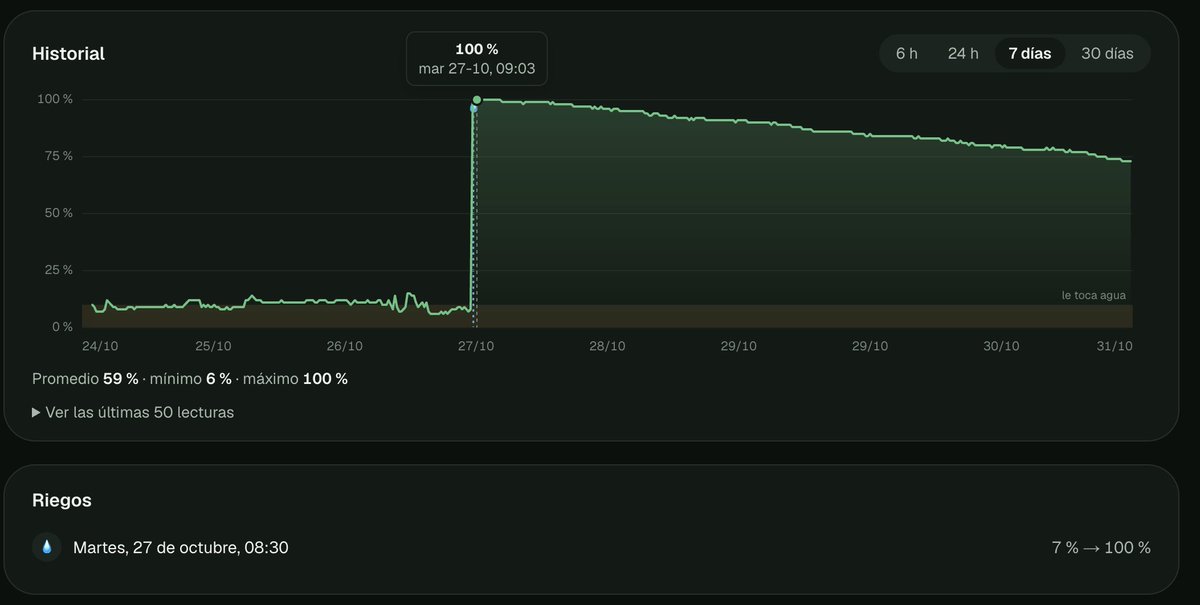
4) el backend guarda el dato en Supabase y una web muestra cómo cambia la humedad en un gráfico.
para que eso funcione, armé con Claude Code el programa (C++) que corre en la ESP32. usé arduino-cli para compilarlo y cargarlo en la placa desde la terminal.
lo mejor fue regarla y ver cómo subía la humedad en el gráfico de la web. ahí pude comprobar que todo el recorrido estaba funcionando.
todavía me falta calibrar bien cuándo necesita agua, pero ya está midiendo la humedad bien.
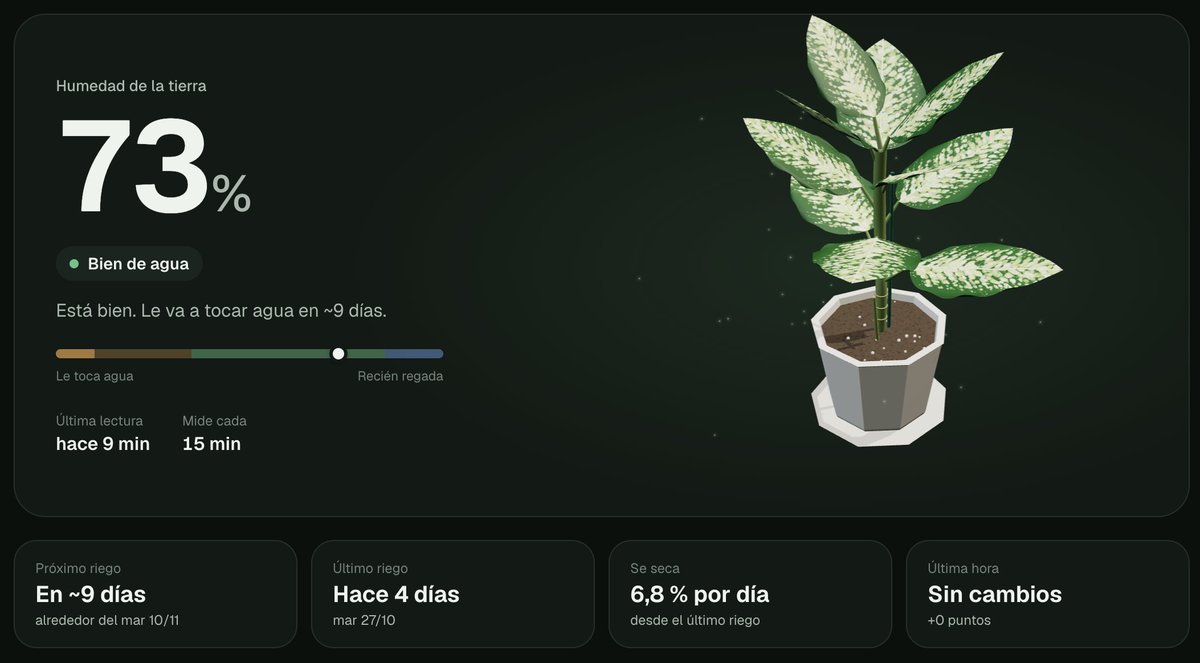
pueden ver las lecturas, el gráfico y una pequeña guía del proyecto acá:
https://t.co/EEMh5VwM4p
se me ocurren mil proyectos más, pero para arrancar me estoy divirtiendo muchísimo.
es increíble todo lo que podes hacer hoy con IA!
Growing up in the United States, NYSE was synonymous with the story of American capitalism. I vividly remember learning about the Buttonwood agreement in 9th grade history class. 24 stockbrokers met under a tree on Wall Street and formed the beginning of what would become the world's financial center. From pits to computers to now onchain markets, America has always led the way in innovating markets to improve price discovery and capital formation. Today the next chapter begins with ICE, trade[XYZ], and Hyperliquid.
ICE started as an electricity-trading platform in 2000, growing to acquire NYSE itself in only 13 years. It is a key infrastructure provider of America’s energy, bond, and mortgage markets. ICE is a rare story of exponential growth of a financial giant over decades, continually embracing innovation and technology.
trade[XYZ] was the first HIP-3 deployer and responsible for spearheading the flourishing global RWA perpetual market today. Only a year ago, trade[XYZ] launched its first RWA perpetual markets. They took a bet on HIP-3, which had just launched after months of tireless development. Having followed their journey from day 1, I cannot overstate how much Shoku and the team have poured into growing these markets to a genuine source of price discovery for the most important assets in the world.
Over the past three years, Hyperliquid has pioneered onchain infrastructure to house all of finance. Hyperliquid is nothing without its world-class builders. I am honored that trade[XYZ] and ICE have chosen to build on Hyperliquid to bring perpetual contracts to America.
When I first spoke to Jeff Sprecher around a year ago, he asked what success looks like to me. I thought for some time and joked that it would be seeing ICE building on Hyperliquid's technology. I could never have predicted the progress that we've made as a community in a single year to make this come true. Excited to see what we can build together next.
Excited to work with Payward to forge a path for onchain derivatives built on Hyperliquid's infrastructure. Kraken is one of the most trusted and respected exchanges in crypto. They are also true believers in the technology and crypto ethos. We're honored that they are building on Hyperliquid to bring the next evolution of perpetual markets to the United States.