From the latest issue: Li, @RosovskyRachel, & colleagues examine management of saddle PE with acute cor pulmonale, reporting favorable outcomes with CDT and highlighting the growing role of mechanical thrombectomy in this high-risk population.
https://t.co/IH2yzx9Wrq
Hoy publicamos esta revisión sobre la insuficiencia cardíaca y embolia pulmonar: como pueden ser tanto causa como consecuencia.
La tenéis disponible gratis en este enlace: https://t.co/b7izQmn8Ns
De qué sirve recetar la mejor dieta si el paciente no la cumple? Recientemente publicamos en @ejin_journal nuevos datos del estudio CORDIOPREV (@IMIBIC). Spoiler: Una alta adherencia redujo la recurrencia de infartos o la muerte cardiovascular hasta un 30-35% a 7 años. 🧵👇
The development of PTS symptoms, signs, or venous ulcer depend on different risk factors.
The development of PTS symptoms, signs, or venous ulcer depend on different risk factors.
The #RIETEregistry experience appearing soon in J Vasc Endovasc Surg
Congratulations, Pedro!
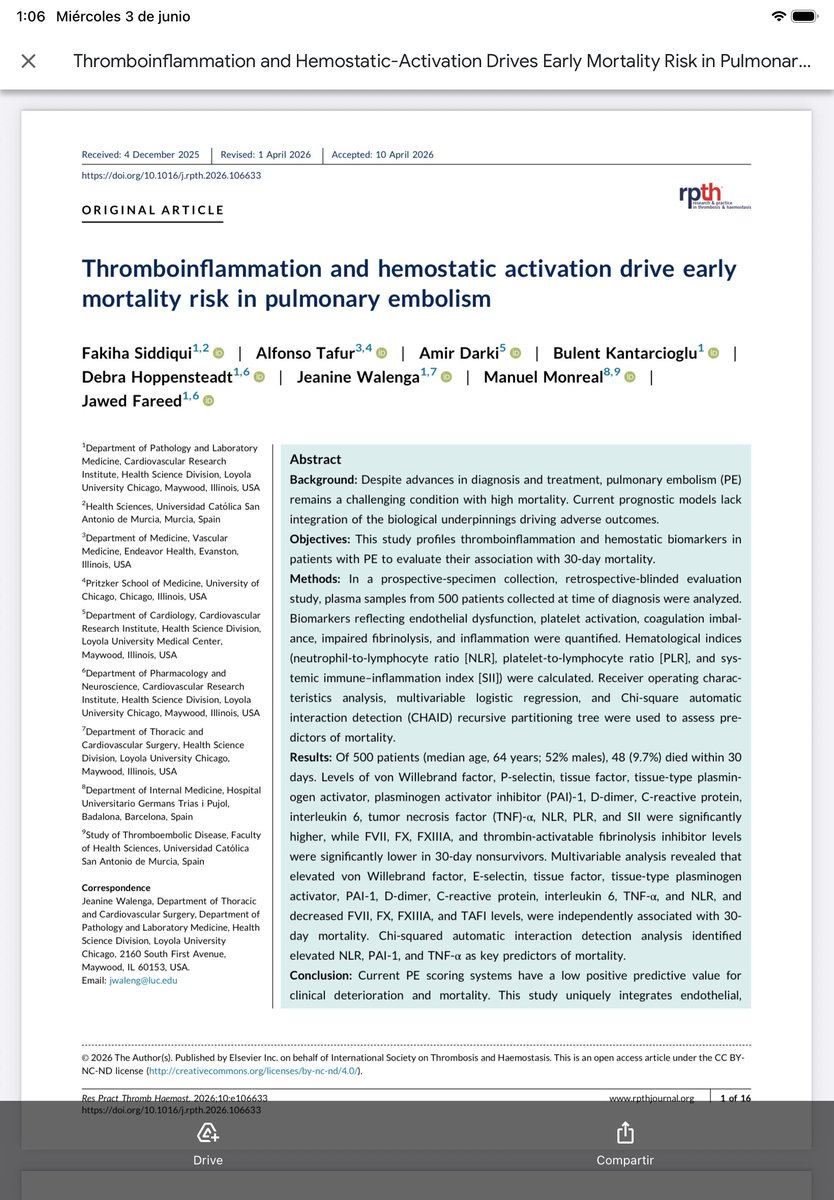
Thromboinflammation in acute pulmonary embolism
The association of several biomarkers reflecting endothelial dysfunction, platelet activation, coagulation imbalance, impaired fibrinolysis, and inflammation with 30-day mortality
📄 SEMI publica la actualización del documento "Estándares de los Servicios de Medicina Interna", una herramienta clave para orientar la organización, actividad y calidad asistencial de los Servicios de Medicina Interna.
La nueva versión incorpora nuevas funciones, una actualización de actividades según el tipo de hospital y una revisión de las recomendaciones para adaptarse a los retos actuales de la especialidad.
💡 Ahora queremos contar con tu participación.
Los socios de SEMI pueden enviar sugerencias y propuestas de mejora hasta el 1 de octubre a través del formulario habilitado.
🔗 https://t.co/plNN2eeABY
#SEMI #MedicinaInterna #CalidadAsistencial #GestiónSanitaria #ProfesionalesSanitarios
A new #RIETEregistry study:
Development and external validation of the RIETE score to identify VTE patients with hidden cancer
Congratulations, Luis and team!
#Hantavirus The @WHO update timeline on the MV Hondius #HantavirusAndes cluster: 8 cases total, 6 confirmed Andes virus, 2 probable, and 3 deaths. The vessel will arrive in Tenerife, Canary Islands, Spain, in the early morning of 10 May.
🟥 Case 1 – index, probable, fatal
A Dutch adult man with prior travel in Argentina/Chile/Uruguay boarded on 1 Apr, became ill on 6 Apr, and died on board on 11 Apr. No lab tests were done; the WHO considers the infection most likely acquired in Argentina before embarkation. According to the press, he was a famous Dutch #ornithologist (bird scientist).
🟥 Case 2 – confirmed, fatal
A Dutch adult woman and close contact (wife) of Case 1 disembarked at Saint Helena on 24 Apr with GI symptoms, deteriorated during transfer, and died in Johannesburg on 26 Apr. PCR confirmed Andes virus on 4 May.
🟪 Case 3 – confirmed, ICU
A British adult man with symptom onset on 24 Apr was medically evacuated from Ascension to the ICU in Johannesburg on 27 Apr. He was PCR-positive on 2 May and sequenced as Andes virus; remains in intensive care.
🟥 Case 4 – confirmed, fatal
A German adult woman with onset on 28 Apr (fever, malaise, then pneumonia) died on 2 May. Post-mortem testing confirmed the Andes virus.
🟩 Case 5 – confirmed, ship doctor
Adult male ship doctor; onset on 30 Apr with fever, fatigue, myalgia, and mild respiratory symptoms. PCR-positive for Andes virus on 6 May; medically evacuated to the Netherlands and stable in isolation.
🟩 Case 6 – confirmed, trip guide
A British adult male expedition guide; onset on 27 Apr with mild respiratory and GI symptoms. PCR-positive for Andes virus on 6 May; medically evacuated to the Netherlands and stable in isolation.
🟩 Case 7 – confirmed, ICU
A Swiss adult male passenger who disembarked at Saint Helena and returned to Switzerland via South Africa and Qatar on 27–28 Apr. Symptoms began on 1 May; PCR-positive for Andes virus on 5 May; hospitalized in isolation in Zurich. (This case was originally case 8 in the previous WHO DON.)
🟧 Case 8 – probable, hospitalized
A British(?) adult male who disembarked at Tristan da Cunha on 14 Apr. Developed diarrhea on 28 Apr and fever two days later; currently stable in isolation and classified by WHO as a probable case.
⚠️ WHO also notes that one previously suspected patient transferred to Germany (originally Case 7) tested negative by PCR and serology, so that person is no longer counted as a case. (but still monitored until the end of incubation)
⚠️ Contact tracing of passengers who disembarked in St. Helena is ongoing; Cases #2, #7, and #8(?) might have had close contacts on the flight due to commercial flight travel in the potential infectious period, but the WHO addresses that contacts were notified and managed by each country's authority and the WHO.
⚠️ WHO currently assesses the public health risk related to the cruise ship as moderate and, at the global level, as low. The main reason for low public risk is that the Andes virus has demonstrated limited human-to-human transmission in previous outbreaks, typically occurring among close contacts and within household settings, generally requiring prolonged close exposure.
⚠️ Investigations on the travel history and potential exposures of the first case in the Southern Cone subregion of the Americas are ongoing and suggest possible exposure to rodents during bird-watching activities. (The index case was an ornithologist, a bird scientist.) Viral sequencing analyses are also ongoing and will compare the ANDV strain associated with this outbreak with strains circulating in Argentina, Chile, and Uruguay, where the disease is enzootic.
⚠️ Full Genome Sequenced by Swiss Experts and Virus Linked to South American Rodent Reservoir: suggesting a spillover event, likely transmission from the known reservoir system in Argentina and Chile.
🔗 https://t.co/qgjjZXtgl1
With already available foundational therapies in HF💊, we now need trials showing how to deliver them to patients. Reflections on LAQUA-HF and implementation trials in HF @RosselloXavier
Our editorial in @Heart_BMJ 📖
https://t.co/2VmNe4rIdU