BofA: Tech saw its 2nd biggest inflow week of all time (26th biggest/97th percentile week when normalized by S&P 500 Tech mkt. cap).
Consumer sectors continue to see inflows (6th/3rd straight week for Discretionary/Staples).
In that regard, they see support and resistance levels keeping the SPX in its trading range:
"For now, we are not directionally biased either way and will rely on our PV bands as the guide for the week. Currently, our upper band is showing resistance at the 7550 strike, while support has shifted higher to 7300.
"Again, these levels should be very familiar by now, as they remain broadly within the same strike range SPX has been stuck in since the end of April."
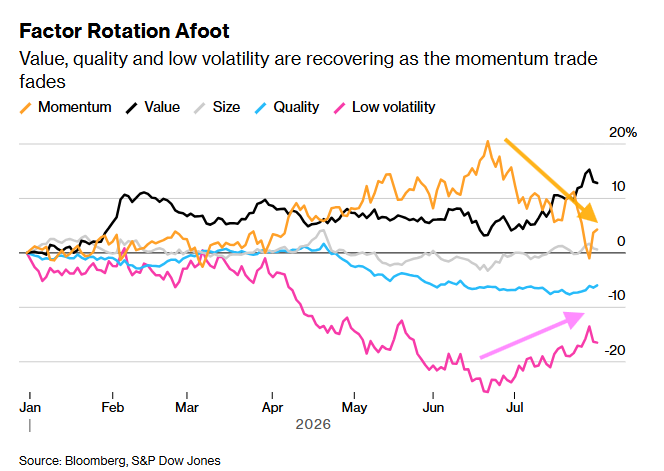
BBG: While momentum had its biggest four-day plunge since 2020 (to be followed by its largest one-day gain since then Thursday), the rotation out of momentum has been going on since June 22nd when it went from an over 20% YTD gain to a slight loss on Wednesday.
During that time low volatility has gone from a -25.6% YTD loss to -13.5% before falling back Thursday and Friday.
“Recent momentum weakness looks more like a rotation than a crash or even a correction,” said Wai Lee, head of systematic equity research at Allspring Global Investments. “Now the market is rewarding those stocks which are showing better return on the investments, free cash flows and the like.”
Momentum exposure remains high among fundamental long-short funds at the 89th percentile of the past five years, but among systematic funds it dropped to the 34th percentile.
“A sharp reversal after such gains is common, and often it’s not about any single catalyst as it is fear-of-missing-out giving way to vertigo,” said Lewis Grant, senior portfolio manager at Federated Hermes. “Given the sharp drawdown in high momentum names and the valuation of many AI-winners now less stretched, I expect the worst of the rotation is behind us.”
In contrast, JPMorgan strategists reckon the rotation has further to run. In a note recommending the quality factor, the quant team led by Khuram Chaudhry cited worsening sentiment and peaking money supply growth. While momentum reversals have been frequent over the past year, “this month felt different,” they wrote Friday.
https://t.co/EumNEu3ppK