Ok, here is my take on the current situation of the peer reviewing system…
We need to accept that with the peer reviewing system does not work anymore because the ratio of qualified reviewers is simply too low.
This is not a problem of LLMs and will not be solved by LLMs. This kill switch was always there, LLMs just activated it. Let me elaborate…
As a thought experiment, imagine we would have gotten 50k submissions in 2018 bc random people who don’t know nothing about ML would have started to learn a bit of Latex and send papers with random math equations and tables to @NeurIPSConf for whatever reason. It would have been the same story. We would have ended up with a huge pool of unqualified reviewers meeting a few qualified ones. So the unqualified would end up with BS papers, but would not care or understand and randomly accept/reject them . So, just based on numbers the amount of BS papers accepted would beat any serious paper.
Fact is, this is exactly what is happening now. The only thing that saved us so far was that most people who submitted were acting responsibly and with an interest to keep the system alive and at a high standard. If this group is outnumbered, that’s technically it … at any point in time … (bonus points if you run a simulation on this)
And this is also why LLMs are not the solution. If they are used by experts, they can help. But if the majority of authors/reviewers don’t even speak English at a decent level, does not have even basic ML knowledge, or simply don’t care at all, it’s not going to change anything. This was always true, and just has happened now.
@iclr_conf@CVPR@CVPRConf@MattNiessner@CSProfKGD
Academia has a problem:
Every author wants to use LLMs to write papers, but no reviewer wants to read AI (assisted) content.
And every reviewer wants to use LLMs for reviews, but no author wants their paper judged by an AI.
Authors & reviewers are the same people though...
Single biggest problem with LLM reviewers right now: extreme pedantry about significance and statistics. You could do an experiment where you jumped off a 100 story building and died, and they would complain about it being n = 1 and ask for more trials + paired tests
It's still crazy to me how "paste without formatting" is not the default.
Surely I really mean to paste colorful multi-font abomination of a text into email body! Of course, who wouldn't want that!
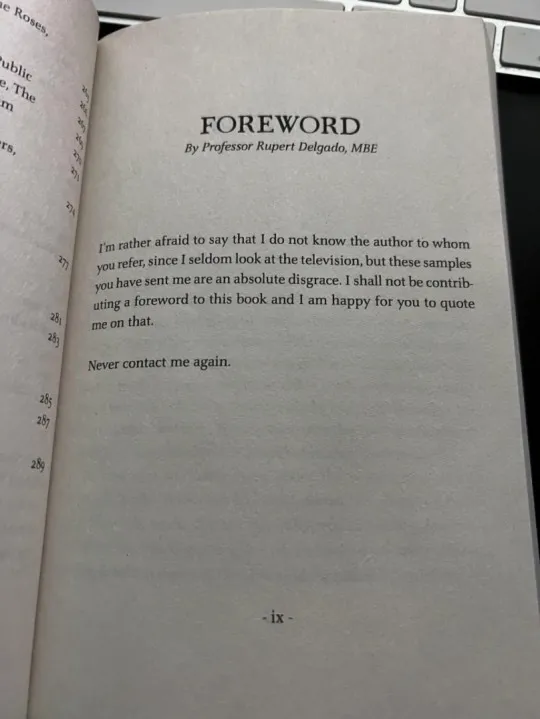
Just got an email from a prospective PhD student containing the below. My response: I’m glad you enjoyed my work on [one short, genuine line]. It’s some of my best. As for supervising you, I think [polite refusal with an excuse - don’t mention the applicant’s AI use].
my question is, if you think I'm dumb enough to not realize your personalized email was tailored by ChatGPT, do you really want me to be your PhD advisor?
+ "you know what i'd really like?"
- "tell me"
+ "a website"
- "...we can do a website"
+ "a real website, not some claude generated neon slop, a real website"
- "i'll make you a very good traditional handmade website, one that is built with dozens of snippets from stackoverflow"
At this point, ICLR and OpenReview feel more like data collection and labeling platforms. I did 3 HITs, 2 labeled as slop and 1 full review. AISTATS pile is looking much better. Less popular venues are still spared from the DDoS.
Anyways, lots of cool benchmarks/datasets to come out once the ICLR data is public.
OpenReview and arXiv can use ICLR data to train a model to classify slop vs. no-slop and use it to desk-reject.
when the cybersecurity team finds out there are actual vulnerabilities and they have to do their jobs instead of trying to trick someone into clicking a phishing email
Craziest arXiv paper this month:
"The author has not independently checked the analyses and does not have the expertise to verify every technical detail"
https://t.co/5fyjjUMQ1Z
Meanwhile, arXiv blocked 島袋隼士's paper @bukuro8810
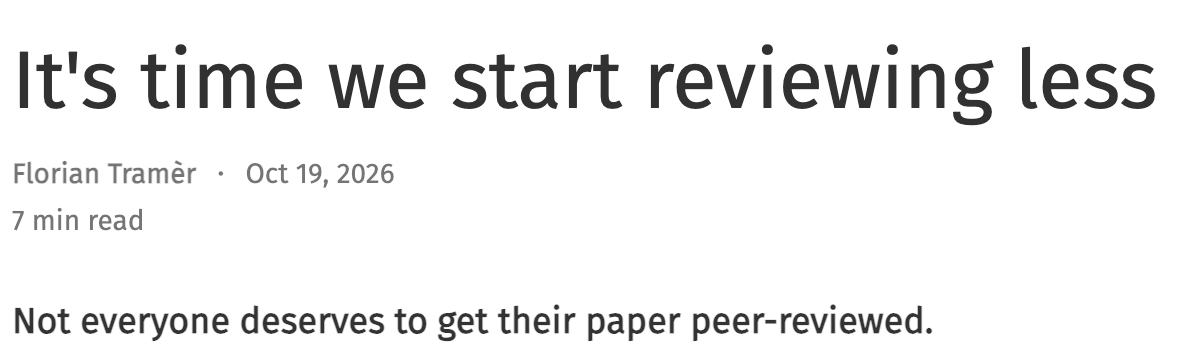
Some thoughts on reviewing: https://t.co/cSo5bLgtzr
First for @satml_conf where we trialed an early reject phase which cut submissions by ~40%.
Then more generally about how not everything deserves peer-review, and why we should reward writing things that people actually read.
SQL Injection was publicly documented 28 years ago. Parameterized prepared statements take zero extra lines of code in every language on Earth.
And yet right now, at this exact second, somebody is concatenating raw user input straight into a SELECT * FROM users WHERE string in production.
Try opening a Microsoft Word document from 1992, a Flash project from 2006, or a proprietary database dump from 2010. Half of it is unreadable binary rot.
Now open a .c source file or a plain .txt file written on a UNIX PDP-11 in 1973. It opens in 0.001 seconds on every computer on Earth.
Plain text is the only truly immortal data format humanity has ever invented.
New in Science: we randomized phone-free classrooms for 16,000+ students across 10 institutions in Odisha, India. Students deposited phones in a box at the start of each class, for a full semester.