I dont usually do these types of deeper dives but I think there is some serious alpha here so I'm trying to share it.
$NUAI might be one of the more interesting behind-the-meter (BTM) AI/HPC data center names I've added recently.
The story is messy. That's exactly what caught my attention.
I suspect many investors looked at the legacy business, couldn't quickly work out what the company was becoming and simply moved on. I nearly did (especially using Claude / ChatGPT which need some poking to get past below surface).
Since then, a lot has changed. The CEO stepped down and Charlie Nelson (previously COO) was appointed CEO. José Rodriguez, who previously led DC engineering and ops at $MSFT and ByteDance, is now COO. The wider leadership team has also been materially strengthened.
The core asset is TCDC, a planned BTM AI/HPC campus in Texas.
There is a non-binding JV LOI with Stream Data Centers and a separate LOI with a hyperscaler referenced in the Macquarie financing docs. The lease is not yet signed. That is the next major catalyst.
Macquarie has already funded $20M and provided a facility with up to another $270M available subject to conditions. It also purchased $5M of $NUAI common stock at $5/share, a 20% premium to the 5-day VWAP, and received warrants to purchase up to another $5M of stock at the same 20% premium, subject to a $4.30 floor.
Stream's involvement also gives me additional confidence. These are sophisticated infrastructure players who have likely done significant diligence on the mgmt. team, assets and regulatory path, reducing execution risk vs. many early stage neoclouds.
The near term outcome is pretty binary. A Hyperscaler lease signed and this becomes materially derisked. No lease and the equity likely gets punished.
If mgmt. executes, a bundled Phase 1 deal with Phase 2 optionality this could provide a real credible path to $20-30/share, which is roughly 5-6x from here. That's the upside investors are being compensated for underwriting against the near term binary risk.
I own roughly 50k shares. I sized it for the current risk and will likely add once the lease is signed and the next stage has been materially derisked.
A few $IREN OGs I respect have also rotated into $NUAI. That isnt the thesis. But I dont ignore smart people independently arriving at the same conclusion.
CC: @PDPhilaPhil for keeping me honest here. 🫡
Another wonderful summary by @awilkinson.
Since I last spoke to him about $NUAI a few months ago, the most meaningful change has been the introduction of Stream, an Apollo portfolio company, that has since replaced PDI as the go-forward strategic partner for TCDC.
Stream is a highly experienced datacenter developer that builds mega campuses for the hyperscalers. Stream was handpicked by NUAI's prospective, investment-grade hyperscale tenant to replace PDI and ultimately build out the full 1GW site. Stream's parent, Apollo, brings a significant balance sheet to backstop the financial needs of the project.
To that end, NUAI has struck a partnership with Stream that will then have a back-to-back agreement with the hyperscaler.
Stream is the "easy" button for NUAI.
Next up, lock in the PPA with the adjacent power generation facility and sign definitive agreements with Stream and the hyperscaler.
All the pieces are falling into place.
A multibagger in the making.
NFA
The hyperscaler deal with $NUAI may be announced sooner than expected. Look at the full Macquarie loan agreement on EDGAR--While everyone is watching October 8 as the drop dead date to trigger the next financing, the actual date buried in the documents is September 8. The next two tranche windows both close that day. So this deal was built around a lease signature before early September, not early October. And here is the bonus…every $ draw forces NUAI to issue Macquarie warrants, which means SEC filings. So warrant paperwork before September 8 means Macquarie chose to lend more, which it has no obligation to do. Summer just got hotter. 🔥
It’s all in the ‘doing’. $NUAI has done a masterful job of executing on every element of the business.
Next up: IG hyperscaler deal announcement.
#Execution $NUAI
When people ask me why @NUAI_IR $nuai has not signed a hyperscaler yet, I’m going to simply reply with the timeline below.
Charlie and Ted are transforming the cap structure, finding great partners and hiring a qualified team while closing in on TCDC.
One deal with @StreamDataCentr is proof of concept that drives a rerate. The next deal and after is the real opportunity
As Guns ‘n Roses once said, “all we need is just a little patience”
H/t @LovedropV
People don't quite understand how many behind the meter power generation assets are being built for datacenters because the US Grid sucks, despite the higher cost and complexity.
$NUAI — Second bite at the data-center-colocation trade
Who this is for: investors who traded the 2024–2025 public data-center cohort ($WULF, $APLD, $HUT, $CIFR, et al.) and already understand how these names re-rate on a first hyperscale lease. The argument below is simply that NUAI is the same setup, one stage earlier, into a demand backdrop that's now proven rather than speculative. The key points are:
· The high-conviction bets this cohort made on data center stocks in 2025 paid off massively, and they were placed when AI demand was far more speculative than it is now. Those names have since re-rated and the thesis is validated. NUAI is the chance to run the same playbook again — pre-lease, power-rich, hyperscaler in the room — except into a confirmed demand backdrop rather than a hoped-for one. The setup is clean and squarely inside a risk profile you already operate in.
· You don't need to redeploy out of the maturing names to capture the convexity here; a modest position can still be highly rewarding given the asymmetry. Small sizing is also better trade construction: it lets you dollar-cost-average through volatility, keeps dry powder for the July tape, and — underrated — keeps you emotionally detached enough to execute well when the chart is whipping around. Position size is risk management and behavioral management.
---------------------------------------------------
For investors who already own the operating cohort at valuations that arguably discount execution, New Era Energy & Digital offers exposure to the pre-contract phase of the same playbook. The relevant question isn't whether NUAI is "good" — it's whether the risk-adjusted payoff justifies a small, ring-fenced allocation. I think it does, with discipline around sizing and entry.
The setup. TCDC: ~650 MW gross secured in Ector County, TX, with 1+ GW potential. NUAI now holds 100% post the Sharon AI buyout. Per Northland ($11 PT), the site is in advanced commercial discussions with a top-four hyperscaler. The investable thesis therefore rests on the following considerations:
1. Migration to a fully islanded, behind-the-meter campus. BTM generation removes the ERCOT batch study, interconnection queue risk, ratepayer politics, and regulatory timeline — converting the dominant schedule risk into procurement/construction risk, which is more controllable. June 11 Odessa Development Corp commentary corroborated tenant urgency and the dedicated-generation path. In a market clearing on speed-to-power, this is the right architecture.
2. A credible Phase 1 power source. Northland's diligence ties Phase 1 (~207 MW) to Vistra/Luminant generation adjacent to CIFR's Odessa site, whose PPA rolls off ~July 2027 — synchronizing with NUAI's targeted delivery. Existing substation infrastructure underpins the "no significant electrical infrastructure required" claim.
3. Counterparty quality. Stream (Apollo-controlled, $40B) as developer/operator, Apollo the presumptive institutional equity arranging ~80% project debt, and Macquarie's $290M project facility. The JV was, per the analyst, hyperscaler-directed — a meaningful signal about deal seriousness.
4. Personnel as a stage-of-development tell. CDO Evan Pierce (5+ GW deployed; prior sole-BTM delivery to the same hyperscaler) and GC Michael Johnson (ex-CoreWeave, ex-Switch). Execution and transaction-closing hires, not narrative hires.
5. Legal overhang cleared. Agreement for full dismissal of the New Mexico action announced May 28 removes a discrete tail risk and unblocks legacy-asset monetization.
6. Catalyst path is time-boxed. The Macquarie facility requires lease execution by Oct 8, 2026; a ~14-month build for pre-YE27 energization implies a signature by early Q4. Lender covenant, tenant timeline, and PPA roll-off converge on the same window. You're not underwriting an open-ended story — there's a forcing function and a defined catalyst date.
7. Valuation bridge. Recent HPC leases clear $140–$190/kW/month. Phase 1 alone (133 MW IT, 15-yr NNN, ~45% NUAI economics) supports analyst floor work of ~$3.55–$8.16/share; Phase 1 + half of Phase 2, ~$6.80–$15.64. The $11 PT credits 283 of ~933 MW potential. The analytical crux: ~$6.25 today embeds legacy-E&P-plus-option value; a signed Big-4 lease re-bases the multiple to contracted-infrastructure comps (private marks ~25x NOI; public REIT/infra peers ~19–29x EBITDA). And critically, every figure above is TCDC-only — it credits a fraction of one campus and assigns zero to the rest: remaining TCDC phases toward 1+ GW, the ~7 GW New Mexico site, and management's stated multi-site pipeline. The first lease isn't just a TCDC re-rate; it's the proof-of-execution that turns a single-asset story into a repeatable platform, and in this cohort deal flow tends to accelerate sharply once the anchor signature de-risks the developer. The floor math understates the option value precisely because it stops at TCDC.
8. Financing / dilution. The market reflexively discounts micro-cap developers for dilution risk, but the playbook this whole cohort converged on (e.g., project-level non-recourse debt) is built to fund the build without repeatedly hitting the corporate equity line. NUAI is pointed the same way: Macquarie's facility sits at the TCDC SPV, the Stream/Apollo JV is expected to carry ~80% project debt plus institutional equity, and NUAI's land contribution offsets part of its cash equity. The dilutive cleanup (SharonAI overhang, going-concern) is largely behind them, which strongly implies funding from here can be minimally dilutive at the parent — the difference between compounding equity value per share and treadmilling it.
9. Flow catalyst. NUAI is on FTSE Russell's preliminary additions list for the Russell 3000 and Russell Microcap indexes, effective at the open June 29. In a thin, ~84%-float micro-cap, mechanical index buying can move price independent of fundamentals — and the post-event flow vacuum is a known reversal risk.
10. EV, not conviction. Illustratively — subjective inputs, not a model — assign ~45–55% to a lease landing within ~12 months, a re-rate toward the lower-mid of the floor range on success, and a substantial (not total) drawdown on failure/dilution/slippage. Even at conservative odds the convexity is positive: the downside is partially floored by legacy assets and site value, while the upside is a multiple of spot. The asymmetry is the reason to hold it — and the wide variance is the reason to keep it small.
---------------------------------------------------
How much of a deal is already in the price? Strip NUAI to its deal-agnostic floor. Assume TCDC land at $100M, a deliberately low ~$15M on the legacy E&P assets (below even the analyst's ~$19M low case), and ~$60M cash per the June report, less modest drawn project debt. That's roughly $150M of identifiable asset value — ~$1.20–1.50/share on ~125M fully diluted shares. Everything above that is the market paying for commercialization it hasn't seen yet. At ~$6.18 / ~$595M, that means ~$150M is asset-backed and ~$445M (~75% of the cap) is pure deal optionality. This is not a stock where a lease is "priced in" — it's a stock where little else is.
Now treat the lease as the binary it is. If Phase 1 signs and NUAI re-rates to the $11 PT, and if it fails back to the ~$1.35 floor, the current ~$6.15 solves to an implied ~50% probability of a Phase 1 deal — a coin flip. That's the first insight: at today's price you're paying roughly fair odds for the first leg, nothing more.
The second leg is where the asymmetry lives. A Phase 1 signature doesn't just validate 133 MW — it makes leasing the rest of TCDC effectively inevitable, because the same hyperscaler, the same islanded-power solution, and the same JV machinery are now proven and in place. The analyst's own sensitivity table reflects this: 283 MW supports ~$11, but ~433 MW supports ~$17, and fuller TCDC credit runs higher — so a ~$20 post-signing fair valueis reasonable once the market extrapolates from "one phase" to "the campus." Re-run the binary against $20 instead of $11, and the current price implies only a ~26% probability of success — i.e., the market is under-pricing the conditional outcome. Put differently: if you handicap the lease at ~50/50 and believe the signed-state is worth ~$20, fair value today is ~0.5 × $20 + 0.5 × $1.35 ≈ $10.70, ~75% above spot.
And ~50% is almost certainly too low as a real-world estimate — it's just what the tape implies. Per the June 15 Northland note, the hyperscaler is actively prioritizing TCDC as other Stream developments slip, is pushing for pre-YE27 delivery, and is steering the project toward the islanded BTM design that strips out the interconnection risk — that's a counterparty leaning in, not kicking tires. But the more important point for handicapping is that the bet does not rest on this specific lease. The binary above treats "deal" as one tenant signing one contract; in reality NUAI has redundancy on both sides of the table. On the demand side, every hyperscaler is power-starved, so a powered, shovel-ready Permian campus with secured generation is a scarce, fungible asset — if the current counterparty stalls, the site doesn't lose its value, it just changes buyers. On the supply/execution side, NUAI isn't even locked to a single developer: neighbors like CIFR and APLD operate adjacent Odessa capacity, understand the power topology intimately, and carry their own hyperscaler relationships — any of them could plausibly step in as developer/operator and accelerate a deal rather than restart one. So the failure case isn't "no deal ever," it's "a slower or differently-structured deal," which is a far smaller haircut to the floor than the binary assumes.
The takeaway: the market is pricing a coin-flip to $11, but the true odds of somecommercialization are higher than 50% — the tenant is already prioritizing the site, and even a broken deal likely reroutes to another power-hungry hyperscaler or a neighboring developer rather than to zero. That means you're getting two things underpriced at once: the probability of a signature andthe $11→$20 second-order re-rate once the rest of TCDC becomes obvious. Your edge isn't betting the lease happens; it's that both the odds and the conditional payoff are higher than the tape is crediting.
Bottom line. Risk is a function of two variables, not one: the probability of an outcome and the price you pay for it. The mature names are genuinely "safer" on probability — APLD, CIFR, HUT have already signed large hyperscale offtakes, so the binary NUAI still faces is, for them, resolved. But that safety is fully priced. TeraWulf is already ~$14.5B, Applied Digital ~$13B, Cipher ~$12B. For any of them to 5x means underwriting a $60–75B large-cap infrastructure outcome — possible, but a heavy lift, and the explosive part of that move is behind you.
NUAI is the inverse: lower probability, dramatically cheaper price — and that price is what makes a 5x still fully warranted here. At ~650M, a 5x is only ~$4B. That's not aggressive; it's roughly where the market values the *pre-contract* version of this exact story today. Fermi ( FRMI), a grid-independent AI-power campus developer with no binding tenant yet, carries a ~$6B market cap — and it IPO'd at roughly $16B with zero revenue or operating history. So ~$4B for NUAI doesn't require it to out-execute the cohort; it requires NUAI to simply be recognized as a credible developer with a hyperscaler lease — at which point it would still sit below pre-deal Fermi and at roughly a quarter of the $12–15B names that have already signed. A signed Big-4 lease re-rates the stock to $15+ as a conservative initial marker (floor-valuation math), with the path to the full 5x opening as the broader platform — remaining TCDC phases, New Mexico, follow-on sites — gets credited. The asymmetry is the entire point: you're paying micro-cap price for an asset the market repeatedly values in the billions before the contract even prints.
That configuration — institutional-grade validators (Apollo/Stream, Macquarie), a valuation still embedding mostly option value, and a setup this audience has personally traded to profit — is rare, and it only sharpens as the Oct 2026 lease window narrows from "someday" to "this quarter." The move is further amplified by mechanics this cohort knows cold: heavy short interest, anticipation of follow-on deals, and passive/index demand into the June 29 Russell add.
---------------------------------------------------
One practical point on building a position in NUAI. A low cost basis isn't just nice math — it's the mechanism that lets you actually stay in the trade long enough to collect the payoff. These names do not re-rate in a straight line; volatility is the toll, not the detour. Say the lease prints and NUAI runs to $20. It will, at some point, draw down to $14 — a ~30% pullback is not the exception in this cohort, it's the near-certainty. The entire difference in how you experience that move is your basis.
If you formed the bulk of your position in the $5–8 range, a slide from $20 to $14 is a wobble inside a triple. You're still up ~2x; you hold easily, and you probably add. If you chased the breakout and bought at $20, that exact same $14 print is a 30% loss staring at you in red — and that's precisely the moment investors capitulate, selling the bottom of a pullback in a stock that's still working. Same security, same price, opposite outcome — decided entirely by where you got in. Loss aversion is real, and it does its worst damage to high-basis holders. So accumulate small and DCA in the $5–8 range, keep dry powder for the seasonally soft July tape, and build the position before the move rather than into it. The low basis is what converts a correct thesis into a return you actually keep, instead of a great call you fumbled on a routine drawdown.
The latest research report on $NUAI from Northland is solid. While I think the price target of $11/sh is highly conservative - I peg it between ~$20/sh on the first 200MW deal alone - there are several insightful nuggets regarding the company’s latest hires and the 206MW power contract between Vistra and $CIFR.
Between that and my meeting with NUAI management at the Macquarie AI infrastructure conference last week, things appear well on track.
NUAI felt like a slam dunk to me last year, when I began investing in this company. TCDC is a pristine asset with an excellent team in Will and Charlie. They have since executed on several fronts: balance sheet cleanup, new credit facility with Macquarie, excellent management hires to broaden out the bench, strong partnerships with leaders such as PDI and Stream, improving competitive positioning with tactical land acquisitions and addressing frivolous lawsuits. Remarkable progress in the past 6mths.
The BTM strategy is the one of the most misunderstood and asymmetric opportunities in today’s datacenter market. Even those in the industry don’t fully understand the virtues of this approach. Most good things take time to be fully appreciated. This is no different. What’s strange here is that @elonmusk has already done this at Colossus and people are still in disbelief that BTM is viable.
If you value this company based on the 1GW at TCDC, 650MW of which have already been detailed by management, at ~45-50% interest in the development, NUAI is a ~$10bn company. I suspect it gets there quickly.
The patient investor will be rewarded here.
NFA
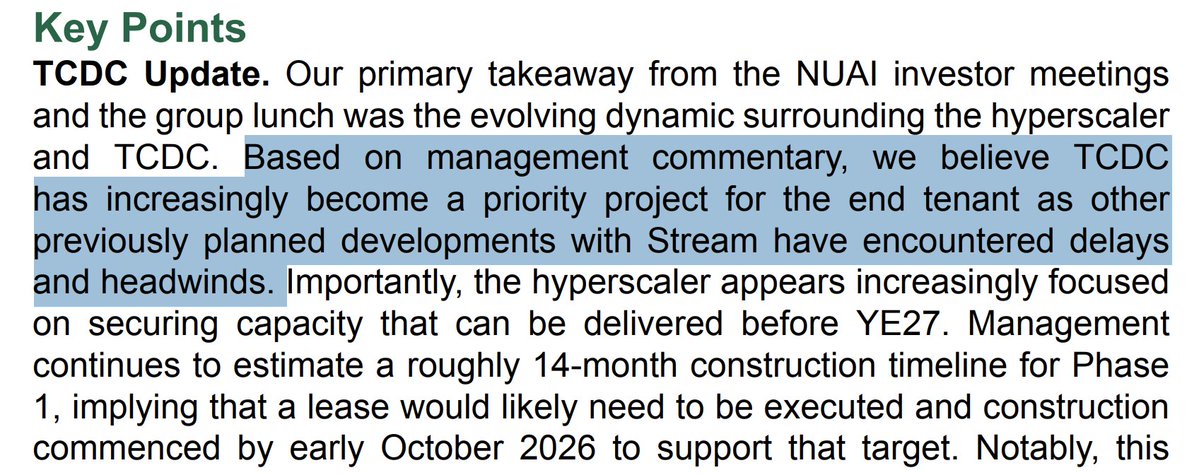
I'll be brief. Based on the highlighted sentence from the recent Northland company update, I believe the probability of $NUAI closing a hyperscaler deal by October 2026 is basically 100%. In fact, I believe October is the line in the sand, and the signing date will likely be late July or early August. Therefore, it would make sense for all data center investors (e.g., investors in $IREN, $WULF, $CIFR, $APLD, $HUT, etc.) to have some exposure to NUAI by August, even if only a lotto position.
@ChrisRGun There's a reason PS games aren't big hits on Steam/PC. Players want games that are unique or engaging, not the same 3rd person cinematic slop that plays the same way every year. Even though they are well made, they just become stale when you milk them like Sony do.
@Pihlbaoge Riv gamla ullevi och ullevi, bygg en ny arena på ullevis tomt som tar minst 40 000 åskådare, som blir fantastisk för både fotboll och konserter. Sälj marken på gamla ullevi till fastighetsutvecklare för att dels finansiera arenabygget. Nostalgi för ullevi kan inte gå före.
Welp, that happened faster than I predicted. Thought it would be end of 2027, then early 2027, but agentic traffic growing so fast that bots have now passed human traffic online for the first time in the Internet's history. https://t.co/2zX5bHdhsa
@Tjurenhornen@livetefterfire "Bara låta det ligga där?" Ja, exakt. Precis som med guld eller konst. Man parkerar värde för att skydda köpkraften. Idag utgör BTC ca 0,2% av världens kapital.Att Wall Street och stater i framtiden allokerar 2% av sin portfölj som ett inflationsskydd är inte extremt.