New article~
Is Vietnam really a middle power or is “middle-power Vietnam” itself a contested role?
Drawing on role theory, my new article on Contemporary Politics examines how Vietnam’s middle-power identity is produced.
https://t.co/pgpDrhEDJ2
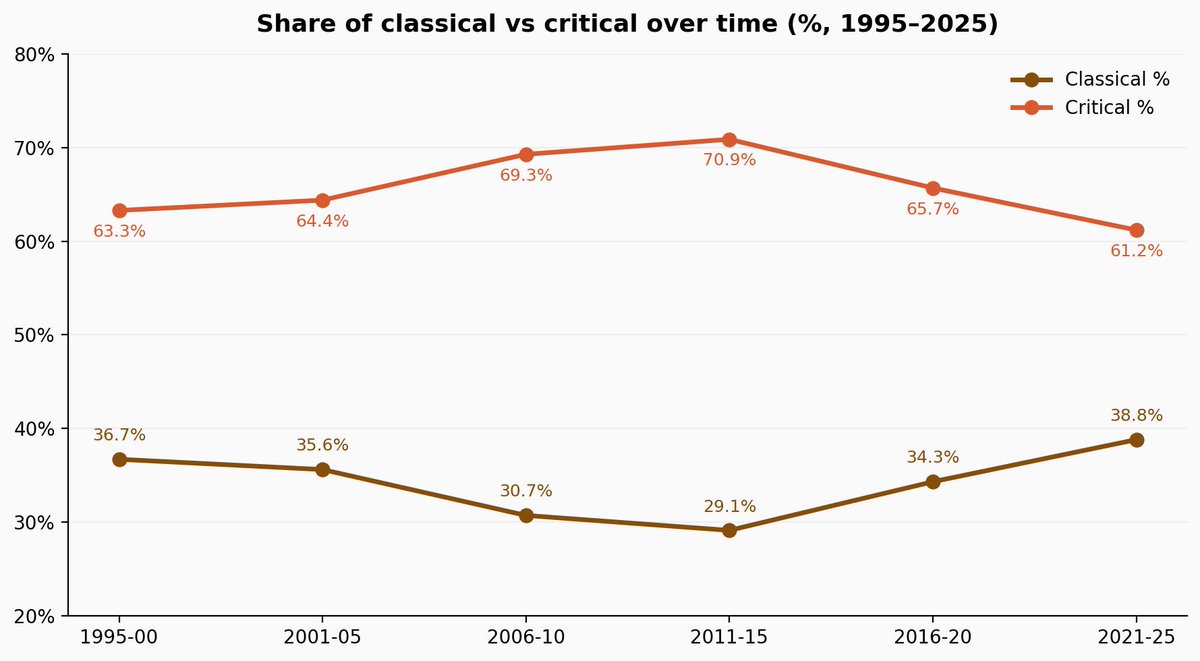
I coded the content of the articles published in the "Review of International Studies", the "European Journal of International Relations" and "Cooperation and Conflict" since 1995 for a forthcoming book chapter on European military capabilities.
Usually, security studies article make up about 30 to 35% of an issue.
Here is the breakdown between "critical" and "classical" security studies over time. Clearly, in European IR, the "critical" is very mainstream.
Been a while since my last writeup - happy to see my piece on Vietnam-Cambodia relations up on The Interpreter.
"Hanoi has shown diplomatic adroitness with major global powers, yet remains in a bind when it comes to its southwestern neighbour."
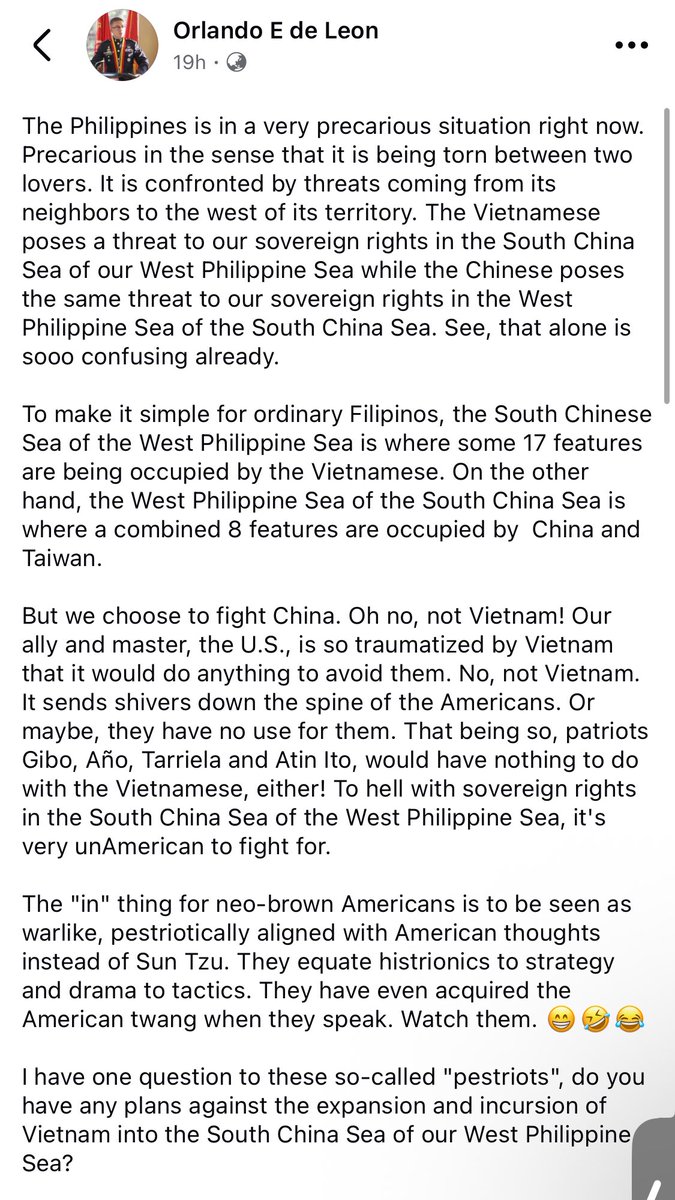
Dear Brigadier General Orlando De Leon (Ret),
I respect your passion and commitment to our national interests, but I feel compelled to point out why advocating for confrontation with Vietnam is misguided and, whether intended or not, serves to advance China’s interests by diverting attention from the actual threat we face.
While the Philippines rightfully raises concerns over Vietnam’s reclamation activities, it is critical to recognize that Vietnam has occupied its features for decades. The status quo is that they occupy those features without any aggressive actions. Since the 2002 Declaration on the Conduct of Parties in the South China Sea, Vietnam has not occupied any new features and has never disturbed our presence on our occupied features. This reflects a longstanding presence, not new expansionism.
In contrast, China’s occupation of Mischief Reef since 1995, a low-tide elevation just 130 nautical miles from Palawan, their illegal deployment of their maritime forces in Scarborough Shoal since 2012, and the persistent bullying of our PCG, BFAR vessels, and fishing boats represent the clearest and most dangerous violations of our sovereignty and sovereign rights.
If your patriotism is genuinely anchored in protecting our fishermen, service members, and our sovereignty and maritime rights, then our focus must be on China. It is China that has repeatedly bullied our people and endangered the AFP and PCG through aggressive actions—lasers, water cannons, and deliberate ramming.
As a retired brigadier general of the AFP—a distinction you continue to highlight on your Facebook profile with the insignia of your one-star rank—you are expected to be well-versed in the geopolitical realities at play and to uphold the Philippines’ firm stance against China’s belligerent actions. Yet, your arguments reveal a lack of grounding in international law and the imperatives of national sovereignty. It is also difficult to ignore that your recent rhetoric aligns with the surge of pro-China narratives directed at Vietnam. Is this truly your independent view, or are you lending your voice to a broader effort that serves Beijing’s interests?
Let us be clear: the Philippines’ position in the West Philippine Sea is not dictated by Washington or any outside power. It is grounded in international law and affirmed by our own national legislation, as President Ferdinand Marcos Jr. has strongly emphasized.
General De Leon, sir, with respect but equal candor, I urge you to reconsider. At a time when unity is vital, lending your voice to narratives that serve China’s agenda does a disservice to the Philippines. Piliin po natin ang Pilipinas, sir—huwag po tayong magpagamit sa China.
“What we witness today is a struggle to stay ‘hopelessly hopeful’,” @MechDara1 says. “Even when there’s no reason to believe things will improve, we can’t help but cling to this diminishing hope.”
https://t.co/LGAKk0qYtf
JVS mourns the premature passing of Gerard Sasges, a brilliant scholar of Vietnam and an Associate Professor in the Dept of Southeast Asian Studies at the National University of Singapore.
A Canadian national with a Ph.D. from UC Berkeley, Gerard made a significant mark...
1/
What do I mean by “authoritarian teleology”? (Thank you @kaiserkuo for the plug!) Broadly speaking, it’s a style of thinking that interprets whatever an authoritarian govt does as a “strategy” to “stay/remain/survive in power.” 1/n
Happy to share my article in @millennjournal, 'The Anxious State: Impossibility of Closure and State’s Ontological (In-)security in Postcolonial and Postrevolutionary Vietnam'. It's been long in the making and was both academic as it was personal...
https://t.co/SCevLLUi4B
As it emerges from the debris of the socialist imaginary and isolation as a pariah state, Vietnam is refounding OS in cultural traditions, Ho Chi Minh Thought, bamboo diplomacy, etc. The latest advent of 'rising era' (kỷ nguyên vươn mình) seems to signal at this enculturation.
Such anxieties are not abstract, present in ongoing discussions about the country's fast-changing identity and modernization impetus - and the role of ideology within them. Vietnam's revolutionary legacies and nationalist impulses possess latent tensions yet to be resolved..