My thoughts are with all those people that spent their day at home today with a potassium of 3.3 (and nothing bad happened to them!)
#foamcc#electrolytes
One major reason doctors face abuse from patients and attenders
Some seniors humiliate juniors in front of patients just to display authority.
That resident or intern is the same person staying in the ward for 12–36 hours, managing everything for those patients.
If you publicly insult your juniors, what respect do you expect patients or attenders to have for them afterward?
Correct mistakes privately.
Humiliation helps nobody.
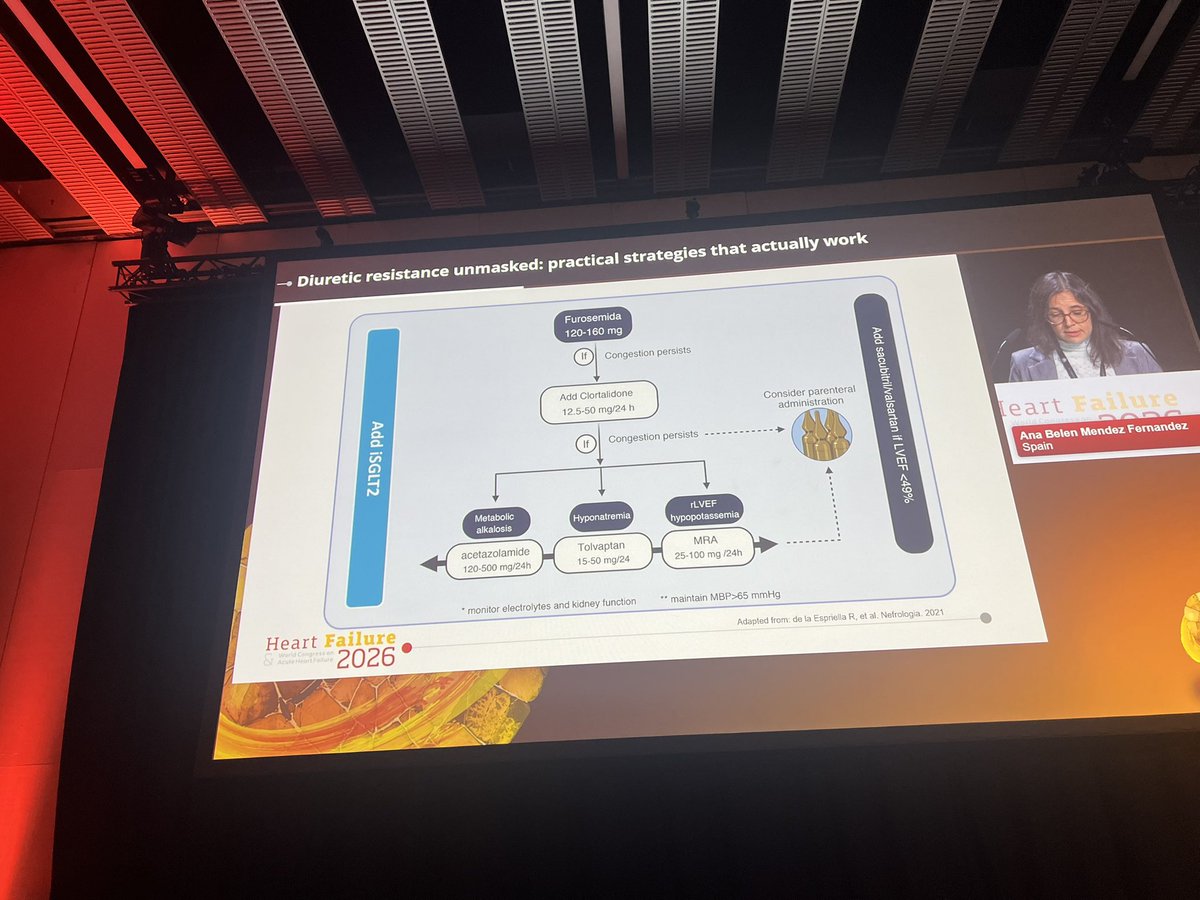
💊 Practical algorithm for diuretic resistance in acute HF from #HeartFailure26— this is the slide to save!
Start: Furosemide 120-160 mg
↓ Still congested?
Add Chlortalidone 12.5-50 mg/24h
↓ Still congested?
Tailor to the problem:
• Metabolic alkalosis → Acetazolamide 120-500 mg/24h
• Hyponatremia → Tolvaptan 15-50 mg/24h
• rLVEF + hypopotassemia → MRA 25-100 mg/24h
And running through the whole algorithm:
➕ Add iSGLT2 throughout
➕ Add sacubitril/valsartan if LVEF <49%
➕ Consider parenteral route if oral absorption is the issue
Clean. Practical. Evidence-based. 💯
(Adapted from de la Espriella R et al. Nefrologia 2021)
#CardioTwitter #HeartFailure #Cardiology #Diuretics #HFrEF
The American Heart Association mourns the passing of the legendary cardiologist Eugene Braunwald, M.D., widely recognized as one of the most influential figures in the history of cardiovascular medicine. Over seven decades, his work reshaped the understanding and treatment of heart disease, leading many to call him the father of modern cardiology.
Braunwald was a lifelong contributor to the American Heart Association, helping advance its research and scientific mission, and was honored with some of the Association’s highest honors for his lasting influence on cardiovascular care and research. His influence extended well beyond his own discoveries, as generations of Association‑supported investigators, clinicians and academic leaders were trained by Braunwald or guided by the clinical trial standards and mentorship models he helped establish.
https://t.co/ieZuHYMyOP
the MOST common WRONG management of endocarditis is...
NOT getting THREE blood cultures BEFORE the start of antibiotic.
second most common WRONG management of endocarditis
NOT getting enough blood into the blood culture bottles.
Needs TEN (10) TEN milliliters into EACH bottle.
I'm thrilled to announce the 10th edition of Talley & O'Connor's CLINICAL EXAMINATION: A systematic guide to physical diagnosis has just been published (Dec 1st, 2025). It is humbling medical students in Australia, New Zealand, UK, Ireland, South Africa, Pakistan, Malaysia, Singapore, Canada and around the world have used and liked the book. We hope the new edition will prove just as useful to all aspiring clinicians.
ICU/ED Secrets:
IKYK but whenever you hear that a patient "tolerates Bipap very well", it's useful to remember that there are 2 ways he may tolerate it:
#1: he is comatose/barely responsive
#2: he is comfortable/awake or easily arousable & can communicate
I see scenario #1
@IM_Crit_ Pupil size change is a very late sign in raised ICP, or brain swelling. There would definitely be other signs, e.g vomiting, restlessness, hypertension etc. 👌🏻
The 🆕 AHA/ACC/Multisociety #ClinicalGuideline on high blood pressure provides updated recommendations for clinicians on the prevention, detection, evaluation, and management of high blood pressure in adults.
Get the details ➡️ https://t.co/RlPVFPTjmT #Hypertension#JACC
DKA with normal glucose with the use of SGLT2 inhibitors is an important thing. Those drugs are gonna be everywhere and they’re never going away and so recognizing a low serum bicarb high and gap with the glucose that’s just a tiny bit above normal is a big deal