Wow, this tweet went very viral!
I wanted share a possibly slightly improved version of the tweet in an "idea file". The idea of the idea file is that in this era of LLM agents, there is less of a point/need of sharing the specific code/app, you just share the idea, then the other person's agent customizes & builds it for your specific needs.
So here's the idea in a gist format: https://t.co/NlAfEJjtJV
You can give this to your agent and it can build you your own LLM wiki and guide you on how to use it etc. It's intentionally kept a little bit abstract/vague because there are so many directions to take this in. And ofc, people can adjust the idea or contribute their own in the Discussion which is cool.
LLM Knowledge Bases
Something I'm finding very useful recently: using LLMs to build personal knowledge bases for various topics of research interest. In this way, a large fraction of my recent token throughput is going less into manipulating code, and more into manipulating knowledge (stored as markdown and images). The latest LLMs are quite good at it. So:
Data ingest:
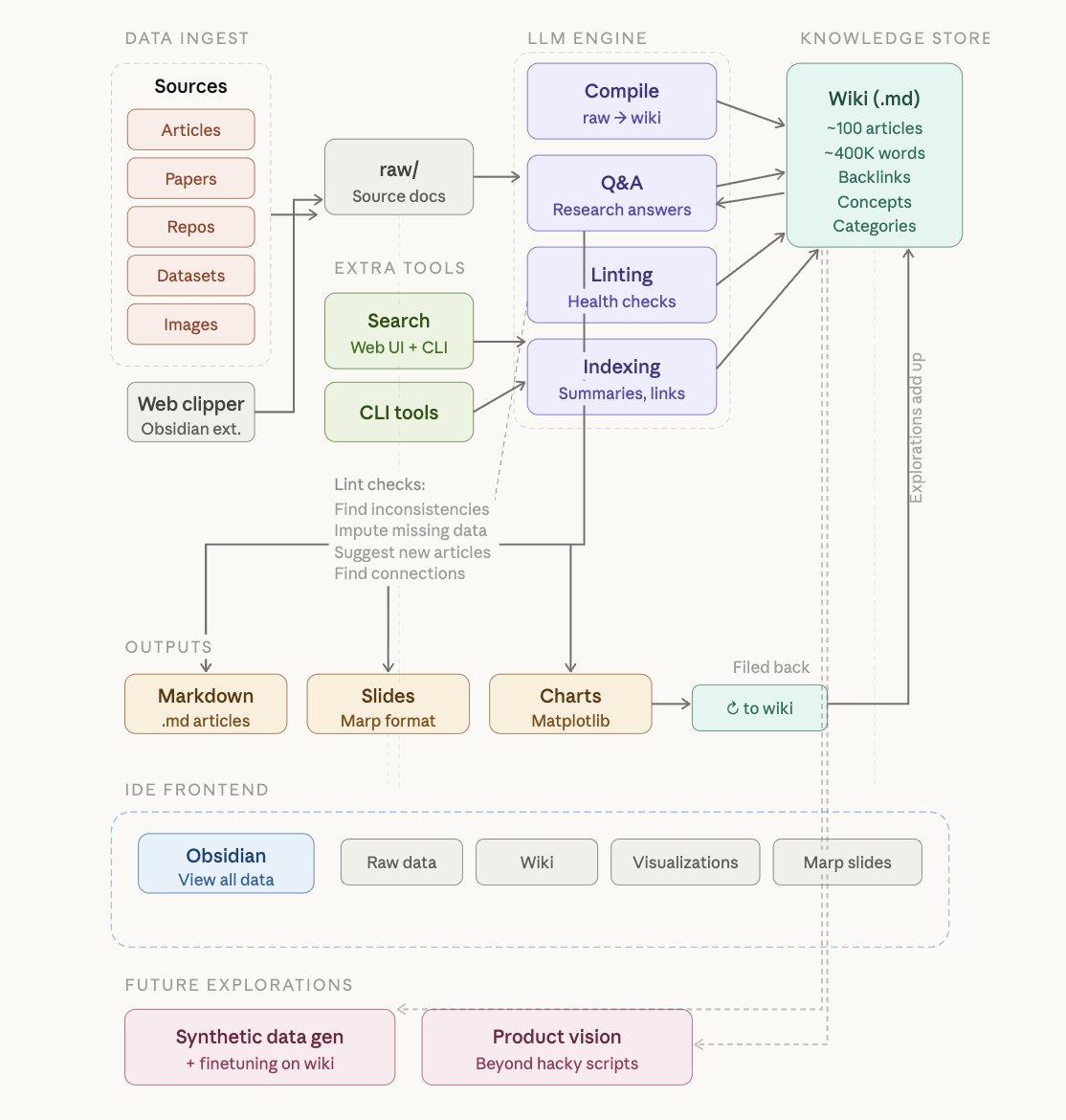
I index source documents (articles, papers, repos, datasets, images, etc.) into a raw/ directory, then I use an LLM to incrementally "compile" a wiki, which is just a collection of .md files in a directory structure. The wiki includes summaries of all the data in raw/, backlinks, and then it categorizes data into concepts, writes articles for them, and links them all. To convert web articles into .md files I like to use the Obsidian Web Clipper extension, and then I also use a hotkey to download all the related images to local so that my LLM can easily reference them.
IDE:
I use Obsidian as the IDE "frontend" where I can view the raw data, the the compiled wiki, and the derived visualizations. Important to note that the LLM writes and maintains all of the data of the wiki, I rarely touch it directly. I've played with a few Obsidian plugins to render and view data in other ways (e.g. Marp for slides).
Q&A:
Where things get interesting is that once your wiki is big enough (e.g. mine on some recent research is ~100 articles and ~400K words), you can ask your LLM agent all kinds of complex questions against the wiki, and it will go off, research the answers, etc. I thought I had to reach for fancy RAG, but the LLM has been pretty good about auto-maintaining index files and brief summaries of all the documents and it reads all the important related data fairly easily at this ~small scale.
Output:
Instead of getting answers in text/terminal, I like to have it render markdown files for me, or slide shows (Marp format), or matplotlib images, all of which I then view again in Obsidian. You can imagine many other visual output formats depending on the query. Often, I end up "filing" the outputs back into the wiki to enhance it for further queries. So my own explorations and queries always "add up" in the knowledge base.
Linting:
I've run some LLM "health checks" over the wiki to e.g. find inconsistent data, impute missing data (with web searchers), find interesting connections for new article candidates, etc., to incrementally clean up the wiki and enhance its overall data integrity. The LLMs are quite good at suggesting further questions to ask and look into.
Extra tools:
I find myself developing additional tools to process the data, e.g. I vibe coded a small and naive search engine over the wiki, which I both use directly (in a web ui), but more often I want to hand it off to an LLM via CLI as a tool for larger queries.
Further explorations:
As the repo grows, the natural desire is to also think about synthetic data generation + finetuning to have your LLM "know" the data in its weights instead of just context windows.
TLDR: raw data from a given number of sources is collected, then compiled by an LLM into a .md wiki, then operated on by various CLIs by the LLM to do Q&A and to incrementally enhance the wiki, and all of it viewable in Obsidian. You rarely ever write or edit the wiki manually, it's the domain of the LLM. I think there is room here for an incredible new product instead of a hacky collection of scripts.
The scariest moment in algo trading
is finding out your strategy works on random data too.
neurotrader video shows the kill switch:
"How I Develop Trading Strategies | Permutation Tests and Trading Strategy Development with Python."
21 minutes of pure framework.
I wrote a companion deep-dive that takes this Monte Carlo foundation
Extending it across every simulation method quant firms actually use
From particle filters updating in real time on election night
To copula models capturing tail dependence across correlated markets.
Start with his video. Go deeper with the article.
I don’t have proof, but this is my theory and I’m sticking to it:
The Egyptians who are credited with building the pyramids, actually found them already there, built by the “gods”, which was actually a previous advanced civilisation.
They tried their best to imitate the style, which is why the oldest pyramids are the most sophisticated, and the newer additions are the ones that actually look primitive.
If you look at the Old Kingdom of Egypt, which are the earliest Dynasties, you have the Great Pyramids with mathematical masterpieces with 70 ton granite beams and laser-flat finishes of millimetre precision.
Then for some reason, as you move forward in time to the Middle and New Kingdoms, the pyramids start to get smaller, the stones get sloppier, and eventually, they just start building with mud bricks.
If those mfs “invented” the tech, they would have gotten better at it. Instead, they clearly lost the manual. They became squatters in structures they knew nothing about building.
There is a literal stone tablet called the Inventory Stele found at Giza and it explicitly states that Khufu, the Pharaoh supposedly responsible for the Great Pyramid found the Sphinx and the Temple of Isis already built.
Mainstream archaeology calls the stele a “pious forgery” created 2,000 years later by priests because if the stele is true, the entire timeline of Egyptology collapses. They would rather believe the Egyptians lied about their own history than admit the pyramids are older than 4500 years.
About the Sphinx, geologists like Robert Schoch have pointed out that the Sphinx and its enclosure walls show deep marks caused by thousands of years of heavy, cascading rainfall.
The problem is that Egypt hasn’t had that kind of rain for at least 12000 years. By the time of the Dynastic Egyptians 4500 years ago, the region was already a desert.
In other words, the Sphinx was already old and heavily eroded when the Pharaohs first saw it. They didn't build it, they wouldn't know how to, so they just re-carved the head to look like a Pharaoh, which is why the head is tiny and less weathered than the body.
Archaeologists claim the pyramids were burial tombs. They probably were, for the Dynastic Egyptians. The Egyptians were the world’s greatest restoration artists. They found these resonance chambers and, which were actually power plants, cleaned them out, and used them for their own religious purposes.
The granite in the King’s Chamber inside the Great Pyramid of Giza isn’t even from the same geological formation as the limestone of the structure. Why import 70-ton blocks from 500 miles away unless those specific material properties mattered for a non-decorative function?
Anyway, the hypothesis I subscribe to argues that thousands of years ago, there were catastrophic global floods, which is why many cultures have their own version of the “Flood of Noah” fable.
Most coastal civilisations were submerged after this cataclysmic event.
This explains why archaeologists find silt and sea shells at the base of the pyramids. They were submerged during this Great Reset.
The survivors were pushed back into a Stone Age survival mode. By the time they rebuilt enough to return to Giza, they had lost the high-frequency technology, but they still remembered the “gods” who built the original structures.
Imagine a global catastrophe today. In 2000 years, a new tribe finds the ruins of the Three Gorges Dam. They can’t make electricity with it, so they use the dam as a massive fortress and bury their chiefs in the turbine rooms because they feel holy.
Future archaeologists would find the bodies, see the tribe’s pottery, and conclude that the Three Gorges Dam was a primitive tomb built by people who worshipped the Water God. That is exactly what Egyptologists are doing with the pyramids.
Again, I don’t have proof, but nor do the anthropologists
You've doubtless read the numerous headlines these past few days on how Xi Jinping called for the Yuan to "become a global reserve currency."
That's true, he actually said that. But, as is often the case, Western media are missing the forest for the trees.
This is extracted from a speech in which Xi laid out a much grander vision of what a “modern financial system with Chinese characteristics” (中国特色现代金融体系) would look like, essentially China's answer to Wall Street.
Fascinatingly, and in stark contrast to the actual Wall Street, Xi's main argument is that what matter most aren't the institutions or status that China is seeking to build up - such as having the Yuan as a global reserve currency. Those are secondary.
Xi argues that what truly will make or break the system is its moral culture. As he describes it, the Western financial system is nihilistic, counterproductive and ultimately politically destabilizing.
Nihilistic in the sense that finance without moral purpose becomes self-referential - it stops serving anything beyond itself. He calls it "脱实向虚" ("drifting from the real economy into the virtual"): when finance detaches from the real economy, it loses its reason for existing. It’s not creating wealth, it’s just moving numbers around.
Counterproductive in the sense that it actually destroys the thing it depends on. As Xi explains "if [finance] becomes obsessed with self-circulation and self-expansion, it becomes water without a source, a tree without roots" (无源之水、无本之木). In other words, finance detached from the real economy - like a tree that has severed its own roots - ultimately kills the economy.
Lastly, politically destabilizing in the sense that financial elites captured by greed become ungovernable - they corrupt regulators, buy politicians, evade accountability. The Qiushi commentary on Xi's speech is extremely blunt about this (https://t.co/PT1EIIft5B): they say Xi seeks to "avoid the Western predicament of financial oligarchs hijacking public policy and deepening social division."
“Financial oligarchs hijacking public policy” (“金融寡头绑架公共政策”) is remarkably blunt language. It's essentially saying that the West allowed oligarchs to capture the state (not wrong!).
To avoid all of this, Xi lays out a vision for - in many ways - an anti-Wall Street: a 金融强国 ("financial powerhouse") that puts serving the real economy at its core. A system that - Xi argues - will ultimately make the Yuan a global reserve currency precisely because, ultimately, a global reserve currency is backed by trust. That's the forest: how you build trust is what matters.
In my latest article I break down the full speech, how exactly Xi proposes to build this anti-Wall Street and what it reveals about a question we in the West have stopped asking: what is our financial system actually for?
Full article here: https://t.co/JVmvdk8M9M
I had a realization recently. The reason I got into studying the world the way I do is I was living in Philly as a teenager. As a declining place which used to be far more important than it currently is, Philly has a massive oversupply of used books. I needed something to do in an otherwise not very happy life, while I didn’t have much money. I saw that these history books from a century ago were like 4-5 dollars while Barnes and Noble were 25 dollars per book.
This informs my entire worldview since my “training data” was from a century ago and rather than be educated by the system I was educated by older historians. This is why I hold of the intellectual frames I do and became a major element coloring how I see the world which largely stemmed from a chance variable of where I grew up. I’ll hear a lot of managerial class arguments and I’ll think “they’re getting the original definition or argument wrong” so their argument is void. People don’t think like that anymore. They’re lost in the web of their own abstractions from arguments that somehow made sense in the 1800s.
These old books were totally ubiquitous for me growing up. I brought them since they were cheap. My parents had a lot and it was not abnormal for educated people to also have them. What I realized with horror recently is that as no one reads and the economy gets worse, as well as universities throwing out their collections of old books for ideological reasons, that these things I took as ubiquitous vast wells of information are going away. People didn’t read but everyone knew if you wanted to learn you should while they available. In 30 years, especially if the Left wins and tries to remove evidence of the old world, 90% of those books could be gone. It could be the fall of Rome levels of loss.
The point I’m trying to make here is that as a teen I saw a window with all of this information that I could process that everyone else took for granted. At the same time, I don’t know very many other Gen Z who basically decided to take the globalized information economy at face value. Adults told me we were entering an information economy so I thought “ok. That means we’ll value knowing things so I should know things.” I don’t know if the next generation even has opportunities like this given the last few gatekeepers of trustworthy info have gone insane. The internet or institutions are so crazy and people don’t read anymore.
We need to make sure that children growing up in the 2050s or 80s are able to do what I did.
The idea that has most troubled me over the last decade of research has been the possibility that industrial civilization exhausts the human capital that created it and is unsustainable. If we regressed from industrial civilization we would keep some technological advances. But not all.
so most tokens are just "here's governance rights for a protocol that never changes anything" or "stake this for 4% apr funded by inflation" but this? this is smart and yeah im talking about @megaeth
let me break down why this is way bigger than people realize
so every high-performance blockchain has this dirty secret nobody talks about: the closer you are to the block producer the more money you make. period
in solana validators in the same data center as the leader get their transactions in first. in ethereum l2s searchers colocate with sequencers to capture mev. this happens everywhere but it's all opaque backroom deals and who you know
if you're some random person in singapore and the sequencer is in virginia you're just fucked. your transaction takes 200ms to arrive while some hedge fund colocated with the sequencer is operating at 5ms. they see your transaction coming and front run you before you even know what happened
megaeth is the first chain that's like "yeah this is real let's stop pretending it doesn't exist and make it fair"
the sequencer rotation thing is actually genius and most people are missing why
when people hear "sequencer rotates every few hours" they think okay cool decentralization. but that's not even the main point
the real innovation is that it follows where people actually are
when asia is trading the sequencer is in tokyo. europe wakes up? moves to netherlands. us hours? virginia and LA
and this isn't just some feel-good geographic diversity thing. it's physics
you literally cannot beat the speed of light. if the sequencer is 10000km away you're adding 100ms minimum just from the signal having to travel that far. no amount of software optimization fixes that problem
what megaeth figured out is that if you're building a blockchain with 10ms blocks the sequencer location becomes THE dominant factor in ux
like you can optimize your code all you want but if users are on the other side of the planet they're still gonna have dogshit latency
so instead of fighting physics they just move the sequencer to where users are. the network literally follows the sun as economic activity moves around the world
and here's what makes it sustainable: operators stake $MEGA to compete for sequencer slots. better performance means you're more likely to get selected next time fuck up and you get slashed lose your stake
this creates actual competition for sequencer quality while keeping latency low for everyone. it's not just "whoever has the most tokens wins" it's stake + performance + infrastructure quality
now the proximity markets are where this gets really spicy and where i think most people aren't grasping how big this could be
traditional finance has this whole thing called low latency trading. firms literally pay millions per year to put their servers in the same building as nasdaq or nyse. they're paying for microseconds of advantage because at that speed microseconds = millions of dollars
in crypto this already happens too but it's all sketchy. you gotta know a guy who knows a guy who can get you into the right data center. zero transparency just pure networking and backroom deals
megaeth said fuck that let's make it an onchain market
you want to be physically next to the sequencer? you bid for that space by locking $MEGA tokens. highest bidders get the closest server racks. fully transparent fully onchain
and here's why this matters way more than people realize:
for market makers: being colocated means you can provide way tighter spreads because you're not worried about getting picked off by someone faster. better spreads means more trading volume means more fees. suddenly that $MEGA you locked to get colocated is paying for itself every single day
for dex frontends: if your interface can submit trades and show confirmations in 15ms total you're literally competing with binance on speed. like actual centralized exchanges. that's never happened before in crypto. users will actually want to trade onchain instead of using cexes
for mev searchers: you're not competing on networking tricks or knowing the sequencer operator personally. you're competing on capital which is transparent and fair. best bidder wins
but here's the really clever part that i think people are sleeping on as the chain grows and handles more volume the value of being colocated goes up proportionally
more trading volume = more arbitrage opportunities = higher willingness to pay for proximity = more demand for $MEGA
this isn't some vague "tokenomics" where buy pressure comes from staking rewards funded by inflation. this is real economic demand from people who want millisecond advantages that are worth actual millions
and unlike most tokens where utility is theoretical this is very concrete you literally cannot get colocated without locking $MEGA. the demand is baked into the architecture
there are some second order effects here that nobody's talking about yet
geographic arbitrage becomes a real thing. imagine you're a trading firm in tokyo. during asia hours you're colocated and printing money. during us hours you're not. this creates incentives for global teams running follow-the-sun operations
firms are gonna optimize their entire strategies around sequencer rotation windows. asian firms bidding aggressively for tokyo slots american firms for virginia slots. you'll see capital flow patterns that mirror the sequencer rotation
liquidity is gonna follow the sequencer around the world. as it rotates the most sophisticated market makers move with it. this means you get actual global liquidity instead of liquidity fragmented by geography
you might even see lending rates or dex spreads vary slightly based on time of day as different market makers rotate in and out of proximity. suddenly time zones matter for defi in ways they never have before
and those colocation slots? they're tokenized. you could have a whole secondary market where people trade proximity rights
maybe a firm only needs low latency during fomc announcements or high volatility events. they could rent their slot to someone else during quiet periods. there's gonna be an entire market around sequencer proximity that doesn't exist anywhere else
the other thing is this puts an actual price on latency. right now latency advantages in crypto are completely hidden. you don't know what you're missing because you can't see it
with proximity markets you can see exactly how much sophisticated players are willing to pay for millisecond advantages. this creates transparency that forces everyone to think about their own latency needs
like if you see market makers bidding $500k in locked $MEGA for colocation you know those milliseconds are worth serious money. that's information that's never been public before
most crypto tokens are solving for "how do we launch a token because that's what you do" not "how do we create actual sustainable value"
megaeth is doing something different: they're tokenizing real scarcity (physical proximity to sequencer) and real costs (running high performance infrastructure globally)
the token isn't governance theater. it's the key to participating in the most valuable parts of the network
wanna run a sequencer? need $MEGA staked
want low latency? need $MEGA to bid for proximity
wanna capture mev efficiently? need $MEGA for colocation
every role that generates outsized returns requires the token. that's actual structural demand not hopium
compare this to most l1 or l2 tokens where utility is "pay gas fees" but gas is cheap so nobody cares or "governance" but proposals never pass anyway. this is fundamentally different
i'm usually super cynical about crypto projects because most are just exit liquidity wrapped in technical jargon but this is one of the few times where the incentives actually line up properly
megaeth is trying to be the fastest blockchain. to do that they need powerful sequencers running in multiple locations around the world. they need sophisticated market makers providing liquidity. they need real usage driving all of it
the token sits at the center of all these needs. it's not bolted on as an afterthought it's structural to how the network functions
and because it captures value from things that scale with network usage (more trading = more colocation demand more users = more sequencer competition) the tokenomics aren't just number go up faith
like the more successful the network is the more valuable these mechanisms become. that's rare in crypto where most tokens are inversely correlated with usage (more users = higher gas = people leave)
the risk is obviously execution. can they actually deliver 100k tps sustainably without the network shitting itself? will market makers actually pay meaningful amounts for colocation? does sequencer rotation work smoothly or does it cause issues?
but the testnet is already doing 20k+ tps with 10ms blocks consistently so the tech risk feels way lower than most crypto projects that are pure vaporware. like they've actually built the thing and it works
if megaeth pulls this off it's basically proof that you can build genuinely high performance blockchains without becoming completely centralized or unfair
the old narrative was fast chains are centralized (solana) and decentralized chains are slow (ethereum). pick one
megaeth is saying fuck that false choice: make the centralized parts rotate and make the advantages transparent and fair. you can have both
this could legitimately change how other chains think about the performance vs decentralization tradeoff. instead of fighting centralization acknowledge where it naturally occurs and build mechanisms to distribute the benefits
honestly the more i sit with this the more i think it's one of the more genuinely innovative token designs in the last few years. most tokens are just securities with extra steps that'll get rekt by regulators
this one actually plugs into how the network operates in ways that make the network better. the token creates value by enabling things that wouldn't otherwise work
whether it succeeds depends on execution and market conditions and a million other things but the design itself? smart asf want to congrulate whole team
we'll see if the market agrees but i think people are sleeping on how big this could be
ik this is long read if you read this you goated
/megaeth
“My friends with the progesterone babies had all kinds of stories about the precocious things they would do.
The most recent story I heard about a couple of them — one of them, I think she’s four years old — she had just started a notebook.
The grandfather told me that she had written out in her notebook some pages with her eight-year-old brother’s name, and the grandfather’s name, and had drawn three lines under her brother’s and five lines under her grandfather’s name.
And he asked what that was for, and she said,
“I want each of you to teach new things every day.”
He asked why he had five lines, and her older brother had only three lines.
She said, “Because you know more than he does.””
— Ray Peat
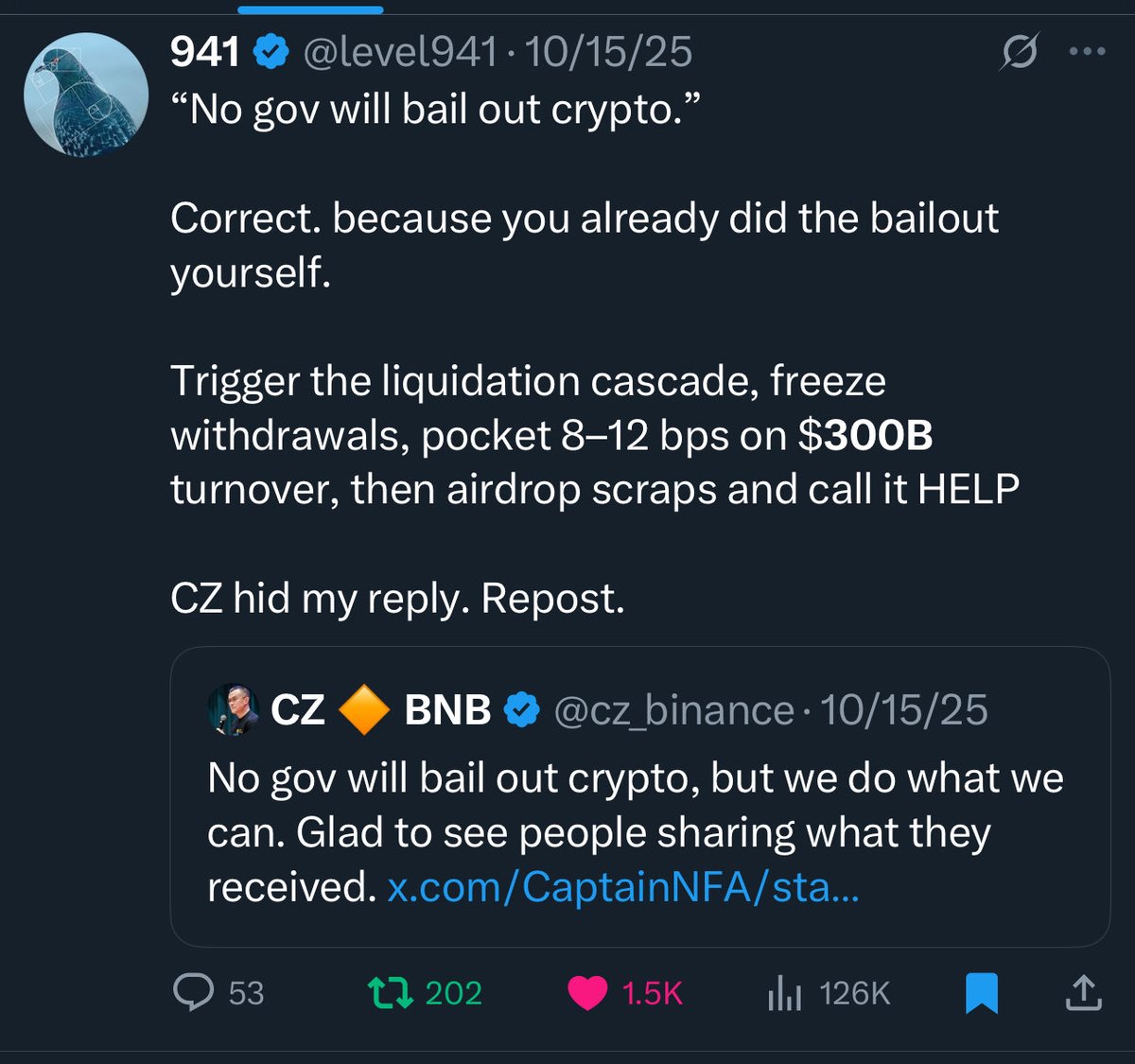
What have I been telling you about China.
The Oct 10–11 wipeout was “manufactured,” withdrawals were throttled, and fees plus internal P&L captured the spread.
Wintermute’s own line is that they stopped trading mid-crash because internal risk limits tripped, not to profit from it. That matters because “stood down” vs “leaned on the book” implies opposite motives.
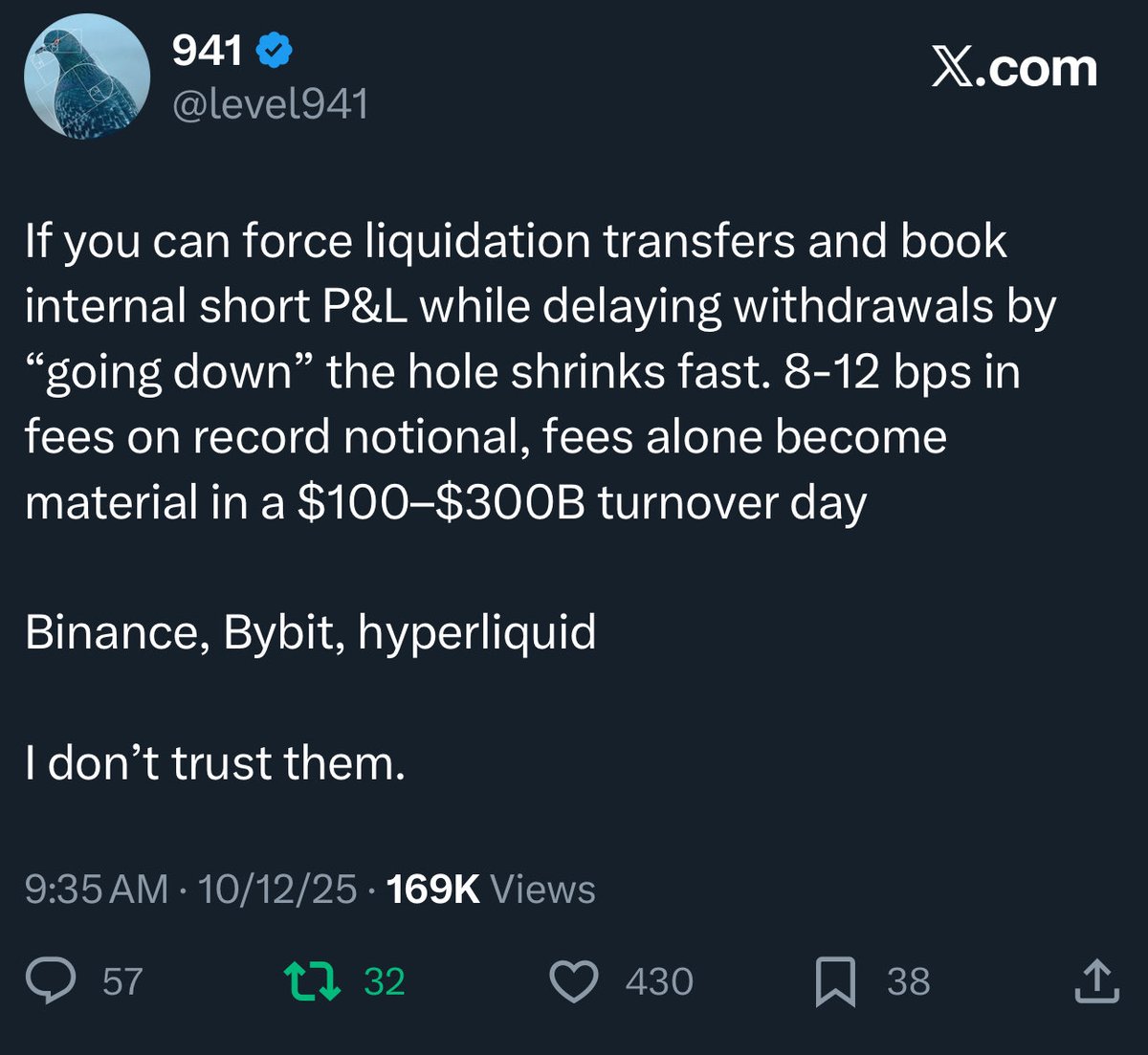
force liquidations, slow withdrawals, book internal P&L, and harvest 8–12 bps on extreme turnover days. That’s exactly the type of play Chinese exchange + MM would do. I just need need order-book and wallet evidence to prove it.
If Washington can make domestic hash-rate and mined BTC the new collateral for Treasuries, the dollar becomes energy backed again this time by compution rather than crude.
That threatens the entire BRICS commodity clearing model China has been building with gold and the digital yuan.
China can’t easily stop American miners or ETF flows directly, but it can attack the price discovery layer.
Binance, Bybit, and Hyperliquid are offshore venues with deep liquidity but no U.S. regulatory leash. Each blaming each other like the Spider-Man meme.
Most large market makers routing through them. Wintermute. Jump, etc. operate globally.
If you control latency, liquidation engines, or synthetic funding rates, you can spike or crush BTC’s price at will.
The easiest way to discredit BTC is to make its market look chaotic and manipulated.
You see gold crash 5% two days in a row?
Exactly. That’s the counter punch. Bitcoin is a large asset class now. Beijing’s rational response is to suppress Bitcoin’s perceived reliability until the U.S. hash-standard architecture is too costly or politically risky to finish.
If the U.S. succeeds, Bitcoin becomes the backbone of a Hash-Dollar energy-reserve economy, reviving dollar hegemony.
the market behavior you’re seeing fits perfectly with a financial proxy war:
Hash-Dollar vs. BRICS-Gold.
WW3 isn’t fought with bullets.
You all act as if sovereign nations don’t know that Bitcoin is the greatest innovation the world has ever seen…
-pigeon
Expected Value in Prediction Markets: Turning Intuition into Edge
1) Prediction Markets Are Still Inefficient
Prediction markets are supposed to be the ultimate truth-pricing machine. In theory, prices reflect all available information
In practice, they don’t. Most retail traders are just playing with a number in their head: 'This feels like a 60% chance, not 45%'
The problem is that these quick estimates are rarely based on complete information. They might come from a headline, a tweet, or a hunch. That’s not enough. If you want to build real edge, you need to gather more data than the average trader and actually translate it into probabilities
The more angles you cover, the closer you get to seeing the market clearly
2) What Information Matters?
The kind of information you need depends entirely on the type of market. Here are a few categories to make it concrete:
a) Politics
Useful signals: polling data, demographic splits, fundraising reports, historical turnout, campaign ground game, local endorsements
Where to look: poll aggregators like FiveThirtyEight, RealClearPolitics, FEC filings, state election websites, and even local newspapers that catch stories before they go national
b) Sports
Useful signals: injuries, lineup announcements, historical head-to-head matchups, advanced stats (xG in soccer, DVOA in football), even weather conditions
Where to look: stat sites like FBRef, Basketball-Reference, ESPN injury reports, and sharp betting lines from sportsbooks. Twitter is often ahead of the news here
c) Crypto & Finance
Useful signals: on-chain wallet flows, derivatives data, funding rates, options implied volatility, central bank policy
Where to look: dashboards on Dune, Glassnode, CME futures data, Fed minutes, crypto whale trackers
d) Event-driven markets (e.g. “Will Apple launch a foldable iPhone by 2026?”)
Useful signals: company filings, patent applications, analyst reports, supplier rumors, leaked prototypes.
Where to look: SEC filings, Bloomberg, Nikkei Asia supply chain scoops, industry blogs, and forums where leaks pop up
If you’re only looking at the obvious headlines, you’re playing the same game as everyone else. Edge comes from digging where others don’t
3) From Information to Expected Value
Collecting info is only half the job. You need to turn it into numbers. That’s where expected value comes in
a) Estimate your probability
Start with your own assessment based on all the information you’ve gathered. Say you’ve weighed the polls and turnout models and decide Candidate A has a 55% chance of winning
b) Compare it to the market
If the “Yes” side is trading at $0.45, that means the market is implying a 45% chance
Run the EV calculation
In this case:
Your probability: 55%
Market price: $0.45
Payout if correct = 0.10
That’s a positive expected value of 10 cents per dollar bet.
Over time, that edge compounds.
4) Building Strategies
Knowing how to calculate EV is the start. Building strategies around it is where the real money is made
- Play the long game
- Don’t chase one 'big win.' Place lots of positive EV bets across many markets. Even if you lose some, the math works out over time
- Pick your niche
It’s impossible to be the best at everything. Focus where you consistently have better info than the crowd. That could be local politics, niche sports, or a corner of crypto
- Stay flexible
Probabilities aren’t static. As new information arrives, your estimates should change. Updating quickly is often where the edge lies
- Manage your risk
A positive EV doesn’t mean you can’t lose. Bankroll management, sizing, and guardrails like stop losses and take profits keep you alive long enough for the edge to matter
Closing Thoughts
Prediction markets are inefficient because most people trade them on gut instinct. That leaves room for traders who take information seriously
If you can gather more data, translate it into better probabilities, and consistently identify positive expected value, you’ll be on the right side of the long-term math
At the end of the day, the market rewards those who move beyond 'this feels about right' and start playing with actual numbers.
Yes, Binance/CZ, all Chinese exchanges are dangerous right now. It’s the geopolitical landscape. They will exploit DEX’s to shift liquidity around and keep the spotlight off of them. Tensions are HOT.
China isn’t directly dumping Bitcoin or spoofing order books. They’re playing the higher layer. They are waging a liquidity war, not a price war. Beijing’s move is to tighten the flow of real-world energy and materials that back Western production while simultaneously draining offshore dollar liquidity that supports U.S.-aligned risk assets.
Start with the supply chain. China has been weaponizing rare earth export licenses, EV battery inputs, and polysilicon flow. Every new “license requirement” is a synthetic tariff. It slows dollar circulation into physical production. That constrains U.S. manufacturing margins and adds input inflation. The Fed cannot raise rates into that without breaking risk markets. So capital flees to gold and away from digital beta.
Next, the liquidity vector. China has been quietly pulling credit lines from Hong Kong intermediaries that serve Western hedge funds. That starves the arbitrage channels between Asian stablecoin liquidity and Western exchanges. When Binance loses that Asia-based collateral velocity, it bleeds liquidity depth on U.S. pairs. You see it in the tape as cascading wicks and empty bids. No one is spoofing books but they are removing the market makers. The lack of bid depth creates algorithmic panic.
The third layer is psychological. Beijing understands the U.S. is pivoting to a hash-backed reserve model. They know the Treasury and BlackRock ETFs are building digital custody to collateralize energy. The only way to slow that architecture is to make the underlying asset, Bitcoin, look unstable and untrustworthy. So they coordinate a geopolitical environment that amplifies fear trades. Gold surges. VIX spikes. BTC pukes. The world sees chaos while they quietly harden their commodity chokeholds.
So the cause is not direct selling. The cause is strategic liquidity constriction and narrative poisoning. Every tick on the tape is the reaction of Western algos trying to price risk into a supply chain throttled by Beijing and a dollar system defending its energy collateral base. The real war is about control of collateral. China controls atoms. Today’s tape was Beijing’s reminder that they still hold the material choke points while Washington builds the computational ones.
Trump: this won’t lead to WW3
Macro context. BRICS pushed their narrative this week. China anchored gold as soft collateral for its trade bloc. Russia tested energy leverage in Eastern markets. The Middle East flirted with petro-yuan settlement. That chatter triggered the gold panic. The U.S. response came instantly. Trump’s quote was the macro brake pedal. It signals Washington will not allow a kinetic spillover that forces a flight from Treasuries.
This moment is the split screen of power. BRICS wants a war of attrition to drain Western liquidity. The U.S. wants peace through algorithmic control of money and energy. Gold’s blow off was their victory lap. Bitcoin’s liquidation event was their shadow shot. This is not World War III. This is Monetary War II.
The U.S. holds the hash-power.
MAGA & MARA for America 🇺🇸
Thank you for your attention to this matter!
-pigeon
I'll start with the headline: there is no change to my bullish macro view on risk over the next 6-12 months.
I hope everyone out there is doing okay. That was quite a rollercoaster. I managed to get through it mostly unscathed, taking a modest hit on spot BTC and cash equities, with my leverage being on gold, and having almost zero alt exposure. I am annoyed at myself because I woke up early on Friday worried about the rare earth controls (and messaged Chumba in a panic about it), but after doing work on the impacts to the supply chain, ultimately came to the conclusion it was certain to be quickly de-escalated. I've been trying to be less tactical and focused on HTF, but underestimated how vulnerable the market was. With private credit strains, focus on circular financing in AI, and everything having melted higher for a while, there was room for a flush in risk. All that said, in a month's time, I'm confident this episode will have been mostly forgotten.
For altcoins, it is a different story. The full picture is still emerging but clearly there were infra failures and an exposure of underlying fragility.
With positioning having been significantly lightened, there is room for a nice move higher in BTC and some altcoins as the latest round of tariff drama gets reversed, as anyone who was liquidated or stopped out will have burning fomo. A massive amount of crypto native capital was destroyed, but it is not accurate to say the majority of people were zeroed, as some have been insinuating. My sense is that the median outcome is traders having lost a few accounts representing a meaningful but not overwhelming portion of their capital base, but their exposure has mostly been taken down, which forces them to chase things up into empty books.
All that said, I also believe this event has meaningfully weakened the industry, at a time when belief in altcoins had already been making lower highs and lower lows. It will accelerate the PvP rotational dynamics we have been seeing, and put a further cap on ultimate upside. It will also catalyze more people to consider alternate approaches, such as taking LT views in revenue-generating coins, focusing on BTC, or moving to equities.
Now in terms of positive news, we have just gotten two incremental pieces of news that are connected to each other.
1. Alvarez & Marshall released an incredibly detailed piece on the banking deregulation initiative and how big it will be in terms of unlocking capital
2. JPM announced it would invest $1.5 trillion in the US (majority being lending + $10bn in equity), specifically into growth initiatives like AI, defense, and manufacturing. This is an increase of $500bn over previously planned levels.
It is clear to me that these are connected, in two different ways. Bessent had these in his back pocket and wanted to get them out to support the market, and there was an element of quid pro quo: JPMorgan got the banking deregulation, and a role in shaping it, in exchange for re-investing the upside in the American economy. This is classic Trump and think we will see this playbook manifest in a myriad of ways.
I am still absorbing the A&M piece as it is incredibly detailed, but feel convicted they have been speaking to the admin and getting details fed to them, and it represents the views of the Bessent and the admin. Having banking lending capacity freed up and then it being redeployed into growth initiatives is bullish and additive to my macro views. It also solves the problem of how they will keep financing AI data centers.
The banking deregulation impact is larger than anyone was thinking, with a -168bps decline in risk-based capital needs and a 7 point benefit to return on equity. This means banks don't have to put as much of a capital buffer aside against lending, allowing for more lending (and thus liquidity) to circulate through the economy, increasing the velocity of money. In general, no one has been talking about this, so wanted to get it out there.
tbh i understand the liberals: capitalism does systematically take money from the poor and give it to the rich
not directly, that would be too obvious and invoke a revolution. instead, they wrap this indirect taxation on poor people into a fancy financial term called "quantitative easing" and suddenly you have analysts and politicians talk about it openly without causing any outrage, bc it sounds complicated
the excessive printing of money we have seen in the past years dilutes all our money. the difference is that most rich people hardly hold any money, at most 20% probably. the rest is in assets, which rise in prices as the dollar goes down in value
asset prices are not rising bc the assets are growing in value, it is the USD that is falling in value making the assets more valuable in USD terms
poor people ONLY hold usd. their entire life. most poor people don't own ANY assets so their entire life they are subsidising the asset price increases by having inflation devalue their bags. it is so blatantly obvious that everyone can feel it: the middle class, which also only has very little assets, is objectively poorer today than 20 years ago
you could argue that this is unfair. you could also argue that it is a skill issue, bc everyone can buy assets so the game is fair. either way, it is so important that YOU position yourself in a way that you are on the RECEIVING end of the non-stop money printing and that inflation does not hurt you, but benefit you
I have a deeply unpopular opinion about coins that no one would like to hear, and here it is:
- This relates greatly to all my tweets over the past few days. If you notice, I started being "less fundamentals" and less "intellectual masturbation". People have dm'ed me about this, asking me what changed, why my style seems to have changed so much
- To start with, my fundamental axioms shifted (h/t @izebel_eth) to being simply: everything is flows
all philosophies are downstream of that:
new coin good old coin bad, because it's all flavor of the week, the latest flavor gets all the flows. Recency bias wins. First order thinking wins.
- +ve flows: net buying pressure, lockups, sinks. -ve flows: selling pressure, & emissions (which sells)
- As such, today, people want the coins to go up, but constant selling means the coins go down. Emissions, whatever. And most sinks don't work. No one wants to lock their shit up. Thus, tokens have a natural tendency to go down, not up
- Fundamentals is just another way to attract flows. The idea is hopefully you trade at low P/E = you are attractive = people buy. Or better yet, you buy back your own token (more flows)
- DATs are the latest way to stop this. Again, these guys basically shore up $$$ and buy a ton of the token - net buying pressure. DATs are the best example of this ideology being right: bc for a short amount of time, these tokens go up (net buying), before going back down again (natural tendency to go down)
- Buybacks also work for a while, but the truth is, only Hyperliquid has enough to actually buyback ALOT of their own token. Otherwise, buybacks themselves is non-negligible
- But across the past 6 months, there have been some outperformers. And using my natural pattern recognition skills, I realised - and this is my deeply unpopular opinion:
Chinese coins win, Western coins lose. Or as this tweet says:
- This isn't a race thing, it just boils down to how the incentives are aligned, and how the tokens are structured.
Both BNB and MNT are heavily controlled by Binance and Bybit, but they don't have an incentive to sell. Why would they? This basically represents the exchange. If it goes to 0, this would reflect so badly on the exchange.
- Whereas EVERY OTHER SINGLE TOKEN IN THE WORLD, has VCs, who have a FIDUCIARY MANDATE to sell. This is obvious, but no one has gotten it in their heads. <MEGAFUND> owns your coin? Good for flows (attention game) when you launch, bad when they unlock.
- It's very simply an incentive design question. And if you ask me "yea but we need VCs" - I don't disagree. All I'm saying is, as a trader, I want things to go up. And things with selling pressure tend to not go up.
- Memes and onchain were popular because they actually went up. And then it got bad because people got scammed, and onchain coins started being rugged, and the breadth was too much, and capital started flowing everywhere, and then now we have no capital again, yada yada
- Anyways, this is also not a tweet that says low float high fdv is good. I believe low float high fdv is again, a flows thing - it does well for a week, and then dumps (because the fdv is high, so there's alot of unlocks)
- Instead, it's really more of <who owns your coin?> It's why I'm 50% ASTER, 50% MNT. Look at this glorious tokenomics sheets. 0% to VCs and investors. And obviously the airdrop is gonna just be gamed such that Binance-aligned entities own most of the airdrop.
But what's wrong w that? I'd want my token to be in the hands of people who actually believe in the thing.
As such, I do not own 99% of other coins over the longer term time horizon. Again, short term flows could dominate leading to good PA (see XPL on launch), but over the long term, they will flow out (see XPL today)
Look at Hyperliquid. What's their selling point? NO VCs. NO ONE MISALIGNED. I'm like 90% sure the team is not gonna dump their tokens too. So Hyperliquid is probably the only other coin that makes sense. Ultimately, I want something I can comfortably hold, and today, that is basically exchange related coins + Hyperliquid. That is all.
I think degentrading's tweet very aptly summarizes it tbh. Everyone smart has basically come to the same conclusion at some point, I probably am not early, am not that smart, but I am loud, so I am shouting about it (doing my job as a key opinion leader, giving my key opinions)
okii gbye.





![RnaudBertrand's tweet photo. You've doubtless read the numerous headlines these past few days on how Xi Jinping called for the Yuan to "become a global reserve currency."
That's true, he actually said that. But, as is often the case, Western media are missing the forest for the trees.
This is extracted from a speech in which Xi laid out a much grander vision of what a “modern financial system with Chinese characteristics” (中国特色现代金融体系) would look like, essentially China's answer to Wall Street.
Fascinatingly, and in stark contrast to the actual Wall Street, Xi's main argument is that what matter most aren't the institutions or status that China is seeking to build up - such as having the Yuan as a global reserve currency. Those are secondary.
Xi argues that what truly will make or break the system is its moral culture. As he describes it, the Western financial system is nihilistic, counterproductive and ultimately politically destabilizing.
Nihilistic in the sense that finance without moral purpose becomes self-referential - it stops serving anything beyond itself. He calls it "脱实向虚" ("drifting from the real economy into the virtual"): when finance detaches from the real economy, it loses its reason for existing. It’s not creating wealth, it’s just moving numbers around.
Counterproductive in the sense that it actually destroys the thing it depends on. As Xi explains "if [finance] becomes obsessed with self-circulation and self-expansion, it becomes water without a source, a tree without roots" (无源之水、无本之木). In other words, finance detached from the real economy - like a tree that has severed its own roots - ultimately kills the economy.
Lastly, politically destabilizing in the sense that financial elites captured by greed become ungovernable - they corrupt regulators, buy politicians, evade accountability. The Qiushi commentary on Xi's speech is extremely blunt about this (https://t.co/PT1EIIft5B): they say Xi seeks to "avoid the Western predicament of financial oligarchs hijacking public policy and deepening social division."
“Financial oligarchs hijacking public policy” (“金融寡头绑架公共政策”) is remarkably blunt language. It's essentially saying that the West allowed oligarchs to capture the state (not wrong!).
To avoid all of this, Xi lays out a vision for - in many ways - an anti-Wall Street: a 金融强国 ("financial powerhouse") that puts serving the real economy at its core. A system that - Xi argues - will ultimately make the Yuan a global reserve currency precisely because, ultimately, a global reserve currency is backed by trust. That's the forest: how you build trust is what matters.
In my latest article I break down the full speech, how exactly Xi proposes to build this anti-Wall Street and what it reveals about a question we in the West have stopped asking: what is our financial system actually for?
Full article here: https://t.co/JVmvdk8M9M](https://pbs.twimg.com/media/HAORhT6b0AEeLdg.jpg)