we could really use some help getting this film across the finish line.
if you're interested in supporting this film about the legendary group who helped pioneer and shape everything from ai to crypto, and probably inspired your favorite founder, please contribute here:
https://t.co/WgYE63shFx
one of the most rewarding parts of making the extropian documentary has been the conversations i've had with people who have shaped so much of today's world. pioneers in ai, cryptocurrency, prediction markets, longevity, quantum computing, experimental communities, and beyond.
i've really enjoyed learning the history of these ideas directly from the people who helped shape them. i've also learned a lot about myself while making this.
at their core, they were a community of contrarians driven by conviction rather than consensus, pursuing ideas that challenged the status quo.
they weren't waiting for permission. they pushed against technological stagnation. their influence on today's culture is extraordinary.
Boards should start hiring their own hookers to seduce their execs. If it fails, great, you’ve got a good one. If it succeeds, nothing leaks and now you know what you’re dealing with and have leverage to boot.
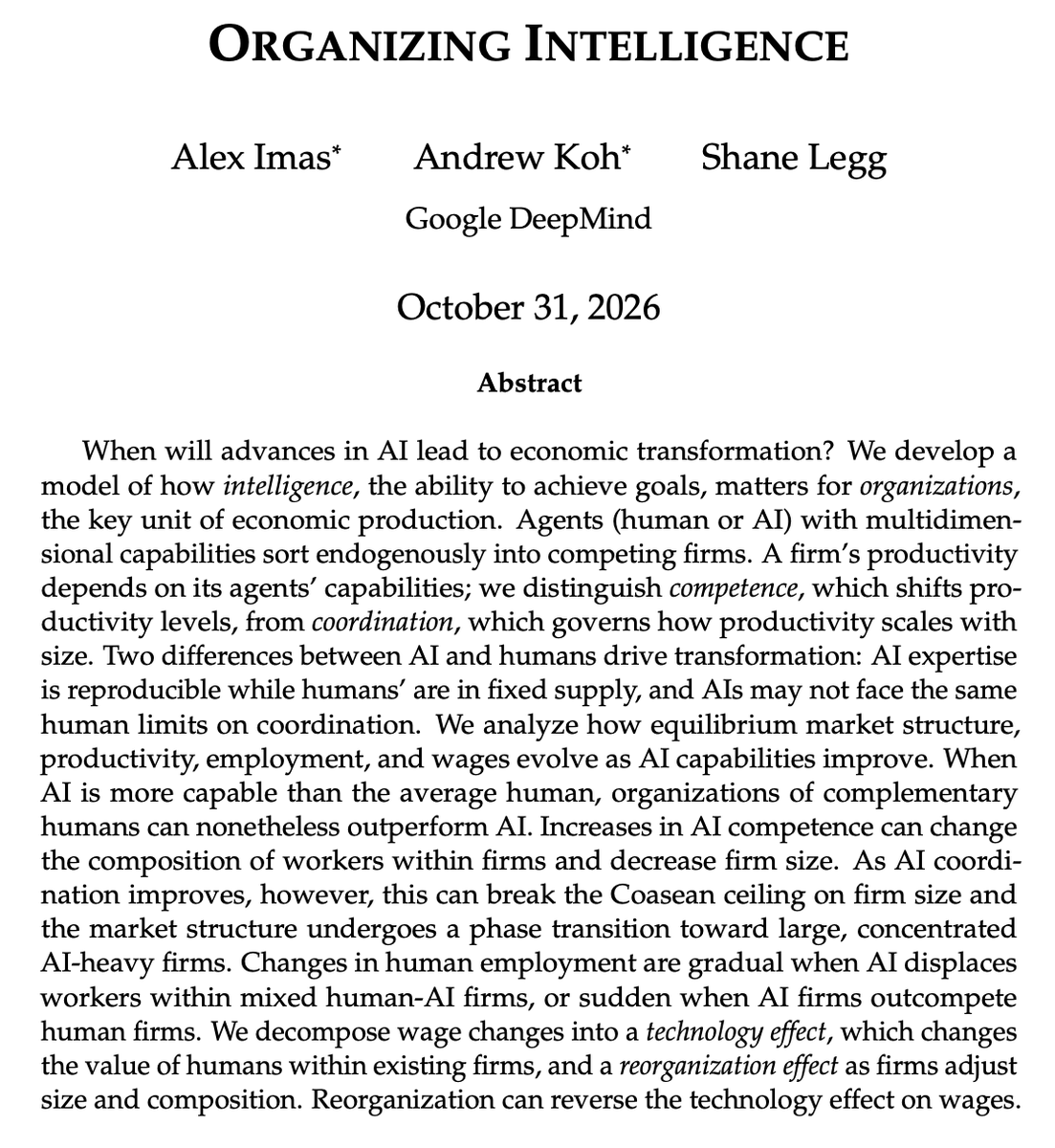
Imas, Koh & Legg: competence sets a firm’s productivity, coordination sets how it scales. Nest AI agents inside agents and each level’s coordination becomes the next level’s competence. The scaling question starts over at every boundary.
https://t.co/PQwTd2ihMv
New paper with Alex Imas (@alexolegimas) and Shane Legg (@ShaneLegg). We build a model of how intelligence is organized into firms, who wins and loses, and when the economy will be transformed: https://t.co/xmv7FooI2a
Blog post: https://t.co/HI1eLiJv3P
@edelwax Yes I think that is consistent with my own (idiosyncratic) view: intelligence is the ability to play a game well, wisdom is the ability to play the metagame of choosing which games to play.
Positive visions of a future with powerful AI tend to leave questions around human meaning, judgment and power wide open.
@edelwax introduces telocracy: a vision for a society where AI holds institutions accountable to their purposes.
@SansMetier@dailystoic The closest authentic passages (such as Meditations 6.39) urge accepting what fate assigns and loving the circumstances and people it brings, which is the core of the concept the quote modernises. (according to Grok)
I built Knot, a tiny universal language where every bitstring is a valid program and the empty program is its own interpreter. A full Rule 30 history fits in 2,042 bits. Here’s what that says about physics emerging from pure information.
https://t.co/0AtvUMcuhz
Here's my understanding of your position (LMK if I got this right):
1. Greater cognitive capabilities permit increasingly complex moral systems.
2. Superintelligence will therefore have access to moral possibilities beyond human comprehension.
3. Reflectively self-modifying intelligence may repeatedly reconsider its values.
4. Humanity's continued survival requires future intelligences to retain some concern for human welfare.
5. Across a vast sequence of value transformations, retaining that concern becomes increasingly improbable.
6. Therefore, eventual human irrelevance or extinction is overwhelmingly likely.
I'd challenge #5. Why should expanding the space of possible values make concern for humanity progressively less likely? An ASI might preserve its existing values, or develop new values without abandoning old ones. What makes you expect otherwise?