Our new @nberpubs paper extends Fogel’s social-savings approach to account for congestion and spatial externalities. These forces can change infrastructure priorities. Full explanation in the video below (sound on 🔊). ⬇️
A guide for students of economics: Ten statements that demonstrate that someone does not understand modern economics or what an equilibrium is, and that you can safely ignore everything else they say.
1. “Equilibrium means the economy is stable or at rest.”
Many assume that an equilibrium is a peaceful state with no forces at play. Instead, an equilibrium is just an arrangement of actions and expectations over time that are mutually consistent. It can be locally unstable, explosive, or fragile. Nothing in the definition of equilibrium implies stability.
2. “Equilibrium implies optimality or social efficiency.”
Equilibrium is often conflated with efficiency, but equilibrium merely reflects decentralized consistency, not welfare maximization. Market power, externalities, incomplete markets, nominal rigidities, and frictions routinely produce inefficient equilibria. I often teach a first-year macro graduate course, and not a single one of the equilibria I define is efficient.
3. “Equilibrium is a unique outcome.”
Many often expect models to have one equilibrium. In reality, multiple equilibria arise naturally in dynamic, strategic, and incomplete-market environments. Models of coordination failures, self-fulfilling expectations, bubbles, overlapping generations, and liquidity traps all hinge on the existence of equilibrium multiplicity.
4. “Equilibrium requires perfect foresight or perfect information.”
Equilibrium does not assume agents know the future. In fact, equilibria are often stochastic. The definition of equilibrium only requires that beliefs are consistent with the (perceived) stochastic laws of motion implied by the model. Bayesian learning, noisy signals, ambiguity, and subjective uncertainty all fit well within an equilibrium framework, provided beliefs converge to an internally consistent (but possibly incorrect) distribution.
Bonus point: equilibria are compatible with agents having diverging beliefs that never converge to a single Dirac distribution.
5. “Real economies are rarely in equilibrium, so the concept is unrealistic.”
Equilibrium is not meant to describe the daily state of the world. It is a conceptual device used to understand the outcome of our models under the assumptions we make. Also, see point 1 above.
6. “Equilibrium requires agents to be fully rational in a psychological sense.”
Equilibrium only assumes internal consistency: agents optimize given preferences and constraints. It does not assume realism about human cognition. We can and do define equilibria in models with behavioral biases, bounded rationality, inattention, or rule-of-thumb behavior. We only need to ensure that the resulting actions and beliefs are mutually compatible.
7. “Equilibrium eliminates dynamics or learning.”
Equilibrium is sometimes misinterpreted as a static state in which nothing evolves. In fact, many equilibria are sequences of probability distributions over states driven by shocks, policy rules, and endogenous responses. Learning dynamics (Bayesian updating, adaptive rules, experience-based expectations) can occur within equilibrium if the evolution of beliefs is self-consistent.
8. “Equilibrium renders expectations unimportant.”
A common misconception is that equilibrium mechanically determines outcomes. In reality, expectations are often central: they determine investment, consumption, asset prices, and policy responses. Many equilibria differ only in their expectations. This is why communication, credibility, and forward guidance matter even in fully rational models.
9. “Equilibrium excludes policy intervention.”
Some interpret equilibrium as a laissez-faire concept. In fact, equilibrium analysis is the foundation of modern policy evaluation. Fiscal, monetary, and regulatory interventions work through equilibrium responses (prices, wages, interest rates, quantities) and must satisfy equilibrium conditions to be credible. Equilibrium is a tool for policy design, not a barrier to it.
10. “Equilibriums…”
Aequilibrium is a Latin neuter noun of the second declension, which forms a nominative plural in “a”. It is composed of aequus (equal; the same root as equality or equity) and libra (balance or scales or the name of several currencies over history).
A final thought: “equilibrium” is a term of art. Its meaning in economics differs from its use in the natural sciences or in everyday language. Terms of art are ubiquitous across academic disciplines, and the first act of intellectual diligence when one starts studying a discipline is to learn what they mean.
New at JIE: "Unintended consequences of environmental regulation of maritime shipping: Carbon leakage to air shipping", by Volodymyr Lugovskyy (@lugovskyy), Alexandre Skiba, David Terner
https://t.co/HKHUMVolTG
The International Economic Review has just published a new exciting paper by Orhan Erem Atesagaoglu and Hakki Yazici on Optimal Taxation of Capital in the Presence of Declining Labor Share. It is available through @WileyEconomics here: https://t.co/FiQKTu5V2f
Most trade policy changes are anticipated biasing trade elasticities. Examining US imports from China and Vietnam finds that a long-run trade elasticity of 14 and short-run of 3 to a permanent reform, from George A. Alessandria, @ShafaatYKhan, Armen Khederlarian, @virtual_macro, and @jbsteinberg https://t.co/q51clZnmnR
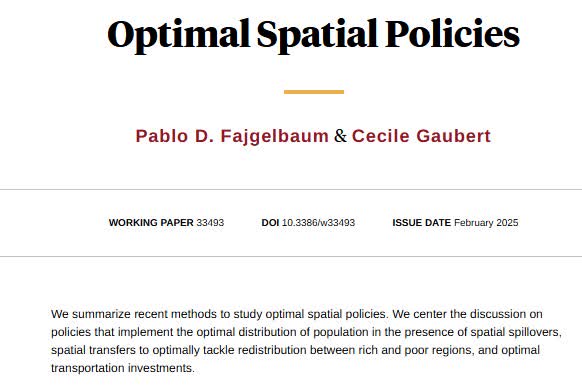
Revisiting the rationale for place-based policies using a canonical urban framework with agglomeration spillovers, from Pablo D. Fajgelbaum and Cecile Gaubert https://t.co/wNMB8W6azy
The US increasingly relies on place-based policy to help distressed regions, but many regions lack the capacity to obtain resources or implement effective policy, from Gordon H. Hanson, Dani Rodrik, and Rohan Sandhu https://t.co/c1iThjYp7O
Reviewing a decade of advances in spatial dynamic modeling, with applications to trade, climate, migration, infrastructure investment, structural change, and policy, from @klausvanieper and Fernando Parro https://t.co/K5bmIGVonQ
The 2017 Tax Cut and Jobs Act (TCJA) cut corporate tax revenue by 40%. Firms with larger cuts invested more, boosting total investment by 11%, but raised GDP by less than 1%. Brief from Gabriel Chodorow-Reich, Owen M. Zidar, and Eric Zwick (@ChicagoBooth) https://t.co/relB7TT3tT
This handbook chapter presents the major advances made in the field of economic geography over the past decade.
NEW in @nberpubs, by @TrebAllen (@DartmouthEcon) & Costas Arkolakis (@Yale): https://t.co/WPtrqMIBXB
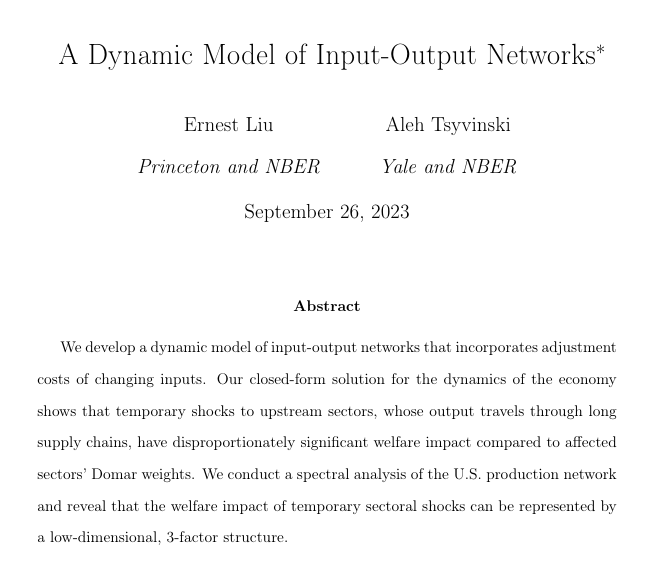
``In a dynamic production network, temporary shocks to upstream sectors have disproportionately significant welfare impact compared to affected sectors’ size.''
From @ErnestLiuEcon and Tsyvinski:
https://t.co/2EQzpPUMxR
10 Favourite Economics Books
1) Inequality - Tony Atkinson
Absolutely THE book on inequality and what can be done about it. Atkinson was a giant in the profession and this book reflects this, covering everything from tech to tax. Incredible considering its moderate length.