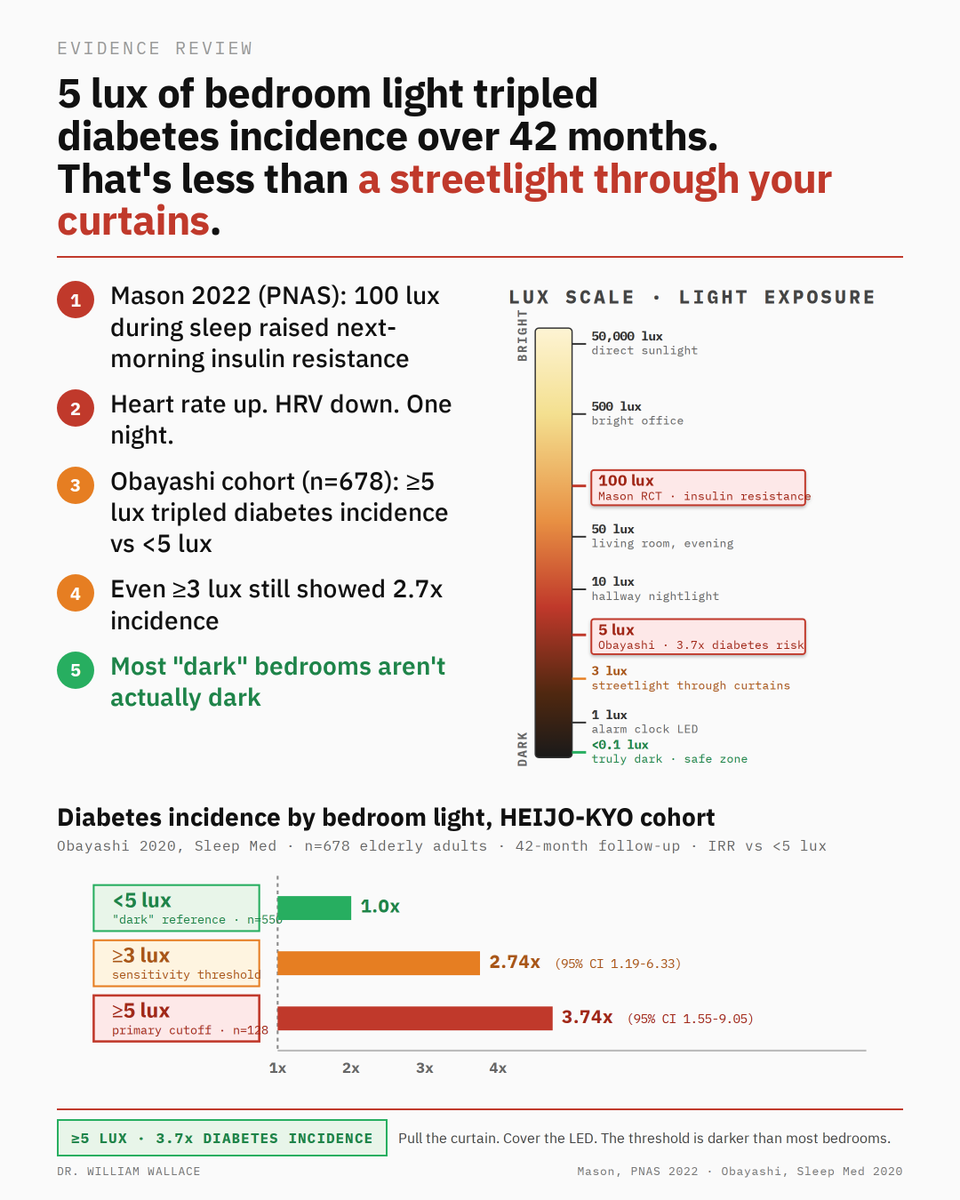
Most "dark" bedrooms aren't dark enough. The threshold where measurable metabolic effects show up is lower than almost any standard sleep environment.
Mason 2022 (PNAS, n=20): one night at 100 lux during sleep raised next-morning insulin resistance, increased nighttime heart rate, and decreased HRV vs <3 lux. Single-night, controlled.
Obayashi 2020 (Sleep Med, n=678 elderly adults): bedroom light averaging ≥5 lux during sleep was associated with 3.74x diabetes incidence over 42 months. ≥3 lux still showed 2.74x.
For context: 5 lux is roughly streetlight through curtains, or an LED display across the room. A hallway nightlight is 10 lux. Most people with any electronics, uncovered windows, or hallway bleed are above the threshold.
Caveats: Mason is small and acute. Obayashi is observational, in elderly Japanese adults. Together: aligned, suggestive, mechanistically plausible. The lever (cover LEDs, close curtains) is mechanical and free.
Mason, PNAS 2022: https://t.co/9WKr6w4zM9
Obayashi, Sleep Med 2020: https://t.co/EHSn7JML8A
Scientists have created one of the most detailed 3D reconstructions of a human cell (eukaryotic cell) ever produced.
This groundbreaking model, often termed a "Cellular Landscape Cross-Section Through a Eukaryotic Cell," combines data from X-ray tomography, nuclear magnetic resonance (NMR), and cryo-electron microscopy to map molecular structures in extreme detail.
Introducing Euphony, an open-source tool for visualizing chat data and Codex session logs.
Paste in a public URL or upload a local file, and Euphony turns the raw data into an easy-to-browse view. It supports translation, filtering, editing, and more.
Today, we’re open-sourcing the draft specification for DESIGN.md, so it can be used across any tool or platform. We’re also adding new capabilities.
DESIGN.md lets you easily export and import your design rules from project to project. Instead of guessing intent, agents know exactly what a color is for and can even validate their choices against WCAG accessibility rules.
Watch David East break down this shared visual language in action👇. New capabilities and links in 🧵
This 1 hour lecture on "Probability Theory" from MIT will teach you more about prediction markets than 2 month internship at at a Wall Street Quant firm.
Bookmark this & give it 1 hour today, no matter what. It’s the most productive start you can give your week. Then read post below.
A peanut-sized Chinese model just dethroned Gemini at reading documents.
GLM-OCR is a 0.9B parameter vision-language model.
It scores 94.62 on OmniDocBench V1.5, ranking #1 overall.
For context, it outperforms models 100x its size. 100% open-source.
It works in two stages.
1. A layout engine detects every region in a document.
2. Each region gets read in parallel.
The model predicts multiple tokens per step instead of one.
That's what makes it so fast at small size.
It handles things most OCR tools struggle with:
> Complex tables and nested layouts
> Handwritten text and stamps
> Math formulas and code blocks
> Mixed image-and-text documents
You can run it locally through Ollama.
It fits on edge devices with limited compute.
Every expensive OCR API just got a free competitor.