A belated thread on our recent paper, Predictability of Human Differential Gene Expression (https://t.co/vcvzT1BU5V) with co-authors Nathaniel Lim @SaraBallouz@JesseAGillis and @paulpavlidis (1/16)
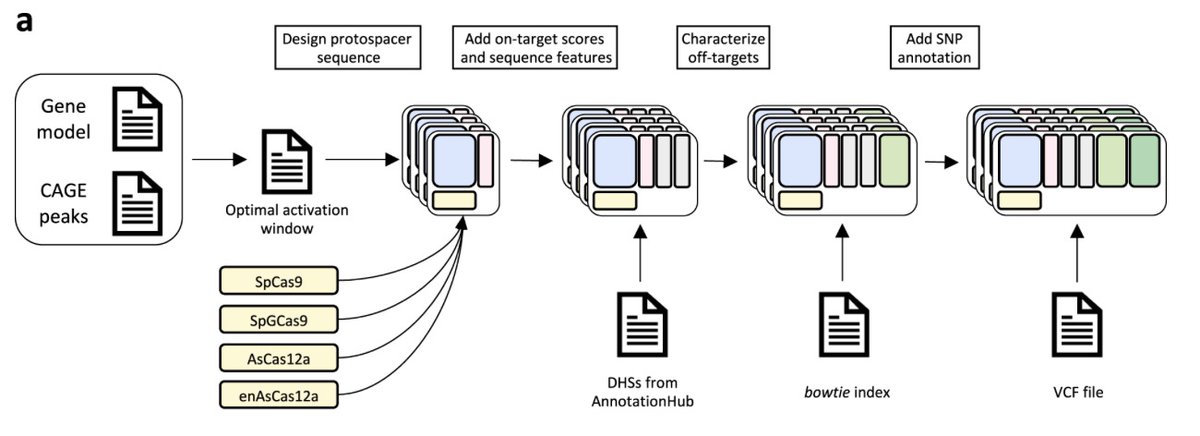
Our crisprVerse paper is out in @NatureComms.
We developed a one-stop shop CRISPR gRNA design tool that works with any nuclease and genome, and includes functionalities for CRISPRko, CRISPRa, CRISPRi, base editing, and RNA-editing.
https://t.co/4fQPlVtDch
Excited to share our recent work. We reclaim bulk RNA-seq to measure the conservation of gene expression neighborhoods in plants, animals and yeast, and find shared mechanisms of cellular diversity along the way. Feedback welcome! https://t.co/7y04bN1FmT
Excited to share my first preprint, we study co-expression in neurons using both bulk and single cell RNAseq to explain how gene-gene relationships are constant through different levels of the cell type hierarchy
This was an emotional read for me. February is now a blur, but I remember being flabbergasted by the continued narrow case definition and restricted testing. Necessary perspective on how much was lost by @alexismadrigal and @yayitsrob. https://t.co/6TA84dqx8U
We're excited to launch Next-Generation Genomics 2020! Its our second year, and we have an entirely new set of phenomenal (and junior!) speakers who are developing genomic tools and technologies. Learn more, register, and submit an abstract at https://t.co/mV9gQIDN4Y
Finally out!! Check out our paper 'Gene gain and loss across the metazoan tree of life' by @toni_gabaldon and yours truly just published in @NatureEcoEvo 1/n
https://t.co/GHbNJHQtd4
First day! I’m excited to announce that the Ballouz Lab is now officially open at the Garvan-Weizmann Centre (@G_WCentre).
Interested in computational and meta-
approaches to study (dys)functional genomics and transcriptomics? Watch this space!
Our native RNA sequencing paper as part of the GM12878 RNA consortium is out: (https://t.co/HDWSZKZ2qo). 6 different institutes across two continents worked to generate and analyze ~10M direct RNA sequencing reads. A few highlights:
I've got my first poster of grad school tonight! If you're interested in co-expression analysis in scRNAseq data, check out my poster (43) titled Methods and Statistics for Differential Co-expression in scRNAseq data tonight #cshlsca#phdchat
STAR 2.7.3a
https://t.co/ZEGm6o1yO8…
Major new STARsolo features:
cell filtering and QC summary; support for complex barcodes (e.g. inDrop);
Velocyto counts;
CB/UMI tags in BAM output;
better compatibility with CellRanger 3.x.x
Our benchmarking study of methods to automatically identify cell populations in single-cell RNA sequencing data is now published @GenomeBiology . Very proud of all the work done by Tamim and Lieke! https://t.co/82W2CNQXFN
@denk_lab @SaraBallouz@JesseAGillis Well... not necessarily! We saw a mixture of both “generic” and “specific” genes even among sets of pancreatic beta cell markers from single cell RNA-seq (Fig 5). But sorted populations certainly help with tracing the source of DE (likelier to be dysregulation than composition).