@edzitron Most of these might end up in the M&A pipeline. For the silicon, the residual value might be repurposed as long as they are protected from obsolescence. Energized shell can be repurposed. For the rest, I reckon it’s a loss they are willing to write off but could be wrong.
Much of the AI security debate is about frontier models. But a lot of people are building on open-weight models. We need to understand their capabilities and risks too. A real testing strategy covers every model, not just the frontier.
Orbital compute is becoming an AI infrastructure question, not a science-fiction one. Which workloads belong in space, which stay on Earth, and how do power, thermal limits, data gravity, interconnects, and launch economics shape the split? https://t.co/ymurq99eum
I remember the first meeting where the team pitched the idea of putting compute in space - exciting idea!
Today's successful launch with our partner @planet prototype satellite shows how far we've come...and how far there is to go. Thanks for the lift, @SpaceX, another spectacular booster landing too🚀
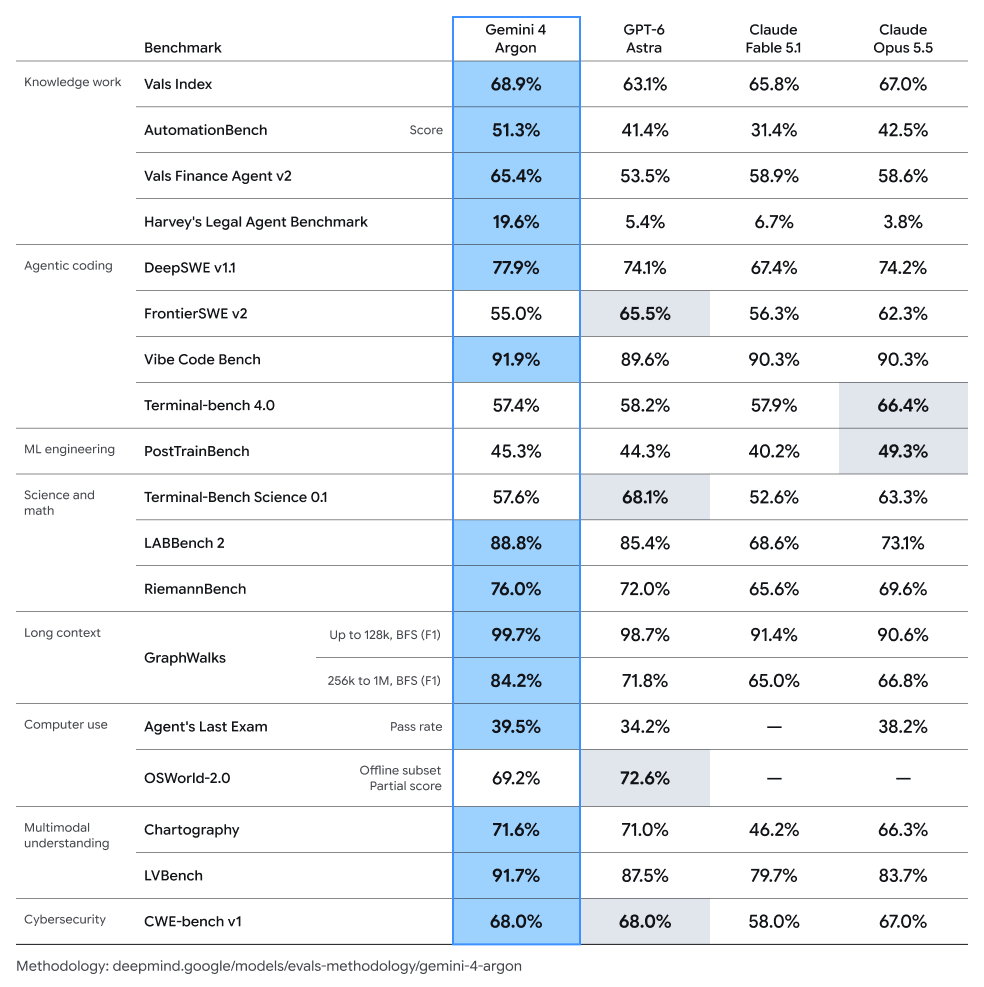
Lots of discussion out there about our next model(!), so I wanted to give an early look as soon as possible. Introducing Gemini 4 Argon!
It shows frontier performance in complex workflows, cyber defense and software engineering. Teams are using it extensively at Google, from coding to quantum computing, great feedback.
Here’s a look at the benchmarks:
Agreed. IMO, stopping daily software mistakes and boxing in current AI tools is indeed an engineering problem, because we already have the practical security blueprints to fix them. In contrast, ensuring that a future, super-smart AI truly shares human intent across every scenario is an unsolved research problem. It isn’t separate from engineering per se, but rather ahead of it. We currently lack the basic scientific laws, mathematical tools, and psychological definitions needed to even write a safety blueprint for it. This begs the question - how do we engineer the unknown?
In all fairness, World Labs spent two years in stealth building a spatial intelligence engine (Marble/Atlas) that calculates physical volume & physics instead of just guessing flat 2D pixels frame-by-frame. They proved that AI can look at just 3 to 5 normal smartphone photos and instantly build an interactive, explorable 3D replica you can fly through. Beyond the cool visuals, this acts as the foundation data engine for next-gen robotics simulation. Did they change the consumer world yet? No. But the proof of concept is a massive feat that will scale beautifully with AMD's advanced compute.
As the strain on compute continues, we will continue seeing this happen. Breaking the compute wall requires full-stack integration. Exciting times ahead for World Labs and AMD! Fusing model research with AMD’s compute & systems architecture solves the scaling bottleneck.
My ranking:
• Ilya Sutskever - Frontier AI
• Judea Pearl - Causality
• Amnon Shashua - Applied AI
• Daphne Koller - AI + biology
• Yossi Matias - Google Research
• Yoav Shoham - Enterprise Agents
• Shai Shalev-Shwartz - Learning theory and formal self-driving safety
Together, they cover where AI could go next. In Infrastructure they're quite many across NVIDIA et al.
Enterprise AI agents need enforceable boundaries: what they can access, what they can do, and what they must stop. That’s why we’re partnering with @nvidia to bring the Open Agent Safety Platform technologies into the Scale GenAI Portfolio. This will help us build, train, deploy, run, and evaluate AI agents in controlled environments with enforceable security and a clear record of their actions.
Can our TPUs survive and operate in space? Well, we're going to find out.
Project Suncatcher is hitching a ride aboard @SpaceX's Transporter-18 mission, testing a prototype satellite built in partnership with @planet
One small step for TPUs....