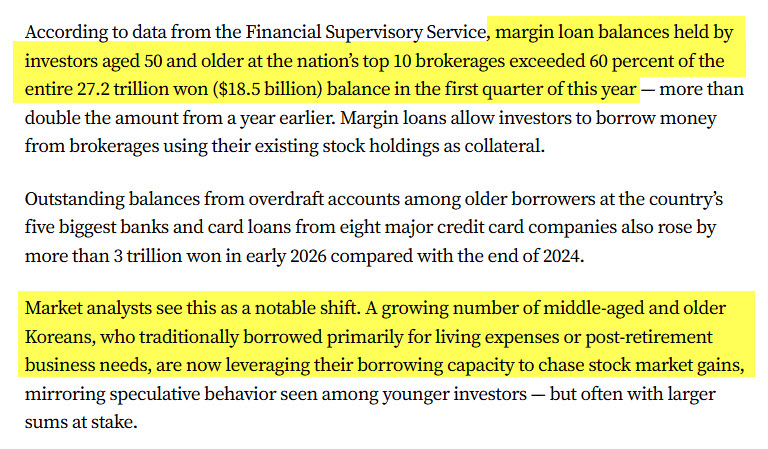
June seasonality is very clear.
$SPX
Strong early June → steady advance through mid-month → seasonal pause late month → positive finish into month end.
$AAPL
Early strength → weakness develops → one of the softer June profiles.
$MSFT
Slow start → strength builds → one of the strongest June trends.
$AMZN
Steady accumulation → consistent upside → strong finish.
$GOOGL
Strong early June → choppy middle → modest edge late month.
$META
Momentum improves as the month progresses → strongest period is the back half.
$TSLA
Early digestion → steady bid → one of the strongest late-month ramps.
$NFLX
Mid-month softness → recovers → strength returns into month end.
$NVDA
Strong first half → momentum cools → softer seasonal tendency into the final week.
June is not a straight line.
It's a month of rotation.
Early strength.
Mid-month trend.
Late-month consolidation.
If leadership continues to broaden, names like TSLA, MSFT, META and AMZN may have the wind at their back.
If not, expect money to continue rotating beneath the surface while the indexes grind higher.
$SPY $QQQ @Optuma
Key Events This Week:
1. May Existing Home Sales data - Tuesday
2. May CPI Inflation data - Wednesday
3. May PPI Inflation data - Thursday
4. OPEC Monthly Report - Thursday
5. MI Inflation Expectations data - Friday
6. MI Consumer Sentiment data - Friday
All eyes are on inflation this week.
Paul Tudor Jones opens a fireside chat with Druckenmiller by admitting one of his biggest mistakes:
"after the crash of '87, i was so worried about debt to GDP that it caused me to be short the stock market for the entire decade of the nineties."
an entire decade. one of the greatest bull markets in history. and one of the greatest traders alive sat short through the whole thing because of a macro obsession.
then Druckenmiller adds his own version:
"the one rule i had for thirty years of trading was never let my obsession with the debt interfere with my trading. because it never had market impact."
"and then i looked at the numbers and i threw out my playbook."
two of the best macro traders ever, both admitting that the hardest part of their career has been separating what they believe should happen from what the market actually does. until the math finally forces you to act.
Ken Griffin's ultimate rule for survival is brutally simple
when asked how Citadel survived a near-death experience in 2008 to become a $60 billion empire - he dropped pure reality:
"we lost 50% of our capital and our flagship fund was down $8 billion - that's when you realize your textbook risk models mean absolutely nothing"
"when you are bleeding $500 million a week you don't survive by having conviction - you survive by aggressively protecting cash"
"today we execute 20% of all US volume - we don't hold losers praying for a bounce, if the math breaks, we liquidate immediately"
Griffin didn't build Citadel by predicting the future. He built it by completely removing human emotion and ego from the equation when the market collapses.
bookmark and watch him break down the reality of risk
A market-structure read on why these parabolic moves are getting more violent.
You've got all these technical factors like leverage ETFs that are just forced to chase it higher. These leverage ETFs basically create a synthetic short gamma?
Because if there's a load of AUM in a leverage ETF and the stock goes up 5, 10%, whatever, those ETFs have to buy more stock to make sure that for tomorrow's return they can deliver 2x, 3x leverage. So it's like their short gamma, in either direction.
By the end of the day, they have to make sure they've got their exposure up (or down) so that their return will track the stock by 3x the next day.
So it's like a gamma you don't see in the options market. That these guys are effectively short.
And that creates these monster moves.
I dread to think the carnage that will eventually come from this when these names turn south.
IRAN SIGNALS IT IS STICKING TO ITS ORIGINAL POSITION IN NUCLEAR TALKS, WITH NO MAJOR CONCESSIONS EXPECTED
TEHRAN CONTINUES TO REJECT KEY U.S. DEMANDS, INCLUDING HANDING OVER HIGHLY ENRICHED URANIUM STOCKPILES AND CHANGES TO ITS CORE NUCLEAR POLICY
#BREAKING
Winston Churchill never hid the fact that he suffered from depression. He called it his “black dog” — a dark shadow that could follow him even when he stood at the height of power.
But Churchill had his own way of keeping that darkness from completely taking over. It was not grand speeches or political victories. It was a simple physical act — laying bricks.
At his estate, Chartwell, he personally laid around 200 bricks a day. Row by row, wall by wall. He built garden walls, utility buildings, sometimes entire structures. What mattered was not only the result, but the process itself.
His principle was simple: keep the hands busy so the mind can rest. When heavy thoughts overwhelmed him, he picked up a trowel. When anxiety tightened its grip, he laid one brick. Then another. And another.
They say Churchill took this craft so seriously that he even joined a bricklayers’ union. Imagine that: the British prime minister carrying a builder’s union card.
There is a phrase often associated with his experience: depression does not like a person who keeps moving.
Sometimes the path through darkness begins not with a great decision, but with one small action. Take a step. Complete a simple task. Lay your own “brick” today.
And tomorrow — lay another one.
BREAKING: Iran directly rejects Trump's claim that Hormuz "will be opened" as part of a "largely negotiated" agreement he just posted on Truth Social, saying Trump's claim is "far from the truth" and that Hormuz "will remain under Iranian management" with Iran retaining exclusive permanent authority over route, timing, method, and permits, per Fars.
Iran also confirms the nuclear file has not been discussed and that American officials themselves have told Iran in multiple messages that "Trump's tweets are primarily for domestic American propaganda and media consumption" and "should be disregarded." The "largely negotiated" deal claim therefore has no basis.
This game has transformed my life, my family’s life, my friends’ lives, and even the lives of my future grandchildren. For that, I am eternally grateful to God for the success He has given me.
At the same time, make no mistake, this game is one of the most cancerous and dangerous in the world. It can ruin and cripple you financially, socially, psychologically, and emotionally in ways you cannot imagine.
If you are playing this game at the highest level, not casually investing, you have to be willing and aching to answer its call at every second of the day. And honestly, monetary advancement alone is not enough to keep you in it. Something has to be socially wrong with you to be obsessed in a way that is difficult to even characterize. You have to be obsessed with solving this puzzle every single day.
If that is not you, it is probably a better choice to avoid it entirely. Very similar to mishandling an AK-47, small mistakes in this game can be life altering.
For my fellow lunatics, another day, and into the fray we go. Blessings and love your way 🫡
I think Warsh talks tough at first because he cannot look like he is easing into an oil shock, especially with diesel, freight, fertilizer, food, and insurance costs still elevated. But if he sees what we are already seeing underneath, deteriorating labor quality, rising defaults, higher bankruptcies, weaker consumers, and businesses starting to protect margins, he may cut earlier than the official data appears to justify. Not because rate cuts fix the Strait of Hormuz. They do not. But because he understands the lag.
Energy shocks hit in stages. First prices spike. Then freight, food, input costs, and insurance rise. Then margins compress. Then consumers trade down, travel slows, businesses pull back, hiring weakens, defaults rise, and industrial output gets cut. That is when oil can finally fall even if supply is still tight, not because the system healed, but because demand got crushed.
So the Fed’s move would not be about solving oil. It would be about trying to cushion the credit and labor damage from the demand destruction they know is coming. Warsh cuts early only once he has enough cover from weaker labor internals, widening credit stress, bank tightening, or a Treasury rally that pulls long yields lower. He will cut because the oil shock is turning into a full blown demand contraction.
To put this in perspective, the second worst prior oil shock on a daily supply loss basis was the Iranian Revolution at roughly 5.6 million barrels per day. The current Iran and Straight of Hormuz shock has reportedly removed more than 12 million barrels per day from the market, meaning the daily shortfall is more than double the previous modern record. The cumulative crude loss was already around 624 million barrels after 52 days, and if Shell is right that the hole is now nearing 1 billion barrels, this is no longer just an oil price story. It is an inventory depletion story.
That is what markets keep missing. The 1973 Arab oil embargo was around 4.5 million barrels per day at peak and caused a multi year inflation and recession shock. This is larger, faster, and hitting a far more leveraged global economy with tighter diesel, jet fuel, LNG, fertilizer, freight, and refinery systems. Even if the war ends tomorrow, the missing barrels do not magically reappear. Inventories have to be rebuilt, shipping routes normalized, refineries restarted, insurance repriced, and physical fuel markets repaired. The second order damage is not the headline price spike. It is the months of shortages, margin compression, consumer stress, and policy panic that come after the market realizes the buffer is gone.
Something every new trader struggles with: picking the right technical method.
There's traditional technical analysis. Smart money concepts. Elliott Wave theory. Candlestick patterns. Order blocks. Order flow. Footprint charts. List goes on
After doing this for over a decade, here's a simple fact:
They all lead to the same outcome. Just different journeys.
Think of it like a road trip.
You can use:
- Paper road maps
- Atlases
- Roadside signs
- Google Maps
- Apple Maps
- Waze
- GPS devices (Garmin, TomTom)
- Car built-in navigation
They all get you to the same destination. Some are faster. Some give you more detail. Some are easier to use.
But at the end of the day? You still arrive.
Trading methods work the same way.
Traditional technicals? Works.
Smart money concepts? Works.
Elliott Wave? Works (if you have the patience).
Order flow? Works.
The method isn't the problem. Sticking with one long enough to actually learn it is.
New traders jump between methods like they're switching GPS apps every 5 minutes.
You'll never arrive if you keep switching.
Pick one method. Learn it. Master it. Stick with it through the losing streaks.
The journey might look different than someone else's, but if you stay on the path, you'll get there.
There isn't one perfect method.
When you run an options book with lots of positions it can get messy.
The way pros think about a portfolio is by aggregating the Greeks
𝗗𝗲𝗹𝘁𝗮 : your directional exposure. Longs vs shorts. Maybe some beta adjustment. You're paid to be right on direction.
𝗧𝗵𝗲𝘁𝗮 : your decay-harvesting trades. Calendars, flies, strangles. You're paid for time passing inside a range.
𝗩𝗲𝗴𝗮: your volatility exposures. VIX trades, dispersion, vol of vol. You're paid when implied moves a certain way.
Some times these Greeks can work in opposing directions.
For example, you might be bet NET long DELTA but you are also long VEGA, so in a rally the PNLs may work against each other. There will also be scenarios where they work in the same direction.
Understanding this interplay between how the Greeks are likely to behave across many scenarios it what allows you to capture edge over time.
The recent QQQ rally in second half of April was a good example where being long Vol and long Delta had a ton of alpha because you were protected in the sell off but crushed it on the rally because the vol performed so well in the move.
I'm going to be brutally honest here
I pay almost no attention to news headlines
they almost never feature in my market analysis-
and if they DO, my outcomes are almost always worse
(short thread)
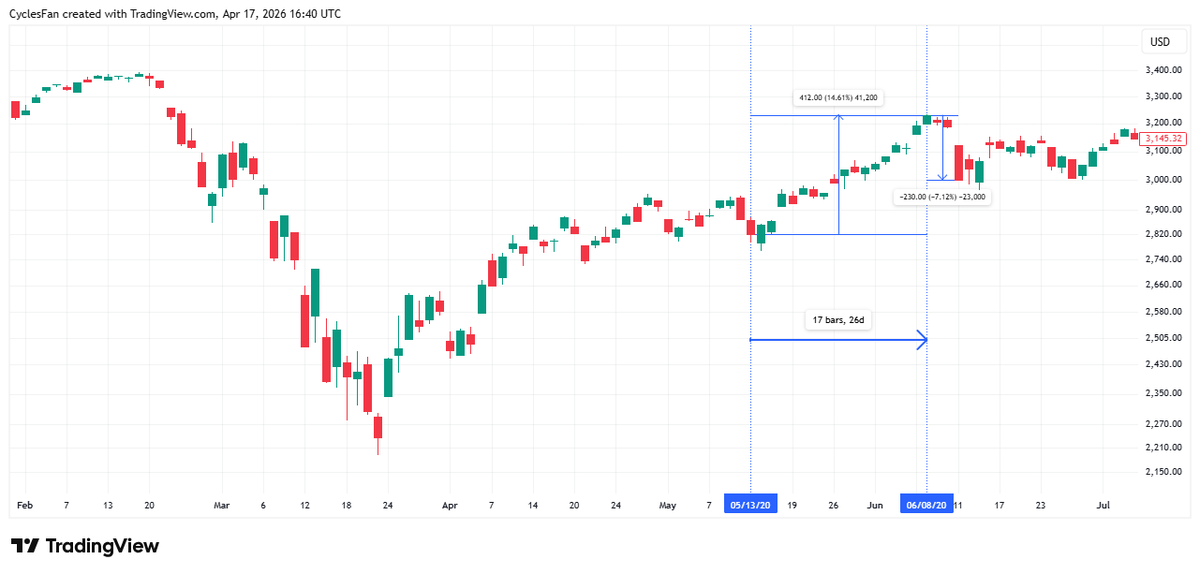
This is interesting because the May 14-June 8, 2020 rally has a few similarities to this rally. It rallied 14.6% in 17 trading days vs. 12.5% in 13 trading days so far. In 2020 there were 4 gaps vs. 3 gaps in this rally. Then it had a 3 day 7% selloff.
https://t.co/lA0xjg0E9K
🇮🇷We will maintain control of the Strait of Hormuz until all Iran’s rights are secured.
We reject any extension of the ceasefire.
We are prepared for a long war — the Americans are not.
This is merely a pause, not peace.
Any ground invasion of Iran will fail completely.
By any number of measures, the U.S. economy is entering a period of unusual strain. Pressures are building simultaneously across immigration, trade, housing affordability, technological disruption and energy costs, an uncomfortable convergence that invites comparisons to the turbulence of the 1970s. The difference now is not just the breadth of the challenges, but the nation’s diminished fiscal flexibility to respond.
From account close to Tehran—not saying it’s correct, but it’s the first real colour we’re getting on what any interim Hormuz reopening during the ceasefire could look like:
“During the two-week ceasefire, only about 10 to 15 ships will be permitted to pass through the Strait of Hormuz with Iran's approval, in coordination with the IRGC Navy and after payment of tolls, and the United States is committed to releasing all of Iran's frozen assets. The Strait of Hormuz will in no way—even after a final agreement—be "open" as it was before.”
Relative to the pre-war pace of 100-120 ships a day, this would constitute a crack in the door and hardly a proper reopening.
Let’s see how many we get tomorrow.
You can get very very rich over the next 1-2 months. Chaos creates asymmetric opportunity. But you MUST wait for the fat pitch. Dont force it. It’ll just appear…always does. And when you see it, do not hesitate. So ignore the chop for now, just survive, and wait. It’s coming…