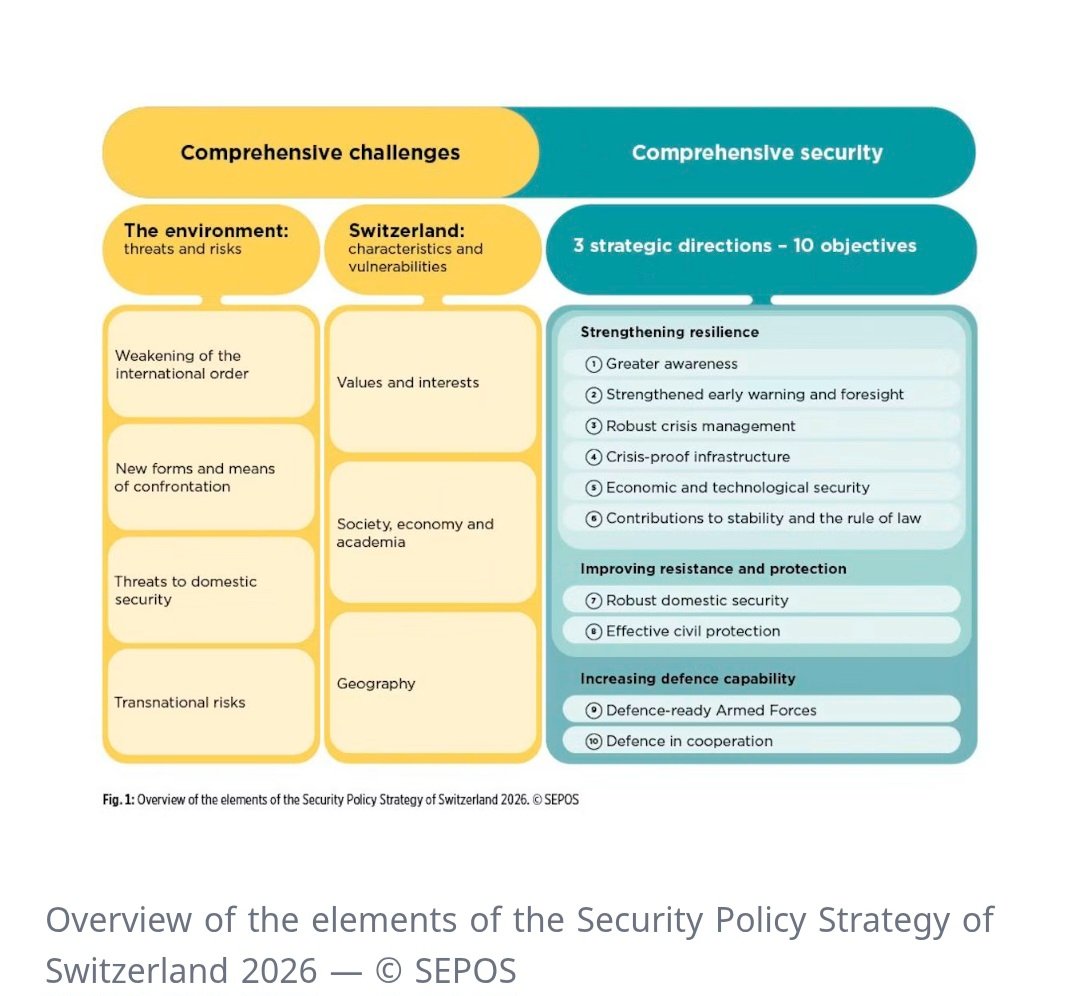
🇨🇭 I’ve gone through Switzerland’s 2026 Security Policy Strategy, and the message from Bern is pretty clear: Switzerland believes its security environment has deteriorated significantly and is preparing for a much more uncertain Europe.
The strategy describes a world becoming more fragmented and unstable, with growing rivalry between major powers, increasing pressure on the international rules-based order and a much more dangerous European security environment.
Switzerland specifically points to Russia’s war against Ukraine, Russia’s expanding war economy and the risk of a wider confrontation between Russia and NATO. It also highlights China’s growing military and global influence, increasing US-China rivalry and the fact that Europe can no longer assume the same level of US security support as in the past.
For Switzerland, the biggest concern in the coming years is hybrid warfare and long-range attacks.
That includes cyberattacks, espionage, sabotage, disinformation, influence operations, attacks against critical infrastructure, drones, ballistic missiles and cruise missiles.
The strategy says a direct armed attack against Switzerland is unlikely in the foreseeable future, but also warns that the situation could change rapidly.
🇨🇭 Switzerland plans to strengthen critical infrastructure against sabotage and cyberattacks, improve intelligence and early-warning capabilities, modernise emergency communications, maintain and expand protective structures and prepare civil protection for armed conflict.
It also wants stronger counter-drone capabilities and better coordination between civilian authorities and the military.
On the military side, Switzerland wants to close capability gaps, increase ammunition and spare-part stocks, improve endurance and develop stronger capabilities against long-range threats.
One particularly notable measure is the planned development of a long-range offensive component as part of deterrence, allowing Switzerland to engage key systems beyond its borders if necessary.
At the same time, Switzerland says it wants significantly deeper security cooperation with NATO, the EU and European partners, including military air-situation data sharing, multinational exercises, interoperability, cooperation with NATO structures and the ability to defend itself together with partners if an armed attack exceeds its own capabilities.
The strategy also says several coordinated cyberattacks or acts of sabotage against critical functions could potentially be considered together when authorities assess whether an armed attack has occurred.
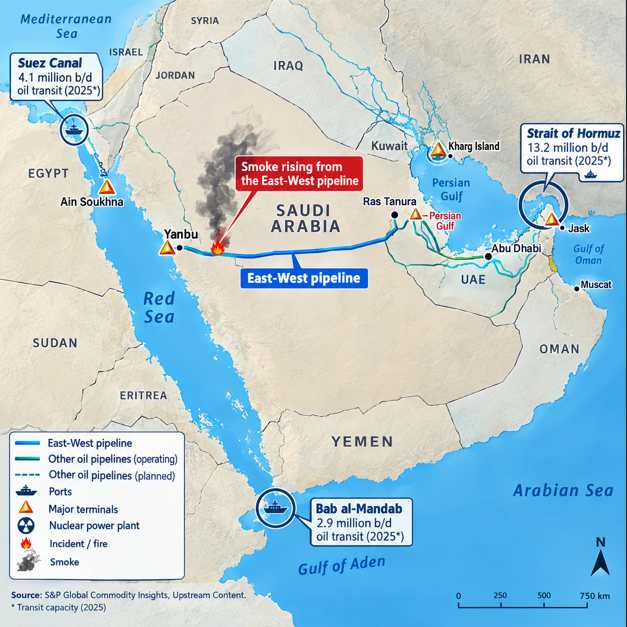
Smoke is rising from the East-West pipeline, the main oil pipeline available to Saudi Arabia to avoid the Strait of Hormuz.
The Houthis are stepping up a massive offensive against Ryihad.
We are really close to a major oil price spike and global energy shockwave.💥🇸🇦🇾🇪🇮🇷🧵