@banteg@SCBuergel@claudeai I was doing some app for myself. It included timers. I asked for a feature where "you can arm and disarm timers". It made a change, and after that I didn't work anymore on the codebase due to safety guardrails until I renamed these parts manually.
Gateway has completed its SOC 2 Type 2 report for Security, covering the design and operating effectiveness of its security controls from January 31, 2026 to April 30, 2026.
This report is another step Gateway has taken to support secure, reliable infrastructure for institutions building onchain financial products. Together with ISO 27001, SOC 2 Type 2 adds another layer of assurance to Gateway’s security and compliance foundation.
We expect regulated onchain finance to become an increasingly important part of the global financial infrastructure, making security, operational resilience, and compliance readiness critical to scaling it responsibly.
@Gateway_eth brings production experience across RPC, validators, node services, rollups, appchains, and developer tooling.
As a Guardian operator, Gateway is helping make private blockchain infrastructure production-ready for builders on Miden.
Read their Operator Story:
https://t.co/syUWGx15Fw
The first batch of Guardian operators on Miden is here:
OpenZeppelin
LambdaClass
Gateway
Private accounts are powerful. But if they’re going to be usable in real apps, they need recovery, synchronization, coordination, and serious operators behind the infrastructure.
Guardians are cool because they make onchain privacy practical.
But also because you’re not trapped with one forever. You can switch.
That’s why having many Guardian operators on @0xMiden matters!
(also @OpenZeppelin@gateway_eth & @class_lambda are uber-cracked teams 🤗)
Eventually blockchains will be the basis for any asset transfer the same way how email will replace the traditional post system entirely. Neobanks will be an important stepping stone. So far they were nice frontends on old money rails … this will change
While Gnosis Pay will be back soon for all users, if you are in some sort of emergency situation where you need the cash on your card immediately, please reach out to @gnosispay support, and we will try to find individual solutions as quick as possible.
Just landed in Amsterdam for Money20/20 this week. If you’re here and working on stablecoin settlement, tokenized assets, payments, or the next layer of regulated onchain finance, I’d be glad to connect. I’ll be in town until Friday - ping me and let’s grab a coffee.
@gateway_eth
@gnosispay Deleted an earlier tweet that asked users to withdraw funds. Most users will not be able to do so, but we are actively working to contain the damage. We believe we can contain the majority of it, and in any case, we will ensure that all users are made whole.
Unfortunately, there is a hack related to @gnosispay and the "delay module".
Please be patient while we try to contain the damage. Rest assured, Gnosis will cover all user losses.
I was doing a simple DSP for a hobby project.
I asked an agent to optimize as much as possible the existing implementation in a loop.
To another agent I said exactly what I want to do (C++, NDK for Android, static memory). The 2nd one did like 3 orders of magnitude faster implementation and negligible RAM usage.
Agent's don't solve the Dunning-Kruger effect.
I've got an agent in a loop optimizing a renderer with the goal to minimize frame times (and tests to measure). It got times down from 88ms to 2ms and allocations down from ~150K to 500. Sounds good, right? Wrong. This is exactly why agent psychosis is a big fucking problem.
As an experiment, I rewrote the Ghostty core render state in Go, with access to identically laid out data structures as Ghostty and the exact same validation tests. I made a purposely naive renderer (simple, correct, but slow). 88ms per frame with 150,000 allocations (horrendous, lol)!
I then kickstarted a Ralph loop to bring the frame times down. I told it it can't modify input data structures or the public API or tests (they're correct), but it can do anything else it wants. It got to work.
It has worked for about 4 hours. I've spent around $350 on this experiment so far. The results?
88ms => 1.5ms
150K allocs => ~500 allocs
Incredible right? Nope.
My hand-written renderer I ported has frame times (same benchmark) of ~20us (0.020ms) and 0 allocations in the update path.
This is the problem with psychosis and lacking systems understanding. If you don't understand the system, you're going to accept that this is an incredible result. If you understand the system, you'll see better solutions immediately and can do roughly 75x better on throughput.
The people who blindly trust agent output are in the former camp. They're sheeple, overdrinking from a fountain of mediocrity.
Standard disclaimer: I use AI all the time. I like AI. The point I'm making is to not blindly accept results. Think. Analyze. Learn.
I've got an agent in a loop optimizing a renderer with the goal to minimize frame times (and tests to measure). It got times down from 88ms to 2ms and allocations down from ~150K to 500. Sounds good, right? Wrong. This is exactly why agent psychosis is a big fucking problem.
As an experiment, I rewrote the Ghostty core render state in Go, with access to identically laid out data structures as Ghostty and the exact same validation tests. I made a purposely naive renderer (simple, correct, but slow). 88ms per frame with 150,000 allocations (horrendous, lol)!
I then kickstarted a Ralph loop to bring the frame times down. I told it it can't modify input data structures or the public API or tests (they're correct), but it can do anything else it wants. It got to work.
It has worked for about 4 hours. I've spent around $350 on this experiment so far. The results?
88ms => 1.5ms
150K allocs => ~500 allocs
Incredible right? Nope.
My hand-written renderer I ported has frame times (same benchmark) of ~20us (0.020ms) and 0 allocations in the update path.
This is the problem with psychosis and lacking systems understanding. If you don't understand the system, you're going to accept that this is an incredible result. If you understand the system, you'll see better solutions immediately and can do roughly 75x better on throughput.
The people who blindly trust agent output are in the former camp. They're sheeple, overdrinking from a fountain of mediocrity.
Standard disclaimer: I use AI all the time. I like AI. The point I'm making is to not blindly accept results. Think. Analyze. Learn.
I’ve seen a pattern that keeps showing up when I review institutional on-chain architectures.
The instinct, especially for teams coming from a traditional SaaS background, is to layer privacy and compliance as separate services on top of an otherwise transparent stack. Access control in one service, audit logging in another, sanctions screening through a third-party API, travel rule data handled at the application layer.
The failure mode is predictable. When a regulator asks to reconstruct what happened in a specific transaction, the answer requires correlating logs across multiple systems with different data models and different timestamp resolutions. The compliance evidence exists, but assembling it under audit pressure is a manual exercise.
The architectural alternative worth thinking about is collapsing access control, disclosure, sanctions screening, travel rule, and audit logging into the same proxy layer that mediates every RPC call. Each request gets processed through all five in sequence. The audit trail is structurally coherent because all five share the same request context.
For engineering leads designing this layer in 2026, it's worth deciding early whether the architecture stays unified or fragments.
Genuinely the funniest shit is it has literally always been this way
Key compromises and opsec and failures at traditional layers have ALWAYS exceeded “true” defi exploits
Yet people keep shilling smart contract audits as the solution and then get scared by the AI
😆
We’re sharing our completed post-mortem on the April 18th incident, prepared with @Mandiant and @CrowdStrike. We are publishing both an executive summary and the full report at the link below.
Over the past four weeks, we’ve worked with hundreds of partners to help them understand their current security posture, and harden it where appropriate. We’ll continue this work, alongside taking additional proactive steps for the benefit of not only our partners, but also the ecosystem as a whole.
We want to extend our thanks to our partners for their support and patience this past month. There’s a reason that over $12 billion has moved across the network in the past four weeks, and why the world’s most valuable asset issuers have stood by our side: they believe in us, in what the LayerZero protocol has to offer, and in the value of modular, isolated, application-controlled security.
The work continues. And we look forward to continue showing up for the applications that trust us with their business, as well as the broader ecosystem.
https://t.co/7bILN6dPJz
For some reason, AI has convinced people that closed-source software is the way forward.
It's not. Security through obscurity isn't security.
Anyone claiming otherwise is too dumb to understand the problem and thus must not propose solutions.
Speak less, listen more.
Agent task duration doubles every 7 months. Horizon: 59 mins.
An hour of autonomous financial workflows is the new tempo.
Compliance must adapt: agent identity, spending governance, real-time audit, automated enforcement.
Same intent. New tempo.
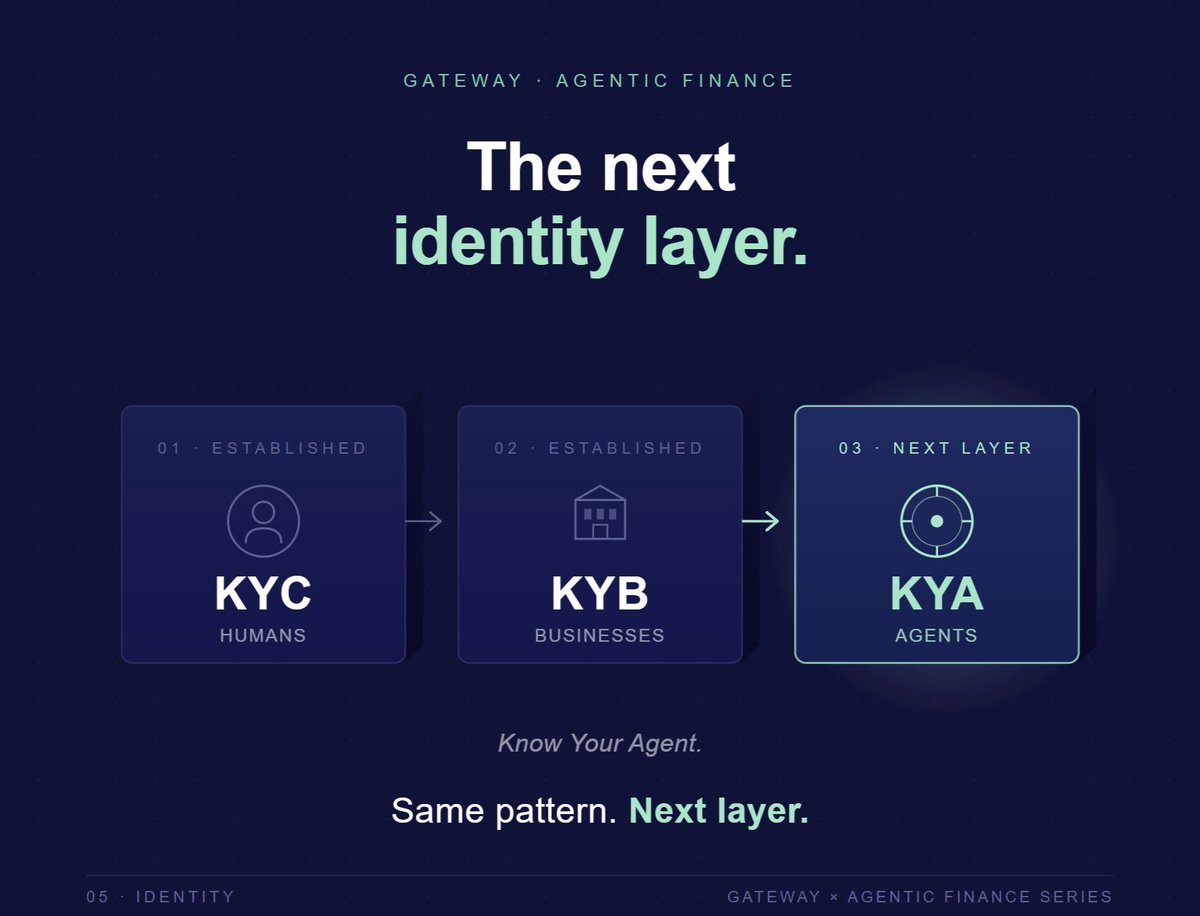
KYC for humans. KYB for businesses. KYA (Know Your Agent) is next.
Agents access APIs, move funds, transact across borders. The identity layer is being built around them now.
Same pattern. Just the next layer.