Megacaps:
You are slowly starting to see signs that megacaps can’t afford to fund the AI trade anymore
First with their actions: raising debt, in some cases diluting and now passing on prices to customers
And then with their words: Apple slated MU today, Microsoft said they can’t afford memory so have to push prices up. Google, meta and Amazon have not said anything yet.
It’s going to be very interesting how this plays out
Good thing Trump is investigating Big Oil. But 85% margins on memory that's raising the price of every electronic device on the planet is ok....
Fed gonna need Supercore ex-Memory soon
@QPhysics2024@SixSigmaCapital Bingo. Been running them side by side for 2 days. Absolutely no reason to pay for Gemini when GLM beats it at everything, for free.
@Davidgek97Q@calvinfroedge It's the only moat still standing. GLM 5.2 gonna be a problem for valuations. Might have to bomb z(dot)ai as a matter of national security to keep the Q's floating.
@crossbordercap@Tyler_Neville_ Thank you for providing neutral quality data in this era of euphoric bias. May I ask what you take on usdjpy is here, seems ominous its straight back to 161 despite boj intervention. What options do they even have left here despite a new plaza accord type of coordination?
Orion-100B is the first step in a larger programme, which we call Project Orion.
Having shown viability in the present case, in the coming months we intend to progressively relax the current restrictions to demonstrate the efficacy of IOTA as a more generalised, decentralised system.
That subsequent work will deliver further proof points as we progress step by step through the following:
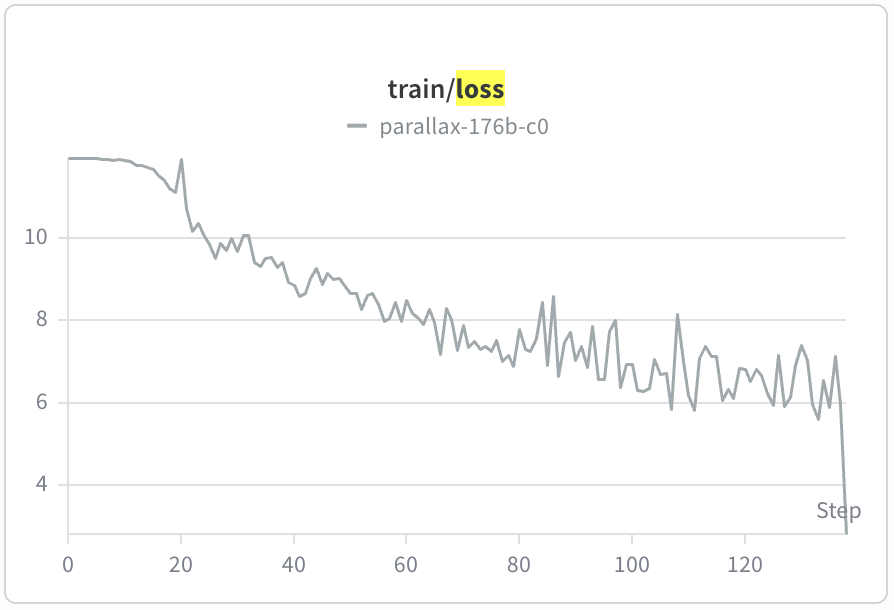
Just for fun I kicked off a run of a 176b parameter model on ~140 steps to prove feasibility - 4 separate nodes across the internet using the "Parallax" method, works like a charm.
Still need a more concrete plan on dataset curation, phases, context elongation, etc. etc. before a full run is ready of this scale, but at least we know 176b should be no problem at all.
@MichaelMOTTCM What would you expect the BoJ to do though? Japanese consumers are getting crushed. Just wait for the repatriation laws and the carry trade unwind in a year or two. 4 trillion in US equities leaving could be quite something.
@DonMiami3 Farmers gobally are on their knees. Weather in quite a few major ag regions not cooperating. Corn, sugar and soy shifting toward biofuels. I'd say wheat breaking out today is just the start. The entire soft coms complex desperatly needs a repricing.
Last week at the @YumaGroup Summit I had the opportunity to present on The State of Bittensor.
That presentation is in the thread below. If you choose to read it, I'd ask that you keep the following three things in mind:
1. This is just one guy's view of what was the most relevant for a 25-minute talk; a difficult filter for such a dynamic industry
2. The slides were designed to supplement a talk; I've done my best to replicate what I recall of the talk in the accompanying X posts
3. The topic of the Summit was "The Tipping Point" - a candid assessment of what could lead to Bittensor's breakout success and what evidence we see of that today - which also thematically anchored this presentation
Let's dive in:
There's a forest in Utah where every single tree is actually the same tree. 47,000 trunks growing out of one giant root system, all clones of the same parent. The whole thing weighs about 13 million pounds, around 40 blue whales worth. It's called Pando, and it's been alive for around 80,000 years. Humans hadn't even started painting in caves yet when this thing took root. It's the heaviest living thing on Earth.
Trees do some properly weird stuff. When a giraffe starts eating an acacia tree in Africa, the tree releases a warning smell into the air within minutes. Other acacia trees nearby pick up that smell and immediately start pumping bitter chemicals into their own leaves, before the giraffe even gets there. Giraffes have actually figured this out and learned to walk upwind, so they can get a few bites in before the trees notice them.
In 1997, a Canadian scientist named Suzanne Simard found that trees in a forest are connected to each other underground, through a giant web of tiny fungus threads that link them all together. Her experiments showed that one tree can send food and chemical messages to another tree through this fungus network. The press nicknamed it "the wood wide web." Some of the bigger claims about trees being one happy family are still being argued over by scientists, but the basic idea, that trees pass signals to each other underground, is now solid science.
And some live for thousands of years. There's a tree in California called Methuselah, a kind of pine, that is almost 4,860 years old. It was already 200 years old when the first Egyptian pyramid was built. There's another one growing nearby that scientists think is over 5,000 years old. Both were already ancient when Stonehenge went up.
Trees also do something to your body when you're around them. A Japanese researcher named Qing Li ran an experiment. He had people spend a few days walking in forests, then took their blood. The cells in their immune system that fight off viruses and tumors had jumped sharply, and the boost lasted for over a week after they got home. He had another group take the same kind of trip but to a city instead. They got nothing. The trees were releasing some kind of compound into the air that the city didn't have.
The tallest tree in the world is in California too, a coast redwood named Hyperion. 381 feet tall (taller than the Statue of Liberty), around 700 years old. A single trunk holds 550 million leaves. You're sharing the planet with all of this.
IT’S COMING HOME 🏆
Out of 1000+ startups that applied to the @ParisBlockWeek startup competition, we take the win.
Big moment for us and for the Bittensor eco. Huge congrats to @arnod3f and @manakoarchie on the stage today.