Australian banks are under siege from hedge funds – up to $11bn of stock now shorted, and more than half of it is CBA.
The short bank trade has been known as the 'widowmaker' – the banks defied gravity and just pushed higher. Maybe this time the shorts finally get rewarded.
If banks are going to struggle and resources are going to struggle, the ASX 200 is going to struggle.
Under Labor's new capital gains tax, if you're on the top tax rate, have a 6% mortgage and 2.5% inflation, you need to earn 9.1% investing - no small feat - just to break even with putting your money in a mortgage offset account. That's before you are compensated one cent for the risk you took, the double taxation, the time and effort.
Say you want to make at least 3% after tax above putting money in your offset account. A modest benefit. You would need to make 14.76% in the market. Do that consistently and you would be ranked amongst the greatest investors of all time. That's right - Labor's hurdle for investing as an Australian is you need to be amongst the greatest investors of all time. So if you're John Templeton or Walter Schloss, no worries.
High Court - Bendel Decision.
So the High Court today found against the Commissioner of Taxation in the significant Bendel case. Critically the High Court found that the ATO approach “was a failure of statutory application”.
The Commissioner, under protest, did the wrong thing for 16 years. Costing SME’s literal billions in additional tax and administration costs.
Who at @ato_gov_au is accountable for this? Who pays the price? Who loses their job? Who compensates the mistreated SME’s?
Business will have to find it from somewhere… (currently near-record high business insolvencies, along with near-record low consumer sentiment).
Costs ($6–8b PA) will more than likely be passed on to consumers (inflation).
Those businesses that can’t pass on the costs could join the growing list of insolvencies and even create indirect job losses.
Pay rises are great, but they should be tied to productivity growth.
You grew up in Public Housing in Scotland Doug, in a difficult economy that saw you lose your job and have zero employment prospects, so you moved to Australia and did well with multiple available jobs in a much freer and growing market.
And you decided the right response to that was to join the union and bring hardcore left Scottish and Northern English unionism and you were joined by your fellow countrymen who left because of Thatcher. You united in you hard left roots from failed counties and cities and spent the rest of your working life trying to reimpose things that didn’t work over there on those of us here in Oz.
Now you are retired on a comfy Australian taxpayer funded pension and you are again longing for the failed system of Glasgow in the 60’s and 70’s and fighting for a much worse time.
The comments contributing to this almighty ratio aren't just the usual one-liner insults. Many reveal the now deep, righteous anger of the 'silent majority' who voted NO to the race-based 'Voice to Parliament'.
No doubt she thinks her statement would be popular with 'tax the rich!' socialists.
But inheritance in Australia doesn't come from aristocratic 'old world' money. It comes from the blood, sweat & tears of the majority middle class already taxed to death on every dollar. Most receiving it still have to work hard, regardless.
Many in the comments are calling her stupid. It is an astonishingly stupid post. However, suggesting inheritance doesn't equate to hard work is an attempt to shame those receiving it, which is emotionally manipulative propaganda likely paving the way for more communist death taxes.
Australia’s private capital community is sounding the alarm on the Federal Budget tax changes.
We just ran a rapid survey of founders, executives and investors.
The early results are brutal!
Investors:
- 94% concerned about the capital gains tax changes
- 88% say their willingness to invest in Australian companies/funds has dropped
- 71% are now more likely to invest offshore
Founders & Exec:
- 70% are currently raising or planning to raise in the next 12 months
- 88% are at least considering moving, expanding or setting up overseas
- 38% say the R&D Tax Incentive is critical to their cash flow
One founder put it bluntly:
“I would shut down and terminate employment of 12 Australians if I didn’t get the R&D Tax Incentive.”
Another: “CGT changes will make Australia the most expensive place in the world to build and exit a business.”If we want more innovation, jobs and globally competitive companies, we need to listen to the people actually taking the risk.
Survey still open → we’re putting real evidence into the submission.
Investors click here - https://t.co/gF5WYXPRg8
Founders click here - https://t.co/gF5WYXPRg8
What’s your take? Are these tax changes going to drive capital and talent offshore?
The last time Australia paid off its national debt was 2007.
Interest on government borrowing now costs more than Medicare.
Every budget assumes the best possible income and the lowest possible spending.
Then they borrow another trillion when reality arrives.
This is not budgeting. It is hoping.
This Betashares article by does a very good job explaining why the proposed return to CGT indexation could quietly kill off direct share investing in Australia.
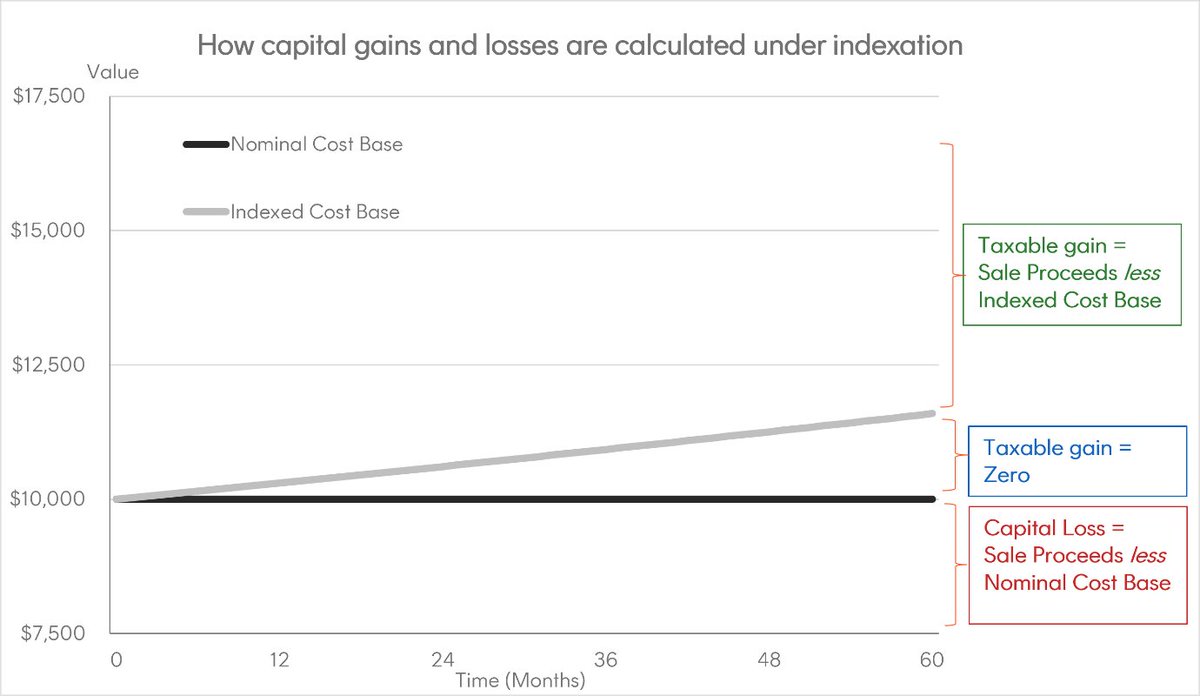
Their “triangle of sadness” analogy shows the core problem... under the proposed rules, capital gains are measured against an indexed cost base, but capital losses are still measured against the original nominal purchase price.
That means if some shares underperform inflation, investors can suffer a real economic loss without receiving a corresponding tax loss.
Meanwhile the winners remain fully taxable.
The result is that diversified direct share portfolios can end up paying tax on gains that don’t actually exist in real terms.
Ironically, ETFs may reduce much of this distortion because the portfolio is treated as a single pooled CGT asset, although the same issue can still emerge if an ETF itself underperforms inflation over long periods.
The longer you invest, and the more diversified your share portfolio becomes, the worse this asymmetry potentially gets for direct shareholders.
That’s very bad news for all direct shareholders and particularly the smaller end of the Australian share market, which doesn’t benefit from being inside ETFs or from large passive index flows.
https://t.co/8YNHr6LLEz
Cheaper electricity? The truth will SHOCK you...
The 'renewables are cheaper' claim is everywhere right now... but is it true?
Who are you going to believe? Your own power bills? Or the minister's press release?
Support my work: https://t.co/BLnqyT134x
"The next Atlassian, Canva, Cochlear or WiseTech does not emerge from a government department. It emerges because someone decides to take a risk. If you reduce the reward for success while leaving all the risk intact, rational people simply stop trying."
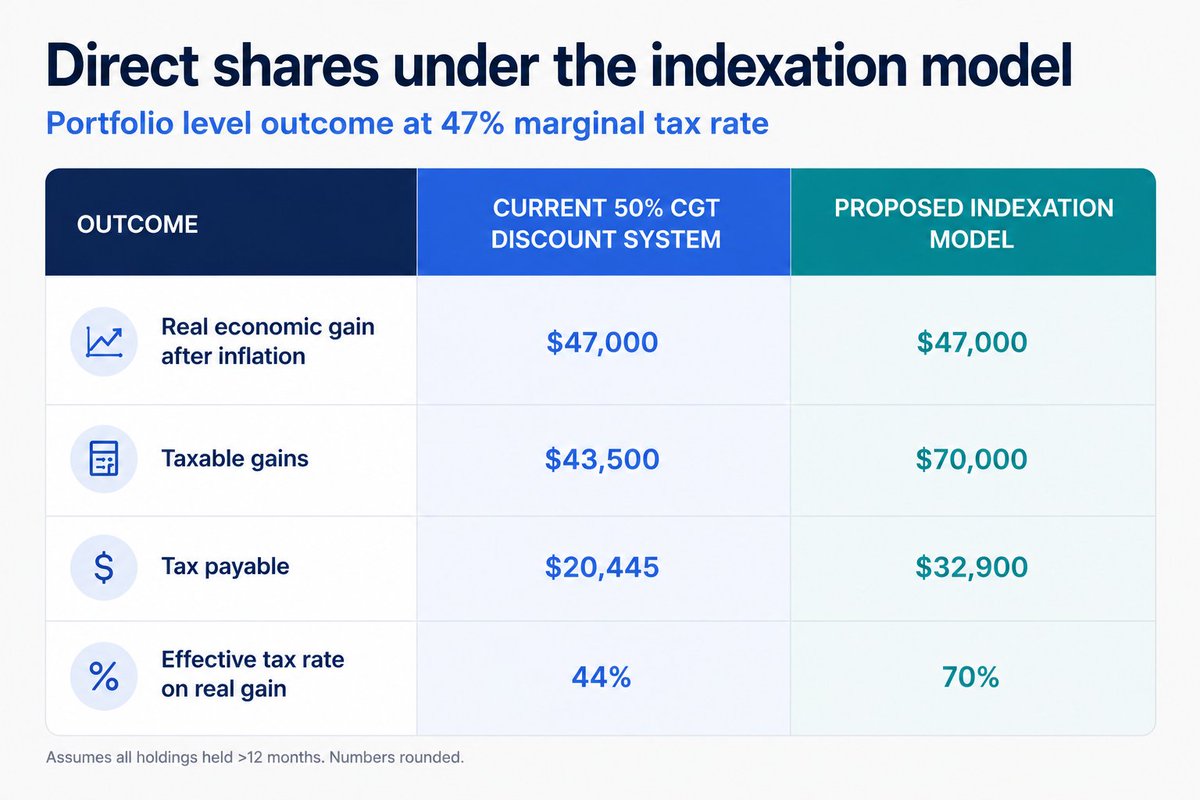
Under the proposed CGT changes, the effective tax rate on a direct share portfolio could rise from 44% to 70% because inflation adjusted losses can’t offset gains unless shares fall in nominal dollar terms.
That means portfolios with a few big winners and lots of average performers (which is how most real world portfolios behave), get hit hardest.
The result is that direct share investing becomes much less attractive than ETFs and pooled investment structures for most Australians, far more so than Treasury’s modelling appears to assume. https://t.co/Efmea0I5oq
Credit @DerekFranc90653@Johnkehoe23 who discovered this impact due to stock return dispersion.