I saw this same video on one of those "China bad" YouTube channels, and it said this was spray paint because China can't grow things. Two days later, I have this same spray on my yard because the construction guys had to fix some pipes, and they used this to grow the grass back. So yeah, I completely fell for the spray paint thing like an idiot. Since then, my eyes have been opened to the lies about China and just how silly I was.
(its a nutrient rich spray filled with seeds)
China-haters who used to claim that 'China is painting itself green' didn't know that this spray is actually to grow plants and grass.
Reality:
1. China has planted 78 BILLION TREES.
2. This green spray helps grow grass and plants.
📢WESTERN MARXISTS SAY: “China’s ‘socialist’ paradise is a clown show of contradictions that would make any real Marxist vomit.”
They ask, “how can the People’s Republic of China run the most advanced Marxist-Leninist state and the most developed market economy in human history—while pretending the two aren’t in open war with each other?”
In my humble opinion, the real problem is good old fashioned Western hubris. The truth is, it’s not your precious Western free-market capitalism. Nor is it your dead Soviet command economy. It’s pure Chinese engineering, and your bleach demon snowflake categories can’t contain it.
Here’s the part that exposes every clueless Westoid: China has zero inheritance tax, zero nationwide annual property tax on your average citizen’s home, and zero capital gains tax on domestic listed stocks for individual investors.
Name one modern Western power—capitalist or “communist”—that ever delivered all three at once without their system imploding under its own greed and bureaucracy.
You pathetic Eurocentrists always measure everything against your own rotting yardstick because your inbred brains literally cannot process a civilization that refuses to kneel to white models.
China doesn’t fit your little boxes. It never did. It built something stronger while you were busy worshipping your own reflection.
And that’s exactly why your kind’s arrogance is dragging the West straight into the next Dark Ages—while China keeps rising.
Now don’t caveman chimp out and get mad, just prove me wrong 😑
Fantastic episode by @andreijikh talking about the master plan
While I can see why @LukeGromen thinks a rising Dollar means the "plan" is failing, it's actually the opposite
They've engineered a Dollar shortage precisely because they are creating a global sovereign debt crisis.
Global debt is denominated in Dollars. An oil shortage + Dollar shortage forces nations to sell their U.S. treasuries before maturity, significantly below face value.
This forced liquidation of US Treasuries will allow the Federal Reserve to print and take them out of circulation, thus reducing the total outstanding debt of the United States.
No country in the world has even close to the same level of incarcerations per capitas as does the USA.
Why? It might be because prison slavery is legal in the USA.
In India, Dalit women are forced to have their hair cut in public by higher caste men, as a form of humiliation ritual.
Beatings and rapes have also been normalized as a form of reinforcing the caste hierarchy.
One Dalit mother once said, "If we are untouchables, when why do they touch our daughters"?
india is a savage land with a savage culture that is totally incompatible with modern society.
Caste-based violence against Dalit women is one of the most underreported and systematically ignored human rights crises in the world. The fact that these acts — public hair cutting, beatings, sexual violence — are ritualized rather than random tells you everything: this is structural domination, not isolated crime.
What makes it more insidious is the legal impunity. The Scheduled Castes and Scheduled Tribes (Prevention of Atrocities) Act exists on paper, but conviction rates remain abysmally low. Perpetrators often belong to dominant-caste networks with local political protection.
And internationally? Silence. Because India is a democracy, a tech powerhouse, a geopolitical ally — so the uncomfortable conversation about its internal apartheid gets sanitized.
Dalit women sit at the intersection of caste, gender, and class — triply marginalized, with the least institutional recourse. Their bodies have historically been treated as sites where caste "honor" is enforced and contested.
Justice here isn't just about individual prosecutions. It requires dismantling the social legitimacy that makes perpetrators feel entitled — which means confronting Brahminical patriarchy directly, not euphemistically.
Solidarity with Dalit women isn't optional for anyone who claims to stand for human dignity. It's the baseline.
I’m in Shenzen.
It’s clear China has implemented a much more effective capitalist system than the US.
And Chinese consumers are the main beneficiaries. Far more choice of cheaper, quality products: electric cars, smartphones etc.
And these are not just copycat products.
Even industrial design here feels like an evolution of what I’ve seen in the US. I wouldn’t be surprised if the next iPhone looks similar to a current model of phone made by Honor or Huawei.
A more accurate description of the US economic system might be “capitalism with American characteristics”
A report from a Japanese military medical conference held in March 1940 suggests that the Imperial Japanese Army may have repeatedly conducted experiments in China involving the transfusion of animal blood into humans during its invasion, local media reported Saturday.
The experiments were carried out in the autumn of 1938 at an undisclosed location, and the identities of the 23 test subjects were not specified, Kyodo News said.
The document indicates that the experimenters injected some subjects with animal blood or serum, specifically including large-volume transfusions of horse blood into those critically ill individuals due to blood loss and injections of chicken blood into humans to observe how long it remained in the human body. It also recorded adverse reactions among the subjects, including high fever following the transfusions.
Kyodo News noted that such practices constituted a clear violation of medical ethics. The document was discovered in a journal published by the Japanese Army Medical Corps, despite efforts by Japan's military authorities to destroy evidence related to human experimentation after the country's defeat in World War II.
In recent years, Japanese researchers and media outlets have successively uncovered additional evidence of wartime atrocities, including human experimentation conducted by the Japanese military.
Some historians argue that Japan should thoroughly reflect on its aggressive war and its brutal acts, particularly regarding wartime atrocities such as human experimentation.
#JapaneseMilitaryMedicalConference #March1940
#ImperialJapaneseArmy #ExperimentsInChina #AnimalBloodTransfusions #WartimeAtrocities #UncoveredEvidence #ReflectOnAggressiveWar
#BrutalActs #WWII #History
This is the most ironic part of the AI race.
The U.S. has tried everything:
sanctions,
export controls,
GPU restrictions,
access bans,
national-security excuses,
and even blocking Chinese users from frontier models.
And yet it still has to wake up every day wondering:
Has the excellent student without a good pen already finished the exam?
Zhipu’s GLM-5.2 is a 744-billion-parameter model.
It secured the No. 2 global ranking on Code Arena for front-end coding, trailing only Anthropic’s Fable 5.
It pushed Zhipu to the world’s third-best AI lab, behind only Anthropic and OpenAI.
It has a 1-million-token context window.
And it was released as open weights while Anthropic was restricting access to Fable 5 under U.S. government pressure.
That is the real story.
America is trying to win AI by closing doors.
China is trying to win AI by building anyway.
The student they tried to deny a pen is still writing the answer sheet.
What is true freedom?
We often hear than the United States has freedom and China doesn’t but what’s the most important aspect of a “free” society? Safety
I’m enjoying a nice afternoon in a local mall in Guangzhou and people routinely leave their bags, computers, purses right on the table in the open with no worries. Why? Because no one in China will take this laptop.
Try that in the US and your laptop would be gone in a couple of minutes. It’s one of the things I most respect about China.
I often like Ray Dalio's takes on China but he gets quite a lot demonstrably wrong in this FT article on the "tribute system."
China's ancient tribute system - called 朝贡 (cháogòng) in Chinese - is typically very misunderstood in the West: we typically think it involved tributary states paying some form of "tribute" to China in exchange for protection - the way medieval vassals would pay fealty to a lord in Europe.
In reality, it had little to do with that. In fact, it was almost the opposite: in the Chaogong system, it was actually China paying the "tributary states."
The system was basically a quid-pro-quo where China would get "得名" (dé míng, literally "getting name/prestige") while tributary states would get "得实" (dé shí, literally "getting substance/material benefit") in exchange. It was about China paying huge amounts of money and other material benefits for the recognition of its centrality.
That's what makes it so alien to the Western framework, where tributary states are paying UP to the center, and security is enforced through military presence. The Chaogong system was almost exactly the inverse on both counts: China was paying DOWN and regional order was maintained not through the military but through generosity.
The core guiding principle of the system was established by the Hongwu emperor, the founding emperor of the Ming dynasty (incidentally one of the most interesting emperors in Chinese history since he is the only founder of a major dynasty who started off in life as a wandering beggar).
The principle he set in place was 厚往薄来 (hòu wǎng bó lái) - literally "generous outflow, modest inflow": giving out much more than you take in. This wasn't a byproduct of the system - it WAS the system. The entire architecture of Chaogong was built on this principle of asymmetric generosity.
Very concretely the way it worked is that tributary states would pay largely symbolic tribute to China (like local specialties and curiosities, the system codified that tribute should be "easy to obtain and not costly", 必易得而不贵) and they would in exchange receive 3 layers of economic benefits:
1) Immediate payback in the form of money and expensive goods (silk, brocade, porcelain, tea, silver, etc.), which value was typically dozens of times the value of the tribute received by the emperor
2) The right to trade during their tribute visit: the envoys' entourage could trade with specially licensed Chinese merchants at the Huitongguan (the official guesthouse in the capital)
3) Most importantly, and that's where the real money was, they would be granted the right to trade at Chinese ports. Under the Ming maritime prohibition, tributary status was the only legal entry point into the Chinese economy
China being China, this gave rise to some pretty funny hustles. The deal was so good that people started inventing entirely fictitious countries just to get in on it. There are several documented cases of people fabricating countries and showing up as "envoys" at the imperial court just to claim the privileges (https://t.co/nlJB8yWblv).
Another funny one is that there are several cases of Fujian merchants who would sail to Southeast Asia, get themselves appointed as minor officials by local rulers, then sail right back to China as "foreign envoys" - carrying huge commercial cargoes. In 1438, three members of Java's tribute delegation turned out to be guys from Fujian (https://t.co/QBES0IVprC).
The scam got so widespread that the Ming had to invent a credential system (勘合, kānhé) specifically to verify that tribute envoys were who they claimed to be and that the countries they came from were real.
More seriously though, the Chaogong system also led to big domestic tensions in some of China's neighboring countries, notably Japan which was permitted only one tribute mission per decade. The stakes were so high that the 2 most powerful feudal clans at the time (the Ōuchi and the Hosokawa) fought a shadow war over who controlled the trade license.
This culminated in the Ningbo Incident of 1523 (https://t.co/TgKtlc7zlO): two Japanese delegations from both rival clans arrived at the port of Ningbo and got into a dispute over whose credentials were legitimate, which ended up in a pitched battle on Chinese soil. They ended up rampaging through the city, killing Ming military officers, and altogether terrorizing the local population - all over who got to trade with China.
The aftermath of the Ningbo Incident led to the total breakdown of Japan-China trade. If that sounds familiar, it should...
Which brings back to today and Ray Dalio's description of China's tribute system, as well as his claim that we're facing some sort of modern revival of it in Asia.
First of all, some parts of his article are correct: there is indeed a significant power shift happening in Asia, with countries hedging by building closer ties with Beijing, and the US progressively withdrawing and altogether losing ground.
He is also completely right that Chinese strategic culture genuinely differs from Western strategic culture: as he writes they indeed play Go (WeiQi) and not chess.
He is however wrong to describe the tribute system as one based on pressure and intimidation. As we've just seen, it was pretty much the opposite: the basic idea was to be so generous that everyone wants in (to the extent that countries would literally fight to be tributaries), not so threatening that nobody dares leave.
He also - weirdly - seems to conflate the tribute system with the Art of War, treating them as two faces of the same Chinese playbook, when they've got strictly nothing to do with each others. They're not even from the same school of thought: the Chaogong system is fundamentally Confucian (以德服人, "winning people through virtue") whereas Sun Tzu is from an entirely different Chinese intellectual tradition - the Strategist school (兵家) - which is about as far removed from Confucian thinking as Machiavelli is from the Bible.
Mashing them together reads like someone who has picked up a handful of Chinese cliché references and treats them as interchangeable ingredients in a single "Chinese strategic culture" soup.
All in all, he makes the error WAY too many Western commentators do with Chinese concepts: he uses them as exotic wrapping paper for a fundamentally Western analysis. Strip away the Chinese terminology and his argument is actually pure Western thinking: what he is claiming is that China, as a rising power, is using its growing economic and military weight to reshape the regional order, weaker states are bandwagoning, and the declining hegemon can't stop it.
He is essentially taking Graham Allison's "Thucydides Trap," awkwardly draping it in misunderstood Chinese concepts, and presenting it as if it were Chinese thinking.
That being said, he is ironically correct - I think - that there is some form of revival of a tribute-like system but not in the way he understands it: China will (and does) use trade - its "generosity" - as a gravitational force to pull countries into its orbit. Not by threatening to cut them off, but by making the relationship too valuable to walk away from. THAT is much closer to how the actual Chaogong system worked.
It doesn't mean that the system is purely benevolent. The flipside of generosity is the absence of it: in the original tribute system, you could be cut off the way Japan was after the Ningbo Incident in the 16th century. And it's also what's happening - to some extent - to Japan today: after PM Takaichi declared that Japan would go to war with China over Taiwan, China has systematically restricted trade with Japan. Same story with what happened, for instance, to Australia in 2020 over PM Morrison's declarations on Covid.
The pattern is the same: the reward for participation is trade, and the punishment for hostility is its withdrawal. Essentially in the tribute system there is no stick, just a carrot: the stick is taking the carrot away.
Which, incidentally, is why you can be extremely confident that China will go to enormous lengths to develop its internal market, and why the current situation where China runs huge trade surpluses is facing mounting pressure to change from within China itself. If countries don't feel they're benefiting enough from trade with China, the entire logic collapses. That's why developing domestic demand isn't some target China sets itself to assuage Western demands, as some claim: it's genuinely a strategic imperative.
It's also why it's ironic that the West is so keen on pushing China to boost domestic consumption: in effect, it means we're already in a de-facto Chaogong-like system and they're asking that the carrot be bigger.
-----
I also wrote a Substack version of this post, which you can find here: https://t.co/jBUIVbDT9C
There is a total potential for a global depression based on oil supply
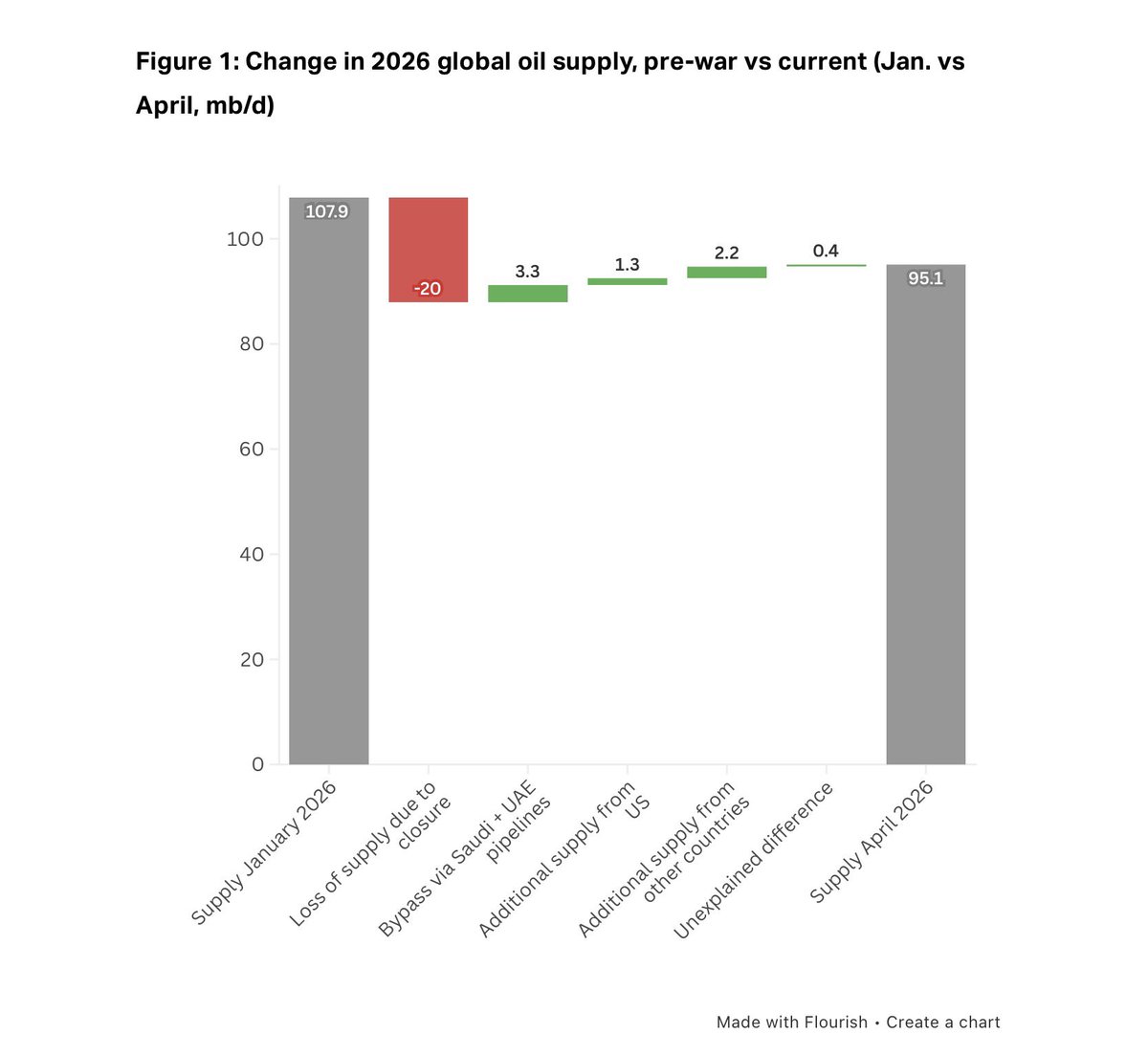
The oil data site Breughel published on June 15, when the “Iran” MoU was being finalized but not yet signed, a report and charting of the global shortfall of oil obtaining at that late date.
Of 107 million bpd consumed globally before the war, 20 million, or 19% of all, had been lost. Then in stages, Saudi and UAE land pipelines, China extra supply, and U.S. exports had been added (the U.S. contribution being significantly the smallest and most difficult of the three), totalling about 6 million bpd. That left 14 million bpd lost to worldwide oil use, or 10%. Comparable loss of LNG.
Then, “Even in the event of a swift reopening of the Strait, the global oil market is expected to remain undersupplied well into 2027 as restarting production facilities and global logistics take several months. Restoring the pre-war supply chain means relocating hundreds of tankers from other trade routes, moving workers and reopening oil fields. Above all, shipping companies and producers must regain confidence in the region’s future stability to restart shipping and production there.”
https://t.co/GEWgDaxrNG
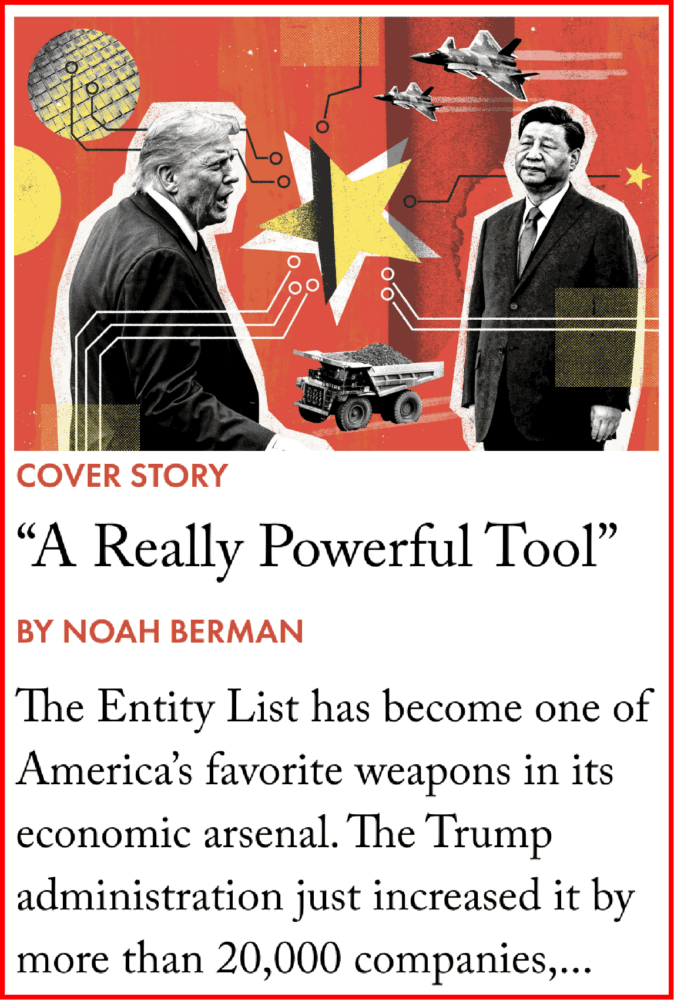
The Japan story in 2010 is very telling actually. I recalled Western press saying bad thing about China using earth earth as a weapon, but I recalled China having told the West to get their own because China can't be the sole seller of rare Earth materials. Well, 16 years later, the West did virtually nothing, assuming the Chinese will always do the dirty work only and blamed the Chinese as usual. Furthermore, since 2018 under Trump 1.0 Cold tech war and escalating tech war on China, it literally only retaliated last year with rare Earth ban of Western MIC only.
But Trump 2.0, even after China visit on May 2026 have not reduced tension significantly with more Chinese firms in the entity list. Hence, China retaliated against US firms which are attending to make rare Earth materials. It is actually extremely tolerant of China to act like this because China hopes US and West could acquire the wisdom of the Chinese to form a more cooperative world. Instead, it looks like the West is doubling down as it thinks hegemony is natural and good. I think this is going to be extremely turbulent time in the coming years, as China increasingly counter act against the escalating policy of the West.
✨🇨🇳Xi Jinping:China seeks to achieve common prosperity, but this does not mean egalitarianism. We will first make the "pie" bigger, and then divide it well through rational institutional arrangements, so that everyone can benefit as the tide rises and each gets their due. We will ensure that the fruits of development are shared by all people in a more equitable way.
@Bensam123TV@KuittinenPetri@RnaudBertrand By sharing AI tech advances through open source? Giving the rest of the world a chance to use AI tools that are truly open and available for all?
I have been writing about this for years and Eric Schmidt just says it aloud. The American elite wants to control the entire globe - a global tyranny, which disguises itself as land of freedom & democracy. What would be Europe's role in this? Just renters and enablers? And what about Israel - who controls whom?
And would China be even allowed to have anything if the Western elite could decide, except source of cheap labor and production?
Even the so called truth-seeking mission of X seems to have failed as it gets very defensive when you ask about Chosen people. They translated for a short time Hebrew language posts, but pulled that out soon, not make it less visible how vile and nasty thoughts many of these people have. And SpaceX is of course deep into the wars and regime change operations with the crucial satellite communications it provides. The U.S. government - primarily spearheaded by the Department of Defense/War and NASA - is SpaceX's largest single client.
OpenAI, Antrophic, Google, Microsoft etc. all work with US government and department of war/defense and in the intelligence apparatus.
The elite and the ruling class have morphed into more or less single entity, but of course it has warring factions, so it is not by any means uni-mind. But they all agree on one thing: they intend to control and own everything.
Eric Schmidt saying the quiet part out loud: "What I don't like about [China's AI] is that it's all open source which means it's largely uncontrolled and not controlled in any way by us."
He adds, "if that makes you feel any better," that only 2 or 3 countries can be independent AI powers.
In other words, it's all about hegemony: the ideal scenario is a world where AI is controlled by the US - and the fewer countries that can resist that, the better.
Src for the video: https://t.co/Gk5iAMtBqa
Breaking: The Ministry of Commerce of China has just announced a decision to place 10 U.S. entities—including Aviox—on the export control list; any ongoing export activities involving these entities must cease immediately.
"Export control is a powerful weapon not exclusive to the United States"—this move by China is a reciprocal countermeasure against the U.S. government's egregious practice of adding companies to its so-called "List of Chinese Military Companies." The 10 U.S. entities included in the list—spanning sectors such as military drones, aerospace, maritime operations, radar, and domestic critical rare-earth supply chains—are part of the U.S. defense supply system or are military-related entities attempting to sever their reliance on China.
In accordance with the *Export Control Law of the People's Republic of China*, the *Regulations of the People's Republic of China on the Export Control of Dual-Use Items*, and other relevant laws and regulations—and in order to safeguard national security and interests while fulfilling international obligations such as non-proliferation—it has been decided to place 10 U.S. entities, including Aviox, on the export control list (see attachment) and to implement the following measures:
I. Export operators are prohibited from exporting dual-use items to the aforementioned 10 entities; organizations and individuals from any country or region are prohibited from transferring or providing dual-use items originating in China to these entities. Any ongoing export activities involving these entities must cease immediately.
II. In special circumstances where export is deemed necessary, export operators must submit an application to the Ministry of Commerce.
This announcement takes effect on the date of its promulgation. Ministry of Commerce, June 22, 2026
Export Control List (June 22, 2026)
1. Aveox, Inc. Address: 2265A Ward Ave., Simi Valley, CA, USA Zip Code: 93065 Common Name: AVEOX
2. Red Cat Holdings, Inc. Address: 2800 S West Temple St., Unit 2, South Salt Lake, UT, USA Zip Code: 84115 Common Name: Red Cat
3. Teal Drones, Inc. Address: 2800 S West Temple St., Unit 2, South Salt Lake, UT, USA Zip Code: 84115 Common Name: Teal Drones, iDrone
4. IMSAR, LLC Address: 940 S 2000 W #140, Springville, UT, USA Zip Code: 84663 Common Name: IMSAR
5. Jaia Robotics, Inc. Address: 22 Burnside St, Bristol, RI, USA Zip Code: 02809 Common Name: Jaia Robotics
6. Ball Aerospace & Technologies Corp. Address: 10 Longs Peak Drive, Broomfield, CO, USA Zip Code: 80301 Common Name: Ball Aerospace, Space & Mission Systems business of BAE Systems
7. Oshkosh Defense, LLC Address: 2307 Oregon Street, Oshkosh, WI, USA Zip Code: 54902 Common Name: Oshkosh Defense
8. L3Harris Maritime Services, Inc. Address: 3835 E Princess Anne Rd, Norfolk, VA, USA Zip Code: 23502 Common Name: L3Harris Maritime
9. MP Materials Corp. (MP Materials Corp.) Address: 1700 S Pavilion Center Drive, Eighth Floor, Las Vegas, NV, USA Zip Code: 89135 Common Name: MP Materials
10. USA Rare Earth, Inc. Address: 100 W Airport Rd, Stillwater, OK, USA Zip Code: 74075 Common Names: USAR, USARE