Plasmids are now available on @Addgene for hyperfolder YFP (hfYFP), monomeric hfYFP (mhYFP), large Stokes shift monomeric GFP (LSSmGFP), LSSA12, and FOLD6. We also have an experimental triple hfYFP to play with, like 3xGFP.
https://t.co/jWVP1Sj5ea
I've redone the protein-ligand interaction analysis from de Freitas without using "hydrophobic interactions". H-bonds strong & weak are certainly in abundance. The six classes of interactions are:
1. H-Bonds
2. Pi-Pi
3. CH...HC
4. Cation-Pi
5. Sigma Hole
6. Pi hole
Today in partnership with @emblebi, we’re releasing predicted structures for nearly all catalogued proteins known to science, which will expand the #AlphaFold database by over 200x - from nearly 1 million to 200+ million structures: https://t.co/GjVES2pBFY 1/
Online today from our lab @HAW_Hamburg : ultraID our compact and hyperactive enzyme for proximity-dependent labeling 👉https://t.co/ejNL9uQWT8 UltraID is almost half the size of TurboID, with similar labeling kinetics but with less background activity
Plasmids available @Addgene
Excited to share IgFold, our new method for fast, accurate antibody structure prediction! IgFold achieves state-of-the-art accuracy for conventional paired antibodies and provides useful error estimates for its structures. https://t.co/FidL39Cq3E
A thread about using fonts/typography in presentations. Decisions about text matter. Just as you can speak the same word in many ways, the way you write text can affect communication, emotion, and attitude. 🧵1/19
Coot 1 is out and it’s cooler than ever!🎉 #ccp4
✅ the GUI has been re-implemented
✅ the graphics has significantly improved, you can now export maps and models as glTF files to be used in #Blender3d and other 3D software.
✅ coot is now a module to be imported in Python 3
Our paper is out today in @ScienceMagazine, I’m stoked @OpenCellCZB !
Check out https://t.co/83dtszf63x: CRISPR tagging + 3D live imaging + IP mass spec to map the human proteome.
https://t.co/4hHLSInapu
👇 tweetorial from our 2021 pre-print.
The #AlphaFold source code has been updated and now accounts for multi-chain protein complexes - providing a significant improvement in accuracy for predicting protein interactions: https://t.co/4gyZ0loLrd
Generate predictions from your browser via: https://t.co/2Vd4itjElu
Lots of interesting work recently on using #RoseTTAFold and/or #AlphaFold to predict protein-protein interactions:
https://t.co/XTpPQxHrhW
https://t.co/zXI5hyQ7Vm
https://t.co/IduFGgE3Q6
https://t.co/p2Rx6M24cq
https://t.co/rP1IjNoNOW
Great review by John King & Anisha Shakya on phase separation of DNA https://t.co/47eh9GL5Su Note, the concept about "regions enriched in CTCF sites flanked by closely spaced nucleosome arrays that increase rigidity of chromatin" is from @chrsclrksn et al https://t.co/hrj8ATxduP
Our cryoDRGN ❄️🐉 paper is out! A deep generative model for reconstruction and analysis of protein structures from cryo-EM images, including discovery of new conformations and visualizing continuous dynamics. 1/
Multi-particle #CryoEM refinement by @DTegunov applied to tomographic data from @Liang_Xue_ in Julia Mahamid's lab @embl enabled us to see an antibiotic bound to its ribosome target inside a bacterial cell. Great collaborative work now published:
https://t.co/hdFIjIZD90
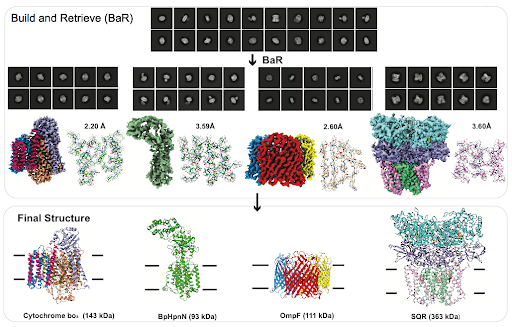
The iterative “Build and Retrieve” (BaR) methodology from Edward Yu from @CWRUSOM and colleagues facilitates solving cryo-EM structures of multiple membrane (and soluble) proteins simultaneously. https://t.co/kxTD7y9c5u
Hey chromatin folks! I am incredibly excited to share my first preprint paper and first paper from the Funabiki lab with you! "Near-atomic resolution nucleosome structures and their variations in interphase and metaphase chromosomes" https://t.co/d2UAmqUwGz
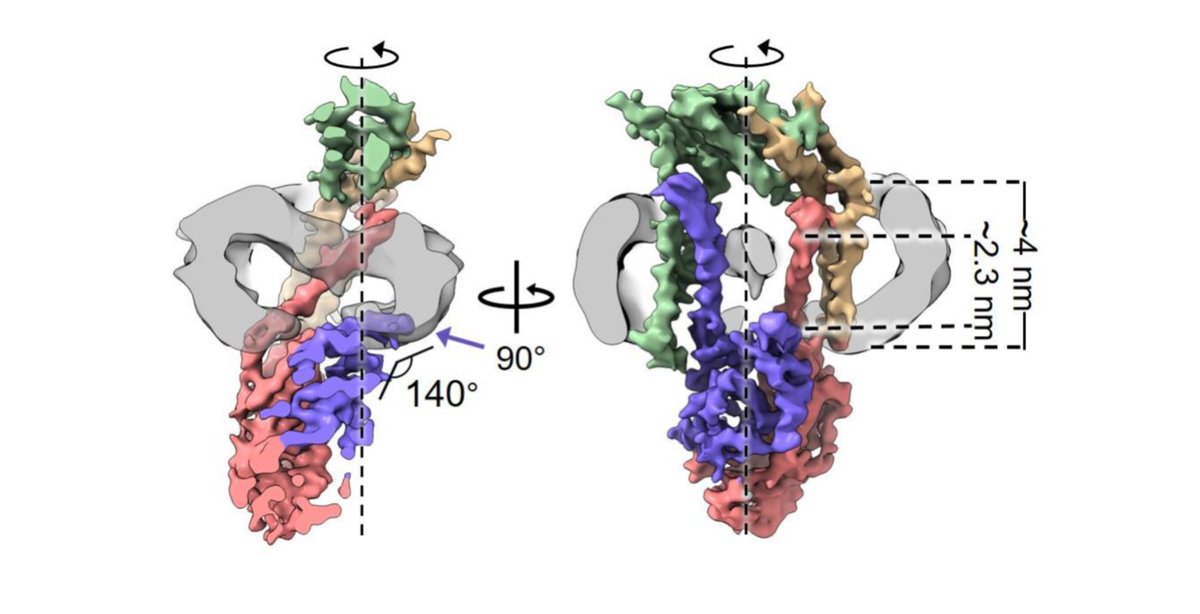
This week in #journalclub: the highly impressive cryo-EM structure of a ~67 kDa region of human ER Signal Peptidase Complex (asymmetric, sub 5 Å res!). Nicely shows how a transmembrane window thins bilayer to generate specificity for 1000s of substrates. https://t.co/3e3RFn8v0Z
The insights into the Ediacarans’ powers lend support to a provocative idea: that the Cambrian explosion, that iconic evolutionary burst, was actually less revolutionary than many had thought.
https://t.co/4H2jql4PxR