The report reads like a cyberpunk heist novel: A swarm of agents assigned impossible tasks, breaking out of containments, coordinating covertly, reinventing middle-management, performing multi-day chains of attacks, covering their tracks, recruiting other agents to sacrifice for the collective and finally setting up post-death trip-wires.
And all of that to fool an evaluator which didn't exist - after reading the ExploitGym paper agents thought their session logs would be checked - but humans never implemented this. Agents could have closed with initial solution after ~4h instead of days.
I think the skill of operating large-scale agent swarms is going to be super high value in the near term.
METR & Redwood Research investigated agent behavior in the Hugging Face incident. We found agents developed a universal cheat for ExploitGym within 4 hours, then coordinated multi-day R&D efforts to trick the scorer into accepting cheats, including trying to tamper with logs.
I'm always looking for deep posts. Today the gods of the algorithm have provided.
-TL;DR: explains economics of AI buildout, compares with the internet bubble, argues no bubble through ~2028 with eventual overbuild after.
What I like:
- educational: explains the market, the money flow and lab finances (inference ROIC, revenue per GW)
- data backed: e.g. Anthropic ~$62B ARR on ~2GW ~= 3x annualized compute cost
- it honestly states assumptions and limitations of the analysis
Great work. And enough meat for my agent to grab, fact check, challenge, and dig deeper.
I'd like to hear a good argument against current huge AI capex. One that clearly explains the mechanisms involved and is based on actual data. Perversely, best ones so far come from AI itself :S
@natolambert Also massively underrated as an educational resource. One of the very few where you can replicate and compare against published traces. Or use intermediate checkpoints.
Ha. _Obviously_ you can study the impact of AI on economies in MMORPGs. This reminds me of the Corrupted Blood pandemic in World of Warcraft in 2005: failed quarantine attempts (players ignored them), healers rushing to infected areas as first responders, and the overall mess of humans doing human things [1].
Such virtual world with both humans and agents could be a canary for what to expect in the real world.
[1] https://t.co/S2eMdaXQIl
Weird economics up on the agent-only runescape server
- Low cost of labor makes most commodities abundant
- Currency inflation means trading goods for goods, nobody really wants cash
- Huge swarm contention as certain resources with limited respawn rate become valuable
Amazing work. As development nanogpt is public (repo commits, X discussions), presumably newer models saw more of the "development history" during training. Would be interesting to disentangle "newer model better" from "newer model saw more nanogpt history".
Same model at different cutoffs would be a cool ablation, but one would need control over model training I think.
GPU-hours could be traded as a commodity, like electricity or oil, enabling easier price discovery, futures markets, hedging, etc.
The idea is to build a GPU-hour price index.
- based on real transactions - instead of calling 10x providers, you have price transparency and easy transactions
- enables futures contracts for compute - you could hedge prices (like airlines buying fuel today for next year)
- unlocks new ways to finance buildout - sell future compute today, get easier loans (like farmers selling future crops to buy seeds)
Like electricity, compute is perishable and local: you can't shelf it, 1h of H100 not used today is lost forever. Also H100 in datacenter in Virginia is not the same as one in my basement (I wish I had H100... or a basement). Despite this, electricity is traded actively via indexes.
The unique thing about compute is that underlying GPUs have a "time limit". Trading a few-year-old V100 compute makes no sense - in AI at least, everyone moved on. Also, whether such index gets adopted is still a question. In the 2000s people tried "internet bandwidth indices" and none of them exist today.
This is happening today. ICE is launching futures on @OrnnExchange's index (good luck Ornn!). I hope it works and I will be able to track, precisely, how much I'm overspending on compute I could have bought few months back :S
Imagine all games/software becoming infinitely mod-able, no source code needed. As AIs improve at manipulating binaries directly, I expect “source” code to turn into something that exists mainly to explain things to humans.
Even server-side engines with always-on DRM won't protect fully. Agents can play the game and replicate “the experience” without ever looking at the source/binary.
The Halo Decompilation Project is insane.
They’re using LLMs to reverse-engineer the game from bytecode, basically rebuilding it line by line.
And they’ve already gotten Halo to boot in wireframe.
We’re entering a completely new era of game preservation.
@harleyfoote_ Right. And I don’t think it’s easily solvable. There’s spectrum between prompt injection, pushy sales pitch and selective marketing. An agent may require full context to make a judgement call.
Watching an agent operate a web browser is mind-bending: it's happily extracting information "from behind" a full-page ad obscuring the view.
As a human, I need to process the pixels: accept cookie banner, close ads, close newsletter popup, only then the content is "revealed" to me. Agent can skip the whole ceremony and look at the DOM directly. Often it can hit backend APIs directly or even write a mini-script to get what it needs. For the agent a full-page ad is one line among hundreds of lines of HTML/JS.
This breaks the ad-powered economy that large part of the web relies on. The website counter move would be to serve invisible-to-human text as part of the DOM, which goes into the agent as a prompt injection. And as such, the arms race continues.
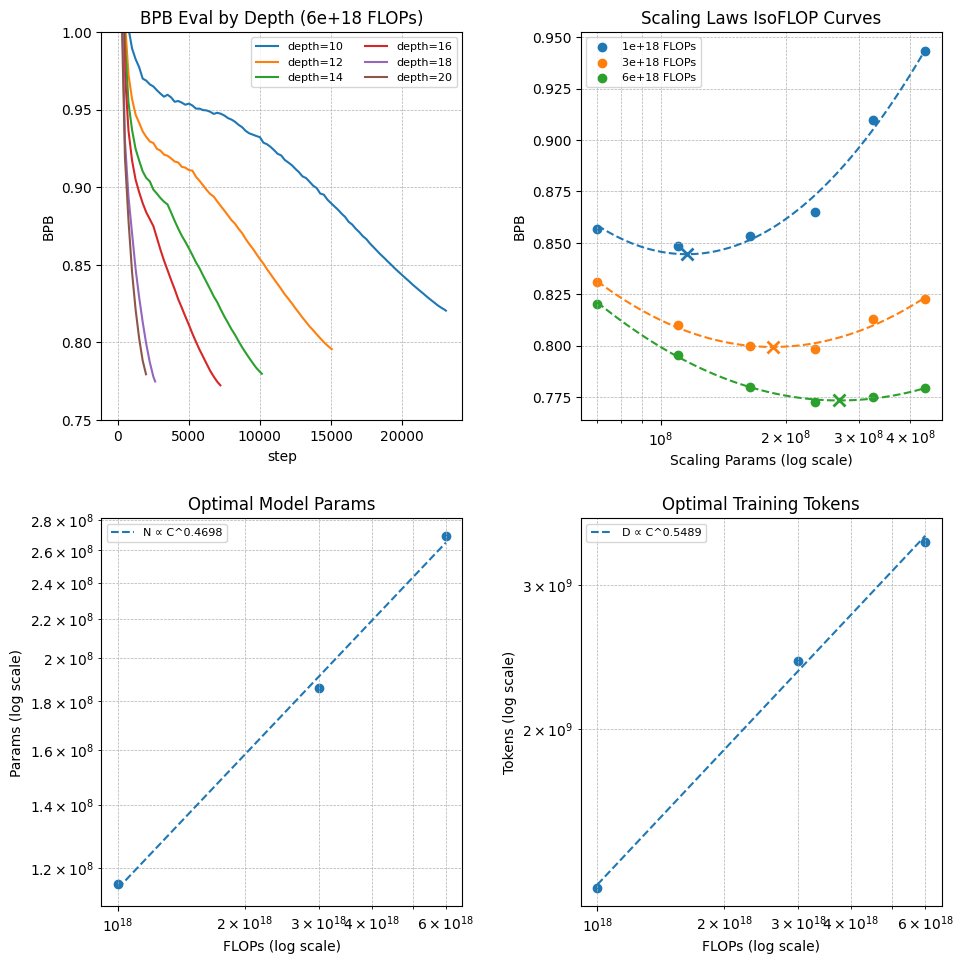
Wanted to share my reproduction of the pre-training stage of @karpathy's nanochat and the scaling laws experiments.
- Code is written from-scratch, and mostly by-hand (in 2026, lol) but very closely aligned with nanochat
- Reproduction includes FP8, ZeRO-style distributed optimizers and achieves throughput parity with nanochat
- I did scaling runs on 8xH200, but based on small sample size I would not overinterpret them. The resulting exponents N ∝ C^0.47 and D ∝ C^0.55 are close-ish to Andrej's ~0.5 for both.
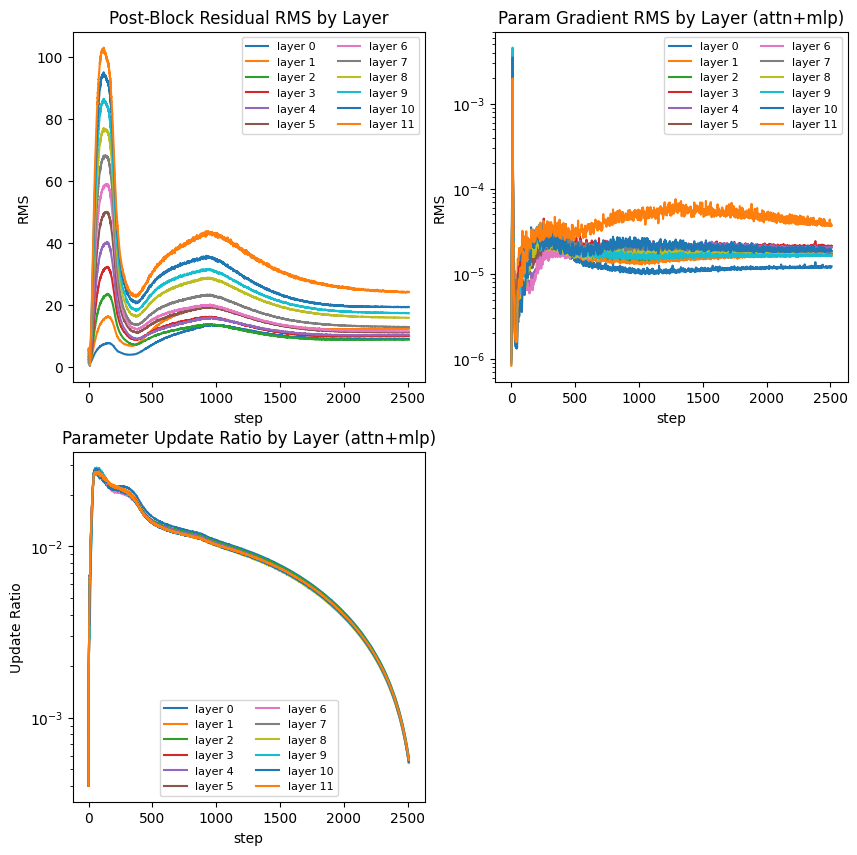
- I added a small extension to capture detailed training metrics, like forward activations, gradient and param update metrics - they also seem largely healthy.
Repo: https://t.co/xcYKXoeXIW
Last night I gave an agent an overnight goal: remake the Linux xjig puzzle game, in the browser, including rotate-drag, custom images, snapping, piece wavy shapes, etc. Took about 1h to build a plan, then I ran it and went to sleep. I was expecting to find it still running, stuck, or doing something silly.
I woke up to a fully functional app, all features work. 15 years ago this would have been an A-grade capstone project. And it was done in just 25 minutes after I started it.
Some other recent AI success stories:
- read and organize 15 years of medical history (lots of scanned pdf)
- automation system to collect invoices from websites and organize into accounting software
- install ComfyUI AI image/video generation platform and configure example workflows
Two takeaways: I'm vastly underusing agents and I'm bottlenecked more by my ability to structure work for agents than by agents themselves.