Marketing & Growth in B2B 🚀 ◆ Branding Studio co-founder ✨ ◆ Building micro-apps to buy a summer 🏡 ◆ Half Marathoner, Marathon soon! 🏃 ◆ Here to connect 🌐
Built 8 products.
Shipped 3.
Killed the rest early.
Helped take a B2B SaaS from pre-seed → Series B → exit.
Now I build simple tools for offline businesses and help others find the simplest solution to complex problems.
Philosophy: less is more. Kill early. Ship what matters.
Follow for honest product lessons.
i've been testing Higgsfield MCP + the NEW Claude Opus 4.8 to generate ALL our Meta ads creative inside 1 conversation...
and it has been ABSOLUTELY cooking
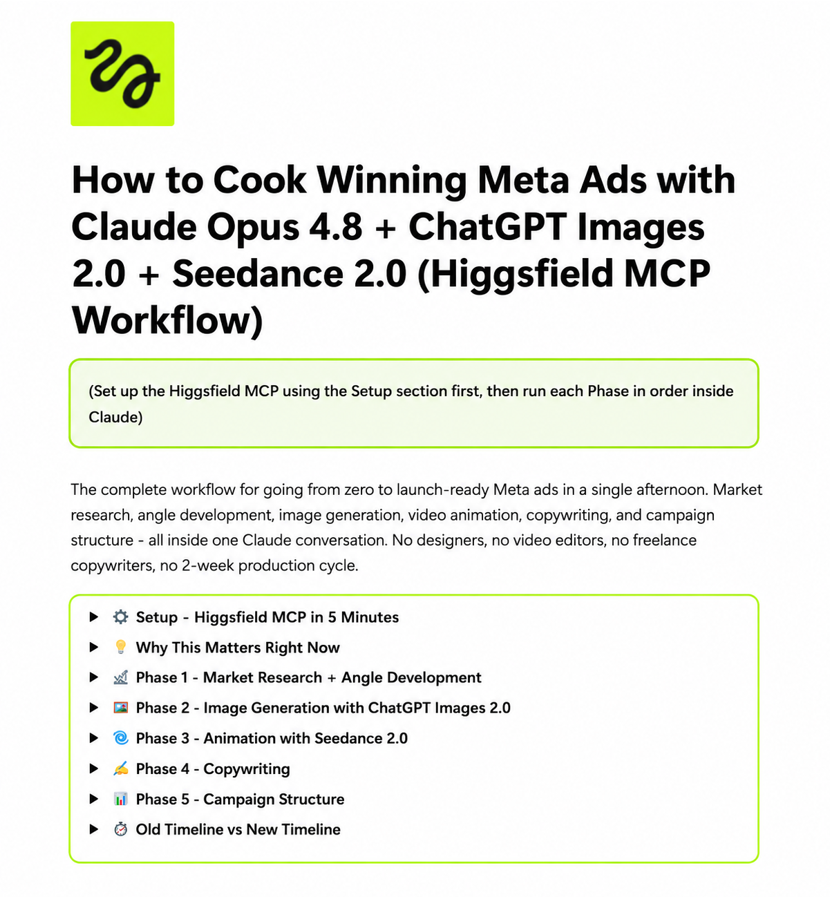
so i've decided to document the ENTIRE workflow...
covering the setup, market research, image gen, animation, copy, and 7-day test campaign structure to take a Meta ads creative batch from 0 to launch in a single afternoon as a service based business (agency, firm, brick and mortar, consultant, etc)
here's what's included inside the guide:
→ Higgsfield MCP setup in 5 minutes (https://t.co/xMyAvg7v9p integrations → paste mcp URL → authorize. 30+ image and video models inside one Claude chat)
→ phase 1, market research + angle development (master brief prompt that returns 7 ad angles ranked by differentiation, top 3 expanded into 3 hook variations each)
→ phase 2, image generation with ChatGPT Images 2.0 (3 variations per angle in under 90 seconds. model selection table covering ChatGPT Images 2.0, Soul 2.0, Nano Banana Pro)
→ phase 3, scroll-stop animation with Seedance 2.0 (static image to cinematic motion loop. first 0.5s stops the scroll. one client hit 5.1% CTR week one... their highest-performing creative ever)
→ phase 4, the 4-variation copy stack (loss aversion, authority + specificity, contrarian, identity. 12 ready-to-test ad combinations from one session)
→ phase 5, 7-day test campaign structure (budget allocation, day 3 signal thresholds, day 7 kill and scale criteria, the 3 highest-probability winners to launch first)
all backed by $10M+ generated through Meta ads funnels for service-based businesses (and a legal funding client that we expanded from 8-12 to 40+ creative variations per month using this method... even finding 3 winners that scaled him to $89k/mo within 90 days)
like + comment "COOK" and i'll send it over
(must be following + RT for priority access)
this OpenClaw bot finds hotels with ugly listing photos, redrafts them as IG posts, and mails the owner a postcard...on autopilot.
here's how social-media agencies can use this system and land hotel clients:
- scrapes every hotel in a city in real time
- filters by review count + rating + last post date + photo quality
- pulls the strongest interior shot from the Google Maps listing
- samples the brand palette from the hotel's actual visual identity
- AI-redrafts the photo into a 1:1 brand-matched Instagram post
- writes a postcard quoting a real reviewer + the exact space
- mails it to the owner hand-addressed with a preview QR
every step from discovery to brand-matching to outreach is automated.
reply "HOTEL" + RT and I'll send you a free guide so you can build this too
@SoraiaDev Look at session count, not just total actions. 300 actions in one sitting tells you something different than 300 actions across a few weeks. The users who convert are the ones who came back; if they only showed up once, no paywall was going to save it.
Paraphrasing the best reframe I've heard for indie builders:
"Ask yourself if this problem genuinely bothers you. If it does, you'll keep showing up to fix it - quietly, consistently - long after the initial excitement fades."
I spent a weekend analyzing competitors. Combined they get ~190K organic visits/month.
Their top pages aren't product pages. They're how-to guides. "How to add email signature in Outlook." "How to change signature in Gmail."
People don't search for email signature tools. They search for help with their email client.
Then they find the tool.
That's the entire content strategy.
I run 6 side projects and none of them are "successful"-here's why I don't care.
None of them are "successful" by tech Twitter standards.
But here's the thing: they all work. They solve real problems for real people. Some of them make money.
All of them taught me something.
I don't need a unicorn. I need a portfolio of small, useful things that compound over time.
People always ask about the stack. Here's what actually matters for a small tool like this:
The signature is just table-based HTML with inline styles.
That's it.
No fancy framework needed.
The hard part wasn't the code.
It was making it render the same in Gmail, Outlook desktop, Outlook web, and Apple Mail. Four different rendering engines. Zero consistency.