My experience at @KingsCollegeLon is coming to an end. Check out the report of my work here in the NENS alumni page! Thanks to @FENSorg and @SapienzaRoma for funding my stay and @drccatmur@marcodavare for having supervised me
https://t.co/pIhYG7RoWW
Very pleased to share the 1st paper of our lab! In collaboration with @marcodavare, we show visual info after object grasp supports digit position variability and swift anticipatory force control |Journal of Neurophysiology |@JNeurophysiol@uoregon@HphyUo https://t.co/ltLESAT4Zn
Our department (@HphyUo) is hiring 3 tenure-track positions related to human performance and health promotion. Eugene, Oregon gets an A++ for living, and that doesn't even include the bonus points for working alongside some very excellent colleagues https://t.co/EBZj4N3f3K
@Scott_Glover_RH@DrGBuckingham we are referring to the same study, with lateral occipital area (LO) being an object sensitive region within OTC. Not an easy TMS target in any case
@Scott_Glover_RH@DrGBuckingham Yes, in fact our hypothesis was to get the SWI to bias force planning following aIPS disruption. This would have shown perceptual info is channeled through aIPS/dorsal areas. As per TL candidates: Lateral Occipital areas?
@StevenLindley0 @idigiulio@delsysinc @R_D_Pollock I’d love to know more about motor unit decomposition/single unit recordings. Sadly can’t be there this aft
On theta-burst #TMS variability: hot off the press https://t.co/YV4gca2qCd, cTBS produces a long-lasting reduction in neuronal activity, but its timing can vary across neurons and hyperexcitability periods are also found. On time for my talk @Brainbox_Init#BBIconf22
Brainbox Initiative 2022 speaker @marcodavare@KingsCollegeLon will be joining us this month with insight into recent advances in the neuronal effects of TMS in awake behaving non-human primates. #BBIconf22
Register here: https://t.co/26WTHwRwNI
How does TMS excite the brain?
In this consensus & critical position paper, we summarize what we know (and still do not know) about the neurophysiological underpinnings of transcranial magnetic stimulation (TMS).
A big "thank you" to all co-authors for their valuable input !
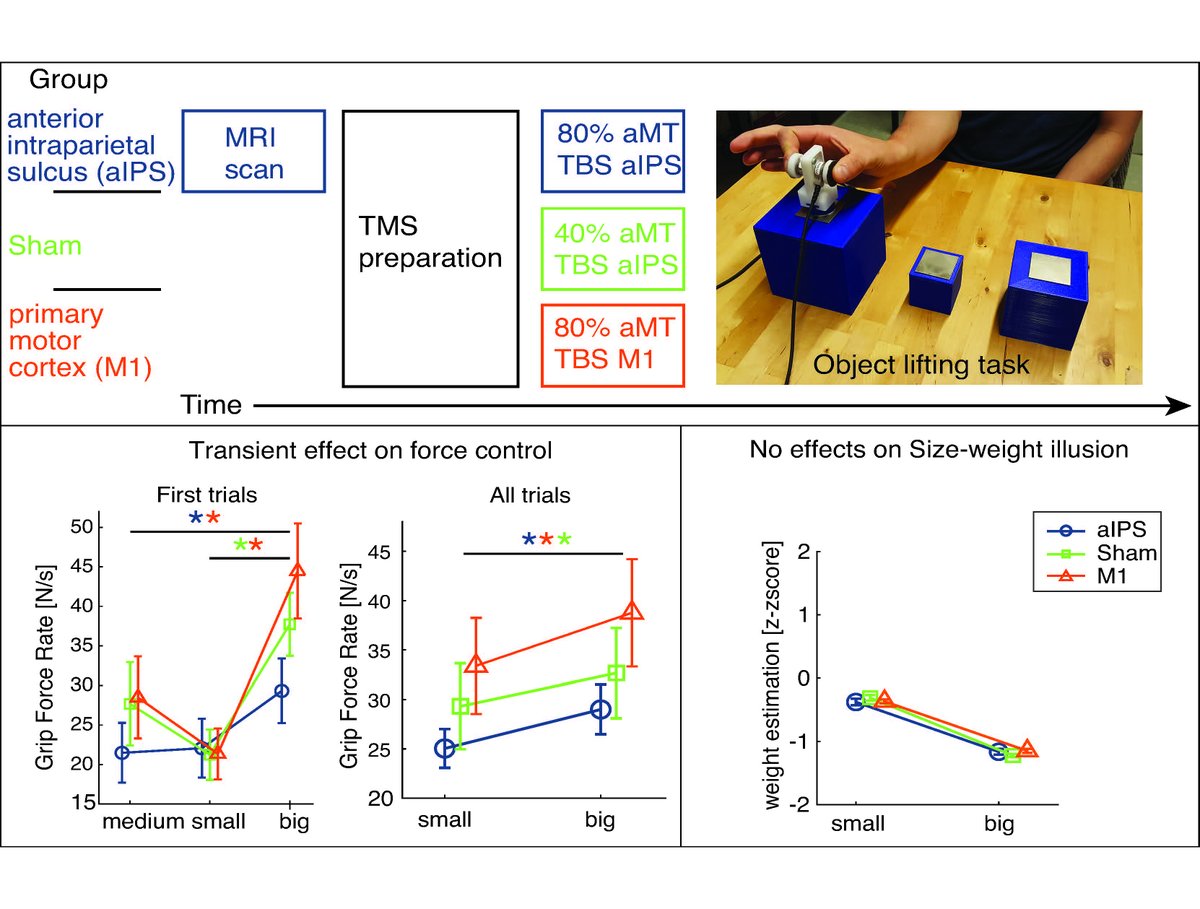
In our quest to disrupt the size-weight illusion with #TMS over AIP, we found a very transient role of AIP in the sensorimotor predictions related to object size. Interesting because it implies another area takes over once force-to-size rules are learned.