@paulnovosad A lot of academic writing is rewriting a sentence 100 times so it reads a little bit better. With AI I can interate way faster than before. More efficient in my view.
@SosaMacho@twitteandoxahi@Soy_Bumer El promedio ese seguramente es tomando cuando están parados en los semáforos. Si bajas a 30 la máxima el promedio cae. No tiene sentido bajar la máxima a 30 en lugares dónde podes circular rápidamente.
I agree with Dario that we need to pace the frontier. This has been a primary topic of discussions we've had at OpenAI in recent weeks.
Committing to having independent evaluators with employee-like access is a great idea, and we will do the same. We'll have more to share soon.
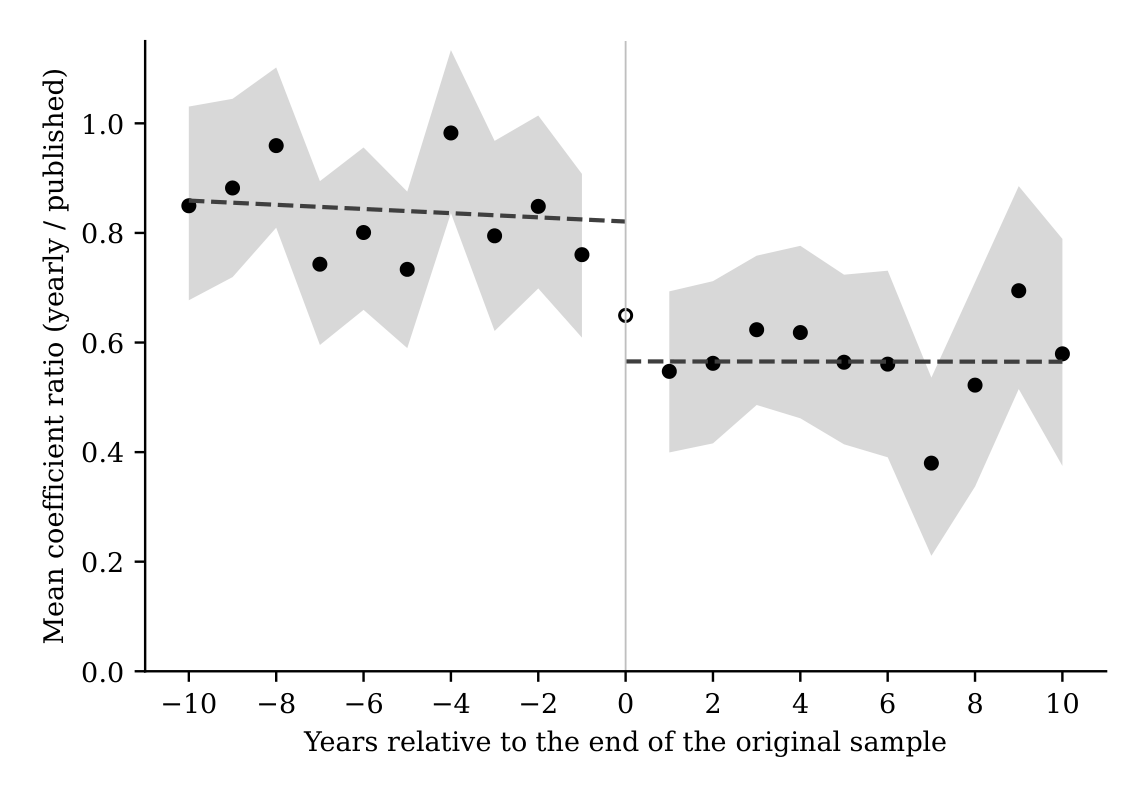
How much of published finance holds up?
I attempted to replicate the main result of every paper in JF, JFE & RFS, 2000–2020.
1,328 in-sample replications; 1,005 out-of-sample. 75% reproduced in sample. But only 42% in later data. Median coeff. : 0.93 → 0.45 of the published.
Apply this situation to the economy and you see why there are big problems ahead
The situation:
-two math whizzes leverage the latest *publicly available* AI to work on solving Navier-Stokes. They’re onto something.
-openAI sees it, wants to win, so puts 10,000 agents from their latest *private* model that is already light-years ahead of what’s publicly available on it
-they solve it in just a few days
The economy problem
-let’s say I leverage the latest publicly available model and find a way to detect skin cancer. I’ve spent tens of thousands on tokens, proven it can work. I get investors and build a company. A path to saving many lives and making hundreds of millions is clear
-openAI (or Google or Meta or Anthropic) see this hundred million opportunity and point their private most-advanced AI model and 10,000 agents toward my idea. In a few days, they win.
Repeat this thought experiment for pharma, legal, medicine, advanced materials, software…
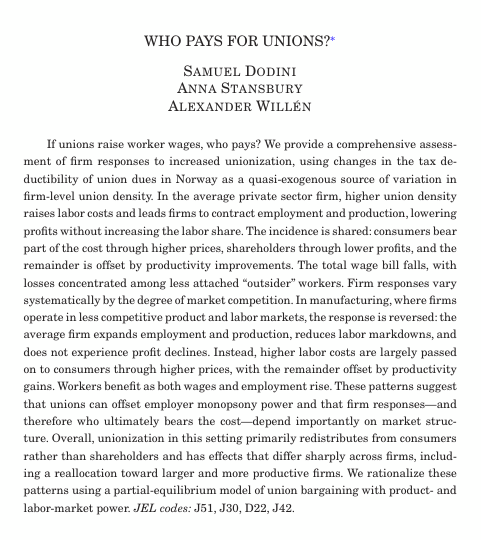
*When unions increase wages, who pays?*
It's normally v hard to answer this Q: unions don't behave randomly, they respond to firm conditions, and detailed firm data is hard to get.
Our setting in Norway tackles both...
🧵on our paper (@microsamonomics & @ALPWillen)
For six months, Google Maps sent a slice of drivers in ten American cities down deliberately slower routes.
About 30 seconds slower on average, and under 2% of trips were touched. The experiment ran on roughly 100 of the most congested road segments in each city, switching on and off day by day so each city acted as its own control. The results are out now in Nature Cities, from Google Research with collaborators at Berkeley and Stanford.
The reasoning behind it is old and slightly counterintuitive. Every navigation app does the same thing: it finds you the fastest route right now, for you alone. When millions of phones do that at once they all pour onto the same handful of arteries, and those arteries stop being fast. Transport economists have been writing about the gap between what's good for one driver and what's good for the network since the 1950s. Nobody had tested a fix at city scale with real drivers, because you'd need to steer routing for a large share of a city's traffic, and about three companies on Earth are in that position.
So Google put a penalty on the worst segments during their worst hours, which nudged the routing engine towards alternatives of similar road class and comparable travel time, then measured what happened across the whole network on weekdays between 7am and 8pm.
On the targeted segments, traffic moved roughly 2% faster in the median city. Los Angeles got 4.56%, Atlanta 3.30%. Fuel burn on those stretches dropped between 0.5% and 1%. Across every road that saw a change in traffic, which covers around 80% of each city's driving, speeds rose 0.35%, reaching 0.5% during the morning and evening peaks. Total travel time on affected trips fell 0.69%. Their Bayesian model put the probability that the speed effect was genuinely positive at 99.8%.
That adds up to more than 1,000 tonnes of CO2-equivalent saved per year, per city, in most of the places studied. Cars and vans account for around 10% of global carbon emissions, and the average driver spends about 2.6 years of their life behind the wheel, so a fraction of a percent across an entire road network is a serious amount of fuel.
Per driver, the saving comes to about 0.25% of an average journey, roughly one fortieth of the normal day-to-day wobble in how long the same commute takes. Nobody in those ten cities noticed anything, in either direction, including the people sent the long way round.
The authors are careful about what they haven't shown. They measured the immediate effect, not what happens once drivers work out the freed-up route is quicker and pile back onto it, which is the standard way road improvements get eaten. Their penalty scheme was deliberately crude, so the ceiling on the approach is unknown. And the underlying Google Maps data is commercially confidential, so nobody outside can check the numbers.
The finding sitting underneath all this is that a private company's routing algorithm has become a piece of transport infrastructure, tunable in the way a traffic light or a congestion charge is tunable. The obvious follow-up experiments are the ones a city government would want to run, not the ones a mapping company would.
link to full article: https://t.co/RlRlDLCSER
@ben_golub@RefineDotInk@__alpoge__@littmath said that with the first 2 pages it was possible for someone knowledgeable to reconstruct the proof, and that the 100+ pages were unnecessary.
@littmath In many situations, like most emails, the goal is to efficiently convey some information. AI is perfect for that, as it does it reasonably well while being faster. It's a win-win. Why would I feel bad for getting AI generated emails?
I follow the AI & math discourse a bit - without understanding the actual math. I thought I might offer some thoughts as a scientist in structural biology - a field transformed by various tech over the years, and recently by AlphaFold. It might perhaps interest @nasqret et al.🧵
@paulnovosad My main qualm is that they also sell to authors. And yeah, I know Refine is just a first correctness check, and that you don't have to buy the Refine review, but there are incentives to do so, if nothing else because it just saves time.
@zarekcb But there's a strong incentive to use Refine before submission, you can't deny that. They have a proprietary AI and they'll be profiting from it, whether intended or not.
I welcome AI reviewing, but I think it should be open source, with many competing options to choose from.