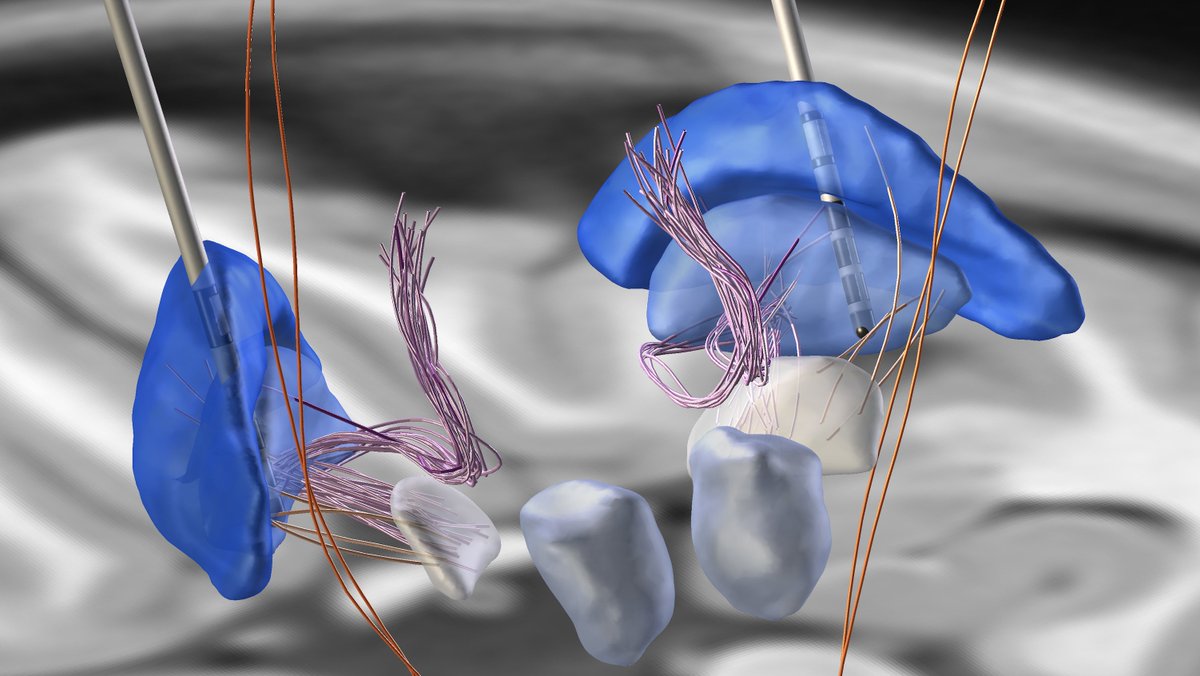
Exciting news on behalf of our DBS team at @MedUni_Wien: We've implanted the first rechargeable Percept RC system at our center - close second to @VVV_Cologne worldwide outside Japan! https://t.co/nh3gFjtwEU #DBS@Medtronic
The latest episode on the phenomenal #BrainInspired podcast by @pgmid is a particular treat: a conversation with @NicholsonHPBio on process philosophy, the machine metaphor, the relevance of history, and an encounter with James Watson. https://t.co/yJA1Lywo9k
Medicalizing mental health doesn’t work very well if your goal is to address the underlying causes of distress, @_danielle_carr says. “It does, however, work really well if you’re trying to come up with a solution everybody in power can agree on.” https://t.co/DCIdzFSTbF
1/2 Nice summary in Pulse Magazine of my recent lecture on (often unexpected) benefits of #art for #health, larded with compelling & touching examples from #Parkinson field. With remarkable role for #dopamine replacement in shaping #creativity.
Very happy to finally see our hypothesis paper on repetitive, stereotyped behaviours online! Many angles instead of simple mappings between neural mech and complex behaviours. @sblanca@sweetneuron@AliceLaciny @KrausCh45 @JoergFingerhut https://t.co/5daFq47XOQ
My book "The Making and Breaking of Minds" is now also available as paperback and ebook. I hope it reaches a broad audience & enables equal opportunities for children at risk to reach their full cognitive potential.
https://t.co/uV2iUww5UT
https://t.co/RreaxSlQ3B
Very nice DBS-dystonia paper with sweet spot/network mapping and fiber filtering. Highlights relevant tracts and regions despite disease heterogeneity and delayed clinical responses https://t.co/K7rLaJGQRA
Also really cool that the cervical/generalized dystonia tracts are already included in lead-DBS as an atlas set, making it possible to compare with electrode locations of specific patients right away.
The KLI stands with the people of Ukraine. We are part of an expanding "Global Research Groups Supporting Ukrainian Scientists” & pledge to offer support through research stays in Theory, History, Philosophy of Biology. Statement: https://t.co/eg75dsMJmg #scienceforukraine /1
This is remarkable bc we tend to attribute human uniqueness to neocortex. Instead, it's more likely that cerebellum (and basal ganglia?) expanded the most in modern humans. I see this as support for the "delegation to automaticity" hypothesis @jmacshine https://t.co/USUTxfuawe
So the evolution of modern human globular brain shape parallels the emergence of behavioral modernity. But actually, the cerebellum grew most, and parietal bulging doesn't come with an outer surface increase, suggesting subcortical expansion https://t.co/KeqJPBTAQT
Exquisite study: tic-associated lesions mapped with normative functional connectomes highlight a shared network and a specifically tic-linked region in the anterior striatum. Connectivity to the lesion network map predicts DBS effectiveness.
https://t.co/tU88sDQ4ih
@RoopeKaaronen I'd also be interested in suggestions there. From my very limited view, I would think of Edwin Hutchins: https://t.co/yGP3rDw3Gy, e.g. Western and Micronesian navigation practices
"It’s not [that evolution] finds solutions to a problem, it’s really exploring variations. And it just so happens that some of those variations accomplish things, that used to be a problem." Great two episodes with Paul Cisek on braininspired: https://t.co/9sFfwisQXC
I suppose the answer is no, and maybe stochastic evolutionary diversity takes care of that. But wondering about the implications for policies in PP if there is some sense of the limits of predictability? 3/3
Theoretical biology question (might make sense or not): In predictive processing, policies are informed by probabilities, preferences and priors. That would mean PP is not set up to deal with strong uncertainty, i.e. where predictions cannot rely on past events? 1/3
Meaning does PP have a place for the precautionary principle? Can organisms factor in rare or one-time events such as sudden irreversible (partial) habitat loss? 2/3