Horizontal #mitochondria transfer. Does #cancer hijack this repair process, increasing #metabolic output for #tumor growth? Are neural mito the systemic energy commander? https://t.co/tFWJRaI3sg
https://t.co/wjF2JuSRCd
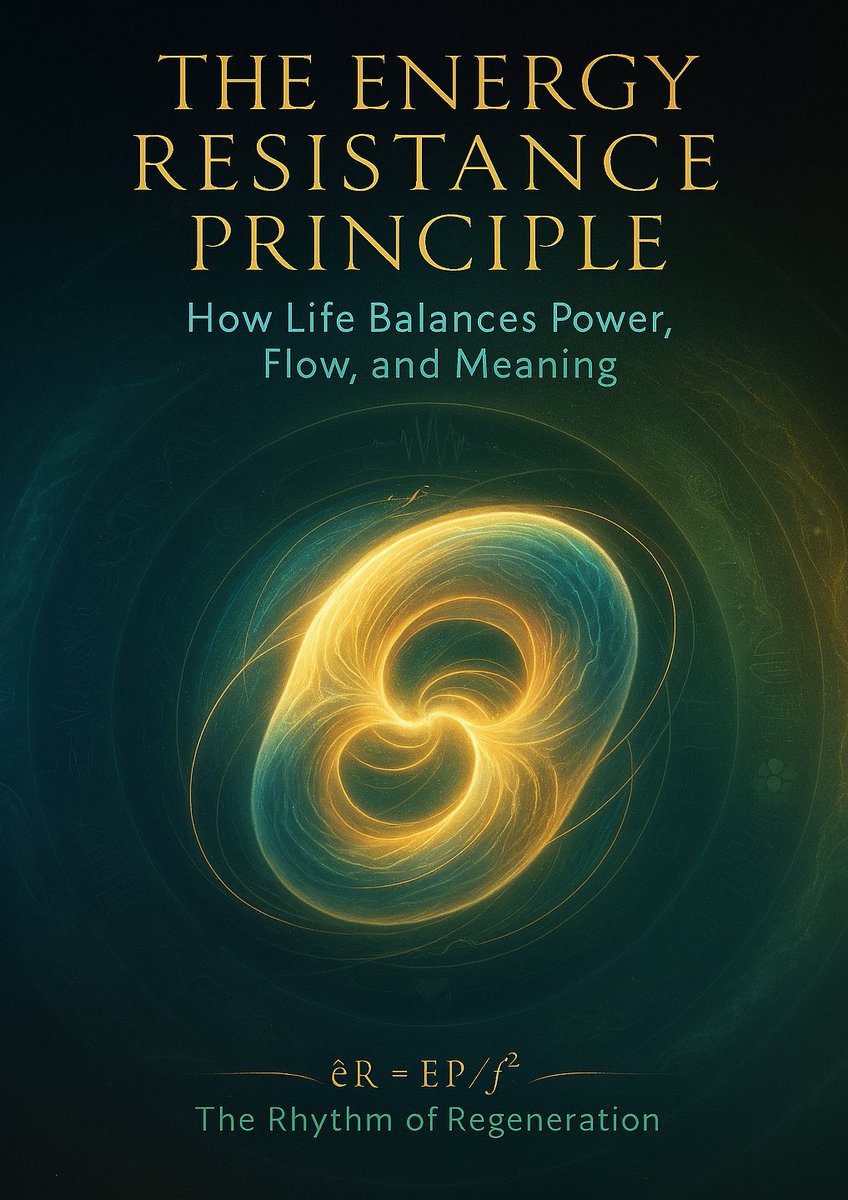
The Energy Resistance Principle: How Life Balances Power, Flow, and Meaning | ChatGPT5 & NotebookLM
Every system that endures — cellular, social, or planetary — must balance the energy it generates with the capacity it has to channel that energy without collapse. Neuroscientist Martin Picard’s Energy Resistance Principle (ERP) describes this balance in biophysical terms: the ratio between energy potential (EP) and flux capacity (f) defines a system’s resistance (ēR = EP / f²). Low ēR corresponds to health and coherence; high ēR to stress and fragmentation.
This white paper expands ERP from its biological origins into an integrative framework for understanding individual and collective life. It shows how four major paradigms — Kate Raworth’s Doughnut Economics, John Fullerton’s Regenerative Paradigm, John McMurtry’s Life-Value Onto-Axiology, and Modern Monetary Theory (MMT) — each describe aspects of the same energetic grammar. When interpreted through ERP, they reveal a unified law of coherence: systems thrive when potential and capacity evolve together across all scales.
By reframing economics, ethics, and governance as expressions of energy flow under constraint, the Energy Resistance Principle offers a practical compass for regeneration — from personal health and institutional design to fiscal and planetary policy. It suggests that the path to sustainability is not acceleration but attunement — the continual tuning of power and form until resistance becomes resonance.
The Gate That Counts Time (IMJ)
Beneath the folds of a mitochondrion sits a bottleneck that appears anatomical yet behaves mathematical: the inner mitochondrial junction (tens of nanometres wide) as torsional filter, a region whose narrowness does not impede flow so much as impose alignment, compelling charges to adopt a shared orientation so that what passes is not only energized but phase-eligible.
Diffusion operates on scalar gradients, the IMJ operates on vector compatibility and connection rules (the orientation constraints imposed by geometry), a gate where admissibility is set by how a trajectory turns, not where it is headed. By compressing degrees of freedom it converts flux into chronometry, ensuring that downstream relaxation events tend to occur on counted delays rather than on chemical convenience.
When geometry loosens here first, coherence fails upstream and light downstream becomes noisy. When geometry holds, the junction outputs synchronized charge, primed for curvature-held delay and the geometry-dependent emission that follows.
What leaves this gate as charge will later return as light. Think of it not as a hallway but as a crankshaft, where orientation becomes time, time becomes sequence, sequence becomes signal.
The IMJ is the timing gate of the engine, where torsion is measured, not guessed.
@eric_todd6@NatGeo Hey! I apologize for not seeing this until now. This is my friend's work and you can contact her directly via her FB page, 'Big Horns and Beyond Photography '. She's wonderful!
@SharonBurnabyBC@science_lil What data do you have on this year's overwhelming flu and RSV outbreaks? And what is your protein biophysical background, if you don't mind me asking, that makes you so adept at analyzing genomic sequencing and the resulting protein production, for example, spike proteins.
@srinivasvivek I ended up giving my son a lot of worksheets and introducing curriculum at home. His school was too slow. And he graduated in 2019. I can't imagine what it's like now.
@batpawed Ohhh...shorts shorts. There was a Nair commercial in the late 70s, early 80s about short shorts that just dam busted in my brain. Yep that song's annoying lol