Your brain has a circuit that doesn't know you live in a city. Its only job is to monitor whether birds are still singing. Right now, in this room, it is on.
The circuit predates primates. Mammals have been using ambient soundscape continuity as a predator-detection system for roughly 200 million years. Birds stop singing when something larger moves through their territory. For most of mammalian history, a forest full of song meant no large predator was nearby, and the cessation of sound was the warning. Your nervous system never updated this software.
The Max Planck Institute tested the inverse in 2022 with 295 participants. Six minutes of birdsong dropped anxiety with a medium effect size. Six minutes of traffic noise raised depression with the same. The effect worked on subjects who lived in dense urban environments and had no regular contact with nature. The brain still ran the check.
Birdsong sits in the 1,000 to 8,000 Hz range. Your brainstem reads continuous patterns in that band as a signal that nothing dangerous is currently moving through the environment. EEG data shows birdsong at 45 to 50 decibels boosts alpha wave activity by 14.1% relative to silence. Alpha is the brainwave signature of relaxed alertness. Push the same birdsong above 60 decibels and the response flips. Stress markers rise 29%. The circuit only trusts the signal at the volume of quiet conversation, which is exactly the volume birds sing at from a typical distance.
Three things happen simultaneously when the brain registers ambient safety. The amygdala downregulates. The parasympathetic nervous system takes over from the sympathetic. Heart rate variability rises, cortisol drops. The posterior cingulate cortex, which sits at the center of the rumination circuit, quiets down. King's College London tracked this through a smartphone study with over 1,200 participants and found the mood lift lasted hours after the sound stopped. People diagnosed with depression got the same response as healthy controls.
Most of what gets labeled mental fatigue is hypervigilance running in the background. Birdsong tells the circuit it can stand down, and the brain reallocates the freed compute everywhere else.
A quiet park feels different from a quiet office because the parks have sentinels.
Welcome home Reid, Victor, Christina, and Jeremy! 🫶
The Artemis II astronauts have splashed down at 8:07pm ET (0007 UTC April 11), bringing their historic 10-day mission around the Moon to an end.
Lessens from the founding story of DoorDash from Stanley Tang.
"Doing things that don’t scale allows you to become an expert in your business.
At YC there’s this mantra we like to talk about: ‘Doing things that don’t scale.’ At the beginning, we were the delivery drivers. We were customer support… We used Square to charge our customers. We used Google Docs to keep track of our orders. We used Apple’s Find My Friends to keep track of where all our drivers were. Just hacking together solutions just trying to get this thing off the ground.”
The lesson is not that scrappiness is romantic. It is that early on, proximity to the problem is often a bigger advantage than sophistication.
---
From "YC Root Access" YT channel (@ycombinator)
Link in comment
Jensen Huang just called out every CEO who’s been firing people “because of AI.”
Jim Cramer asked him why companies are laying people off if AI is supposed to make everyone MORE productive.
Jensen's answer:
"For companies with imagination, you will do more with more. For companies where the leadership is just out of ideas, they have nothing else to do. They have no reason to imagine greater than they are. When they have more capability, they don't do more."
Read that again.
The man who built the most important tech company on Earth just told you that if your CEO is using AI to cut headcount, it means one thing:
They have no imagination.
They have no vision for what comes next.
They got handed the most powerful tool in human history and their FIRST instinct was to fire people.
This is the CEO of NVIDIA. The company whose chips power every AI system on the planet.
If anyone on Earth has the right to say "AI replaces workers," it's Jensen Huang.
And he said the OPPOSITE.
He said every carpenter could become an architect. Every plumber could become an architect. AI elevates capability. It doesn't eliminate it.
But here's where it gets really interesting...
During the same interview, Jensen revealed something nobody's talking about:
He said AI startups like OpenAI and Anthropic are seeing their revenues increase by one to two billion dollars a WEEK. And he wishes these companies were public so the world could see what he sees.
One to two billion per week.
That's a $50 to $100 BILLION annualized run rate.
For companies that most people think are burning cash and making nothing.
The entire Wall Street narrative that "AI companies aren't profitable" might be completely wrong.
Jensen sees their numbers. He sees their compute orders. He sees their growth. And he's saying the revenue is real.
So if the money IS real, why are other companies firing people?
Because they're not building AI products. They're not creating new revenue streams. They're not using AI to expand into new markets.
They're using AI as an EXCUSE to cut costs because they ran out of ideas 3 years ago and need something to tell the board.
Jensen's company added $500 billion in new orders in 5 months. He expects $1 trillion in cumulative revenue through 2027 from just two product lines.
That number doesn't include the new chips, systems, or partnerships announced this week.
And he's not cutting people. He's hiring.
Because when you have imagination, more capability means MORE opportunity. Not less headcount.
Meanwhile Salesforce cut thousands. Meta cut thousands. Amazon cut thousands. All blaming "AI efficiency."
Jensen's response: You're out of imagination.
He also said something that stuck with me.
Cramer asked if he ever thought he'd build a $10 to $20 trillion company while waiting tables at Denny's.
His answer: "I was just trying to make it through the shift."
Biggest tip he ever got? Two, three dollars.
Now he's building tech that increased computing demand by one million times in two years.
He announced OpenClaw, which he says is as big as ChatGPT.
And he's got 21 months of new business that isn't even counted in the trillion dollar figure yet.
When asked how long he plans to keep working?
"I'm hoping to die on the job. And I'm not hoping to die anytime soon."
This is a man who believes every single thing he's building.
And his message to every CEO using AI to justify layoffs is simple...
You're not innovating. You're surrendering.
The technology wasn't built to shrink companies.
It was built to make them limitless.
If your leadership can't see that, the problem isn't AI.
It's THEM.
I’m not sharing this as the CEO of Eternal, but as a fellow human, curious enough to follow a strange thread. A thread I can’t keep with myself any longer.
It’s open-source, backed by science, and shared with you as part of our common quest for scientific progress on human longevity.
Newton gave us a word for it. Einstein said it bends spacetime. I am saying gravity shortens lifespan.
Read on, and tell me what you think.
It is saddening to see such false claims gather millions of views. Most of the claims/data points in the video are from FSD versions that are atleast 4+ years old. For reference, this video was published on youtube Sep 4, 2025.
https://t.co/hTwVQIC0oC
@Tesla@Tesla_AI@elonmusk
In 1985, 8 years before the launch of the worldwide web, James Burke spoke about the impact of technology on businesses, politics and society.
This short video is simply stunning
Introducing Willow, our new state-of-the-art quantum computing chip with a breakthrough that can reduce errors exponentially as we scale up using more qubits, cracking a 30-year challenge in the field. In benchmark tests, Willow solved a standard computation in <5 mins that would take a leading supercomputer over 10^25 years, far beyond the age of the universe(!).
Practice Deliberate Discomfort
The greatest rewards come from pushing your limits, not the outcome itself. Rewire your brain to crave the strain.
Regularly choose the hard path:
• Take on daunting projects
• Learn complex new skills
• Face your fears head-on
Applications are open for Growth Academy: AI for Health.
Who's eligible: startups in Europe, the Middle East and Africa using #AI to build in the healthcare and wellbeing industry.
Check out program details and apply by March 1: https://t.co/Jai6cDp2GF
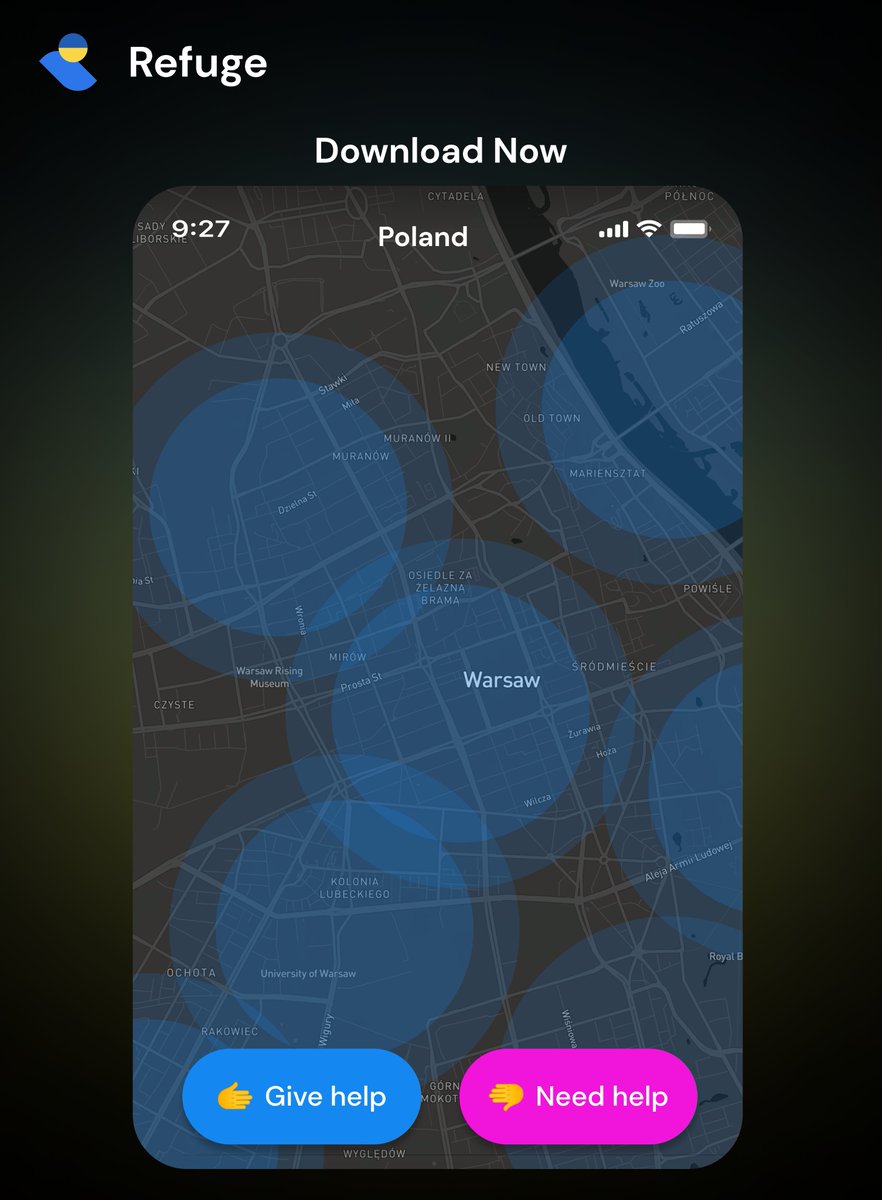
Launching Refuge - To help those displaced from their homes in Ukraine
Refuge is where individuals offering help connect with those who require help.
🔄 Please Retweet to spread the word
Download for Android now: https://t.co/qjerMUgIn2
Educate yourself about things. Study hard what interests you the most. Don't worry about what others think of you, that's none of your business. Train your mind to think, doubt, and question. That's how you grow. 🧠