Is "Afri MAGA" in the room with us now, Ivo?
I wished you did the work of spending even a little bit of time with the likes of AfriForum or Lex Libertas - whose values are essentially identical with classical liberal decentralisation, non-racialism, and limited government - before gratuitously making public assumptions about them. But I've given up the dream that your wing of our movement will ever make that effort. The rest of us, though, eagerly will.
In any graveyard ever dug, you can sort the rich from the poor without reading a headstone.
You measure the thigh bones.
Hunters in Greece and Turkey at the end of the Ice Age averaged 5ft 9.
Their farming descendants, living on grain, averaged 5ft 3.
Mycenae, 1500 BC.
The royal skeletons stand 2 to 3 inches taller than the commoners buried outside, with one bad tooth for every six of theirs.
England, 1800.
Boys of 14 from the London slums stood almost 9 inches shorter than boys of 14 at Sandhurst.
America, 1776.
The farm boys of the Continental Army stood 2 to 3 inches taller than the redcoats.
Same stock, one generation apart, and a continent full of meat.
The Netherlands, 1850.
Among the shortest men in Europe.
Then came 150 years of the highest dairy intake on earth, and they are now the tallest people on the planet.
Korea, today.
Same people, same genes, one border.
Men in the North stand up to 3 inches shorter than men in the South.
Height is the one health record nobody can lose, flatter or fake.
It is animal protein and fat in childhood, written in bone.
Every ruling class in history made sure its own children got it.
Your grandchildren are now being advised to eat less meat, for their health.
In 500 years somebody will dig up this century and know exactly who took the advice.
If you want to know what Islam has planned for our Christian countries in the future, look at how Christianity is treated in Muslim countries now.
It really is that simple.
In post-apartheid South Africa, affirmative action for blacks was followed by early retirements of experienced white civil servants and the annual emigration of thousands of whites. That is not a footnote. When a country drives out scarce skills, the people left behind pay the price in collapsing services and a smaller economy.
Here is an analysis of @News24 subscribers’ comments regarding News24’s latest hit piece on @afriforum and @solidariteit. It seems @AdriaanBasson, @PieterDuToit and @CowansView’s vendetta against us has backfired spectacularly. News24’s own readers are siding with AfriForum and against News24 in large numbers!
The one sector governments left mostly alone delivered forty years of continuous price collapse and it destroyed the central planners' core argument in the process.
A transistor that cost $7.50 in 1961 costs less than a millionth of a cent today. Your 2026 smartphone carries more computing power than a 1990 Cray supercomputer that cost $30 million. Storage, bandwidth, processing speed: every metric deflated while quality exploded. This is what markets do when the state steps back.
Compare that to healthcare, education, and housing, three sectors drowning in subsidies, licensing regimes, and regulatory capture. Prices in all three outpaced inflation every decade since 1980. Government intervention reprices risk, blocks competition, and rewards incumbents for lobbying instead of innovating.
The Federal Reserve spent those same forty years printing money and insisting deflation was catastrophic. Falling prices drive demand, not panic. Intel, Apple, and AMD competed ferociously, drove costs down, and generated trillions in real wealth. Nobody waited to buy a computer because prices might fall next year.
Mises identified capital allocation as the economy's core problem: who decides where resources go? Entrepreneurs decided in tech, taking losses when wrong and profits when right. Bureaucrats decided in healthcare and education, socializing losses and mandating consumption.
You live with the consequences of that distinction every single day, every time you renew your health insurance and watch the premium climb while your phone bill drops.
Solidariteit - dis ‘n wen,
Groot rasslag teen regering in Grondwethof.
MEDIAVERKLARING: Rassevoorskrifte in staatsverkryging ongrondwetlik verklaar
Solidariteit het vandag nog ʼn groot slag geslaan nadat die Konstitusionele Hof in sy guns beslis het met die uitspraak dat die Openbare Verkryging Wet onregmatig in plek gesit is, en as gevolg daarvan mag rassevereistes nie tot onmiddellike uitsluiting in tenderprosesse lei nie.
Die saak, wat in Mei vanjaar aangehoor is, handel oor die Wet op Openbare Verkryging, die proses om die wet in plek te stel en die rassevereistes wat gestel word vir aansoekers wat met die staat wil sake doen. Hierdie vereistes is nie net strenger as in die verlede nie, maar kan ook volgens die verwerpte wet tot onmiddellike uitsluiting uit tenderprosesse lei.
Solidariteit se standpunt was deurgaans dat die wet onregmatig in plek gestel is, dat die staat se aankope nie volgens rassevereistes mag geskied nie en dat die wet derhalwe geskrap moes word.
Volgens Anton van der Bijl, adjunkbestuurshoof van Solidariteit, kan hierdie verkrygingsreëls as die staat se eie interne rassereëls beskou word.
Hierdie interne reëls skryf voor hoe staatsinstellings ras moet gebruik wanneer hulle besluit by wie hulle belastingbetalers se geld bestee.
“Die regering het oor dekades gesorg dat ras al hoe dieper in feitlik elke hoek van die ekonomie ingeskryf is. Vandag het nóg ’n belangrike kaart van daardie kaartehuis geval.
"Hierdie uitspraak oor openbare verkryging is ʼn oorwinning vir Solidariteit, maar dit strek ten bate van elke Suid-Afrikaner.
"Wanneer die staat byvoorbeeld ʼn pad laat bou, rekenaars aankoop of ʼn diensverskaffer aanstel, behoort die eerste vraag te wees wie die werk die beste en teen die beste waarde kan doen, en nie aan watter ras die verskaffer behoort nie," sê Van Der Bijl.
Solidariteit glo sterk daarin dat hierdie fondse benut moet word om te verseker dat die belastingbetaler ʼn goeie dividend op sy swaarverdiende geld kry, en nie om die regering se rassebeleid af te dwing nie.
Volgens Theuns du Buisson, ekonomiese navorser van die Solidariteit Navorsingsinstituut (SNI), strek die betekenis van die uitspraak veel verder as staatsverkryging. Hy glo ook die uitspraak staan in nie isolasie nie en meen dit is duidelik dat die tempo waarteen die regering se rassebedeling plaaslik én internasionaal onder druk kom, nou toeneem.
Die Amerikaanse minister van buitelandse sake, Marco Rubio, het pas ʼn nuwe visumbeperkingsbeleid aangekondig wat onder meer persone teiken wat volgens die Amerikaanse regering verantwoordelik vir of medepligtig is aan die instelling of toepassing van rasgebaseerde diskriminerende wetgewing of beleid in Suid-Afrika.
“Binne die bestek van enkele dae sien ons dus plaaslik én internasionaal hoe die temperatuur rondom Suid-Afrika se rassebeleid styg. Die raswet-kaartehuis is besig om te wankel, en ons sal die druk verhoog om te verseker dat hy val," sê du Buisson.
Learn Austrian Economics in one X post:
1. Humans act. Every choice a person makes traces back to an incentive, a trade-off, a cost weighed against a benefit. Remove the incentive and the action stops. Distort the incentive and the action warps.
Tax income at 90% and watch producers stop producing. Subsidize failure and watch failure multiply. The behavior follows the reward structure, always.
2. Value exists only in the mind of the person choosing. A glass of water is worth nothing to a drowning man and everything to a man dying of thirst. No central authority can calculate this, because it changes with every individual and every circumstance.
Nothing has value in itself, only the degree to which humans choose to value it. Diamonds and even gold only carry value because humans decided they do.
3. Money does not come from a government decree. It emerged spontaneously when traders needed something durable, divisible, and widely accepted to escape the limitations of direct barter. Gold won that competition across centuries and across dozens of independent civilizations because the market, not a ministry, chose it.
Fiat currency is the state hijacking that evolved institution and replacing it with paper backed by nothing but a legal threat. Every central bank on earth operates on this model right now.
4. Wealth does not fall from the sky. A farmer who eats his entire harvest produces nothing next season. The farmer who saves seed, plants it, and specializes in what he grows best accumulates a surplus. That surplus is capital. Capital funds everything that comes after.
Consumption without prior production is just burning down the furniture for warmth. Every welfare state eventually reaches this point.
5. Strip private property rights and production collapses. A farmer will work his own land until midnight. That same farmer, working collective land, stops at noon. The Soviet Union ran this experiment across seventy years and killed tens of millions, proving the point.
When you cannot own the outcome, you do not produce the outcome.
6. Voluntary trade generates wealth from nothing but mutual preference. When you pay twelve dollars for a meal, you value the meal above twelve dollars; the restaurant values twelve dollars above the meal. Both parties walk away wealthier in real terms. No politician, no regulator, no bureaucrat added anything.
Protectionism destroys this. The 2018 US steel tariffs raised steel prices for American manufacturers, killed more jobs in steel-consuming industries than existed in steel production itself, and transferred wealth from productive firms to a protected few.
7. Ludwig von Mises identified inflation as a tax. Every dollar the Federal Reserve creates without corresponding production dilutes every dollar you already hold. The new money flows first to the government and its contractors, who spend it at current prices. By the time it reaches you, prices have already risen.
The US M2 money supply grew from roughly 15 trillion dollars in January 2020 to over 21 trillion by early 2022. Consumer prices followed. Your savings took the loss.
8. Prices carry information. A price spike tells producers to produce more and tells consumers to use less. It coordinates millions of strangers without a single central command. Interfere with that signal and the coordination breaks.
Rent control in New York City is the cleanest example. Cap rents below market and landlords stop maintaining buildings, stop building new ones, and convert units to other uses. The people rent control was supposed to help pay the price through collapsing supply.
9. Interest rates are the price of capital over time. When the Federal Reserve pushed rates to near zero between 2008 and 2022, it told every investor that capital was nearly free. Businesses built projects that only made sense at zero percent. When rates normalized, the projects failed. The 2022 collapse of the US tech sector and the crypto market were not random events. They were the correction of a decade of artificially cheap capital.
The business cycle is not a mystery of capitalism. Central banks manufacture it.
10. Bureaucrats face no profit and loss. A businessman who misallocates capital goes bankrupt. A bureaucrat who misallocates capital writes a report requesting more funding. The feedback loop that disciplines markets simply does not exist inside a government agency.
The US Department of Education has spent over a trillion dollars since 1980. Literacy rates have not improved. No one at the department has been bankrupted by this outcome.
11. Every producer inside a local market holds knowledge that no bureaucrat in a capital city can replicate. A wheat farmer in Kansas tracks soil moisture, futures prices, local equipment costs, his specific buyer relationships, and a hundred other variables simultaneously. That knowledge lives in the price he sets.
Friedrich Hayek called this tacit knowledge in 1945. The Soviet central planners ignored him and spent fifty years proving him correct, producing chronic shortages of goods that private markets coordinate effortlessly. No model, no algorithm, and no committee can compress what millions of independent actors know into a single plan.
12. Every government intervention produces effects you see and effects you don't. You see the road the state builds. You don't see the factory the tax dollars never funded, the job that never existed, the innovation that never happened because capital was extracted at gunpoint and redirected by bureaucrats with no skin in the game.
Take the 2009 Cash for Clunkers program. Congress destroyed 690,000 working cars, handed dealers a short-term spike, and you saw the sales numbers. The used car market was stripped of affordable inventory, pricing working-class buyers out for years afterward.
13. Prices, supply chains, and language itself coordinate millions of strangers without any central planner issuing a single command. That coordination is spontaneous order: complex, functional patterns that emerge from individuals pursuing their own goals under rules they did not collectively design. No committee holds the dispersed local knowledge required to replicate what voluntary exchange produces every second.
Watch how English evolved. No king designed its grammar. Millions of speakers across centuries adopted words and structures that worked, dropped ones that didn't, and produced a language richer than any bureaucrat could have engineered. Central planners who believe they can replicate that process with price controls or production quotas destroy the feedback mechanism that generates the order in the first place.
Thanks for reading this long post! What would you add to this list?
They know what they are doing. They build organizations. Institutes, oversight bodies, advisory councils, ethics boards – staffed, funded, and installed before the technology they will govern is finished.
And so should we…
While we argue, they are building positional advantage.
That is Gramsci’s method applied to the newest thing on earth, and it works for the same reason it always works: whoever staffs the body that decides the rules will still be there after every election, every news cycle, every founder moves on.
And what about us?
We post. We are right. We are read by millions. And we have built almost nothing that will still exist in twenty years without us personally carrying it.
That asymmetry is the whole game. An argument dies with the attention span. An institution outlives its founders, hires, trains, accredits, publishes, and keeps a seat at the table by default.
So we build too. Not a movement, not a hashtag – bodies with names, rules, members, and successors. The Council. The schools. The prizes. The fellowships. The parallel institutions that don’t need anyone’s permission to exist, and won’t need ours to continue.
They understood something before we did: the future is not decided by who is right. It is decided by who is in the room when the rules are written.
So let’s be in the room. Better: let’s build the room.
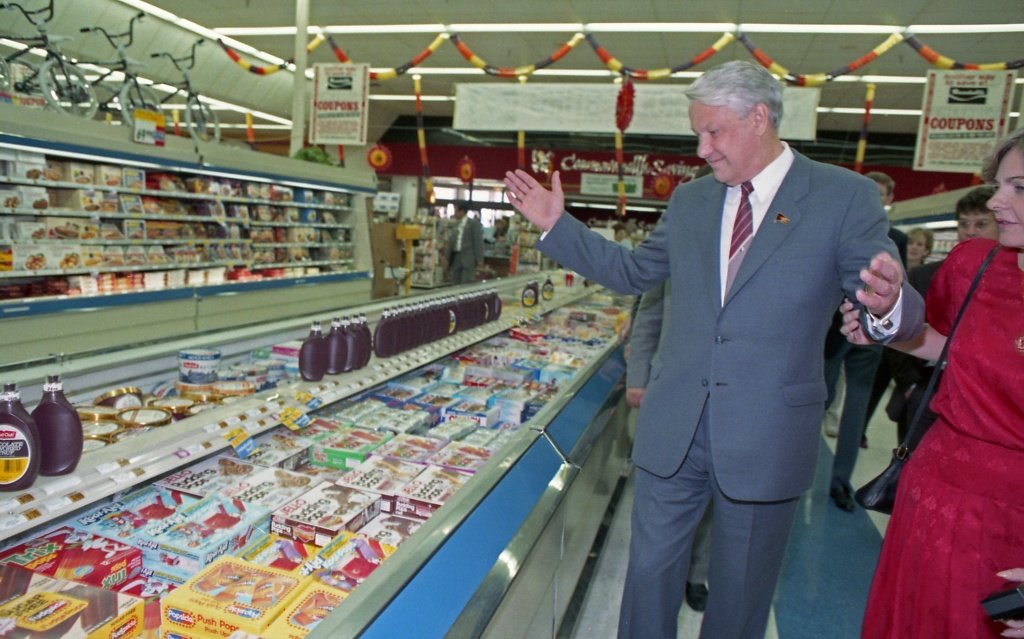
Boris Yeltsin walked into a Houston Randall's grocery store in 1989 and went quiet. Not quiet in a polite, diplomatic way. Quiet in the way a man goes quiet when reality collapses on him.
He saw 30,000 products on shelves. He saw ordinary Americans buying chicken, cheese, and fresh bread without a ration card, without a two-hour queue, without bribing anyone. A Soviet man of real power, surrounded by abundance that Soviet central planners had promised for seventy years and never delivered. He reportedly told his aide that if ordinary Soviet citizens saw this store, they would riot.
Central planners destroyed the price system. Without prices, nobody could calculate where to send resources. Hayek proved this theoretically in 1945. The Soviets proved it empirically with empty shelves every single decade they existed.
You grew up in that system, and you got potatoes when the state decided potatoes existed for you. You stood in line for meat that had already rotted. You traded favors to get medicine your doctor prescribed. Bureaucrats in Moscow set production quotas with no feedback mechanism, no profit signal, no way to know what you actually needed.
Yeltsin left that Houston store and reportedly wept in the car. He later said it destroyed his belief in the Soviet system more than any dissident literature ever had.
Socialism grinds people down daily, in a thousand small humiliations, until standing in line for bread feels normal.
The Cape does not exist to bankroll Pretoria.
Every rand government spends was first earned by a Cape worker, family or business.
Pretoria takes the money, controls the purse, then decides what we get back.
OUR money should serve OUR people.
Our Cape. Our Money. Our Choice!
🔵 " We don't expect BEE to be ended in South Africa because a court says it has to be ended.
It will be ended because..."
- Piet le Roux (CEO, Sakeliga)
South Africa could have become a continent-spanning bastion of excellence and achievement in a world dementedly attached to the equality millstone
After all, the Afrikaners built space and nuclear programs in a land where, before them, the tallest structure was a termite mound. They could have spread that civilization had they remained a bulwark of it against the rising tide of equality and communism
They tried this, at times. They fought bravely in Namibia and Angola
But they didn't always have it in them. They were lured away from resolute anti-communism by the siren song of detente, and in their case it proved deadly, for it convinced them to try to make peace with the communists rather than remain in Rhodesia's corner
And so Rhodesia died as a result of their machinations alongside Kissinger, and when it fell they were completely alone. Soon they got Mandela, and with Mandela came the beginnings of the Cultural Revolution that today risk sending South Africa back to the Stone Age
What might have been! with Rhodesia secure, they could have pushed North to the rich copper belt of Zambia and the vast, fertile fields of Nyasaland. They could have even pushed back into Katanga, from which the Belgians were forced, and achieved dominion over all those valuable minerals
Imagine! A civilization stretching from the Cape to the Congo, secure in its position because it controlled all the valuable minerals of the world, from gold to cobalt, tin to copper. Such an entity could not have been bludgeoned by sanctions as South Africa was, and if nuclear-armed, as apartheid South Africa was, invasion would be a non-issue.
Such a land, not dragged down by the millstone of equality's siren song, could have been glorious. It could have continued to advance as the rest of the world, attached to the false god of equality, destroyed itself. As has already been happening with it and Rhodesia to a certain extent in the Commonwealth, it would have been a land to which the capable and excellent fled to escape the expropriatory tax policies and public security-shredding equality policies of their regimes.
Perhaps we'd already be on Mars, for it would have been an achievement-oriented society rather than one premised on knocking down every tall poppy
Instead, it got Mandela. And now clean drinking water can't even be reliably provided