In ‘The Blue Acceleration: Protecting Our Oceans at Scale’, HRH @rbalsaud, Ambassador of the Kingdom of Saudi Arabia to the United States of America @SaudiEmbassyUSA, announces the first-ever Global Coral Reef Summit taking place later this year in Saudi Arabia.
#SaudiHouse
#WEF26
🌍 Applications now open for our Protected Area Technician Training Scholarships.
Win:
✅ 2 weeks in a top-protected area in South Africa & Kenya
✅ Hands-on with conservation tech
✅ Real-world challenges w/ experts
📅 Apply by 27 Oct 25
https://t.co/vF7OXiMiOb
It's the rise of the end-to-end data scientist. @col_jung's article discusses the growing demand for data scientists with a broad range of skills, including data engineering, MLOps, and GenAI expertise.
https://t.co/LqoLZmZ8mE
Major program launch: Data Analytics Professional Certificate! This large, five-course sequence takes you all the way to being job-ready as a data analyst, and shows how to use Generative AI as a thought partner to enhance your work in this role.
Offered by https://t.co/zpIxRSuky4 on Coursera, this is taught by Sean Barnes, Ph.D., a Data Science & Engineering Leader at Netflix.
Analyzing data remains one of the most important skills in where the world is going with AI. This comprehensive certificate takes you all the way to being job-ready.
Each course comes with practical projects demonstrated in real-world contexts, such as analyzing sales data for a Korean bakery, video game sales trends across different regions, or identifying factors impacting customer retention for a communications company. You'll also work on estimating fire distribution for forest fire prevention, analyzing how a diamond's properties affect its market value, and developing predictive models for retail sales analysis, carbon emissions, and coral reef conservation.
Here's some of what you'll learn:
- How to define data and categorize it into its many types such as discrete & continuous numerical, structured & unstructured, time series, categorical, and know what insights can be derived from the different types of data categories.
- How to differentiate between data-related job roles and their responsibilities, and how data flows through an organization from the moment of capture to decision-making.
- How to perform data processing functions and apply conditional formatting in spreadsheets to extract business value from your data using statistical calculations and best practices for visualizing and interpreting data.
- How to use LLMs for stakeholder analysis, data exploration, and data visualization.
- Best practices for using LLMs for as a thought partner to data analysis work
By the end of this professional certificate program, you will have learned core statistical concepts, analysis techniques, and visualization methodologies that will serve as the foundation for working as a data analyst.
The world needs more data analysts, especially ones who know how to use modern generative AI. With data science roles projected to grow 36% by 2033, the skills taught in this program create new professional opportunities in data.
Sign up here! https://t.co/R2ZiJQCn5g
ChatGPT but for maps.💡Here's a first look at our work on a Smart Mapping Assistant prototype that combines the power of GIS with generative AI. https://t.co/PVIPbyMxKG
#AIinMapping#GeospatialAI
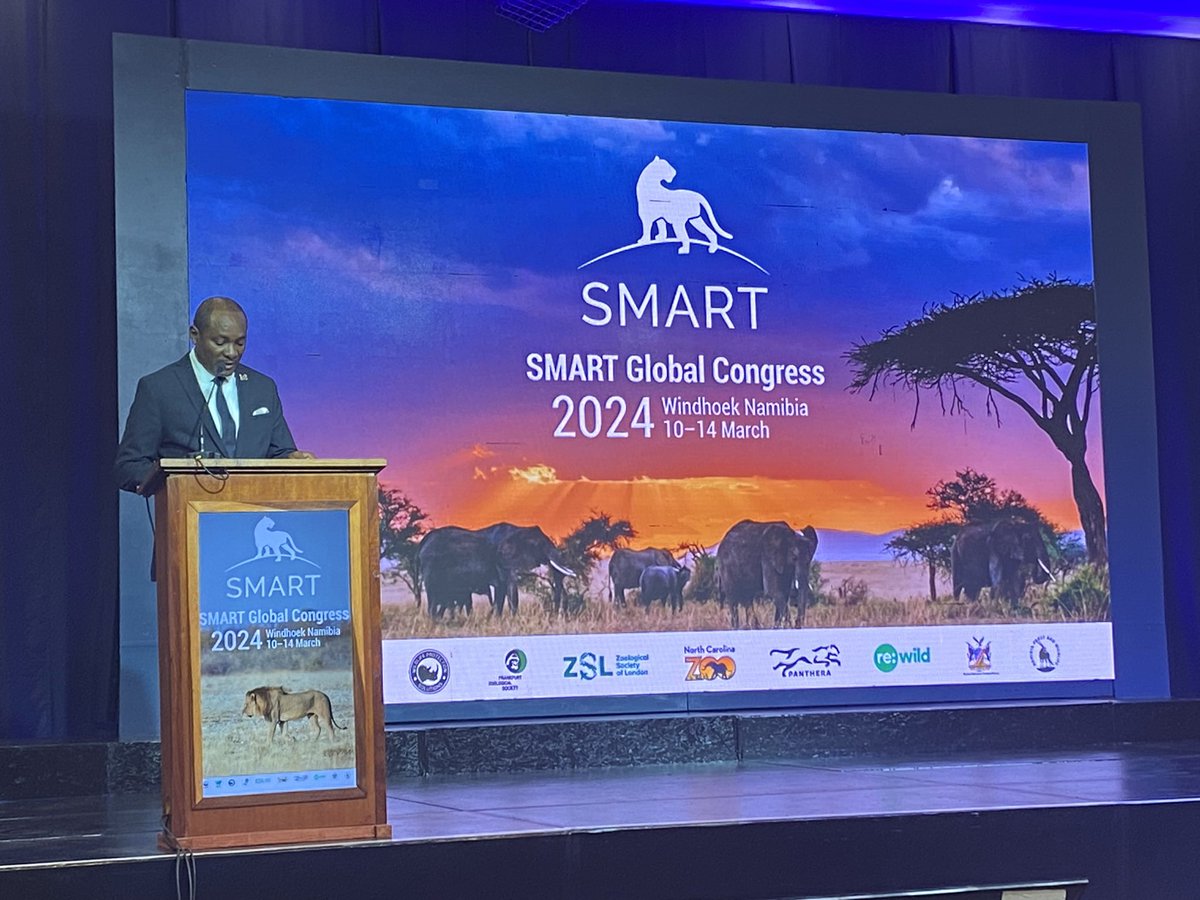
Exciting opportunity to work with a global team of committed conservationists!
We are hiring a SMART Partnership Program Director - a position integral to the success of the SMART Partnership and the implementation of SMART globally.
How to Apply: https://t.co/C4rJzUw3ch
#NewPaper: Working with a huge team of 220 co-authors representing 102 projects in 21 countries, we analyzed data from 5400 #cameratraps to ask how #wildlife behaviours changed during the COVID-19 “anthropause” https://t.co/1VW9b7CI6i ..1/
Super interesting issue to be explored at @CIRESnews and online live at 2 pm US Eastern time Tuesday by @GWSCatUA ecologist/data scientist Kaitlin Kimmel-Haas: "Harbingers of a Replicability Crisis in Ecology": https://t.co/hYky2dKocv
Scientific evidence is supposed to be objective – it is not supposed to be influenced by outside biases or influences. However, in many scientific disciplines, common research practices have been shown to lead to unreliable and exaggerated evidence about scientific phenomena. Here, I will explore the pervasiveness of some of these practices from an empirical analysis of over 350 recent ecology publications from five popular journals. Our analyses show evidence of exaggeration bias (e.g., inflated effect sizes) and selective reporting of statistically significant results. An exaggerated evidence base hinders the ability of empirical ecology to reliably contribute to science, policy, and management. To conclude, I will talk about several actions that ecologists can take to increase the credibility of empirical ecological research to avoid a replicability crisis.
(seen via @matthewburgess)
I could spend all day in this new website.
It uses AI to breakdown any topic in a visual way that is completely different to other search engines.
Table of contents, images, links…it has everything!
A new #Python application programming interface (API) library simplifies NASA Earth science data discovery and access with a few lines of code. ➡️Learn how you can incorporate earthaccess into your data workflow: https://t.co/dsr8h2uEcv
🌊 Wow! A new study by @GlobalFishWatch using #AI & satellite imagery 🛰️ reveals that 75% of the world's industrial fishing vessels are hidden from public view!
This marks the beginning of a new era in ocean management & transparency 🐟
https://t.co/KRO1MZ12x8
#OceanConservation
First-of-its-kind universal adaptor for conservation tech called Gundi has launched. WCS, @EarthRangerTech, Wildlife Protection Solutions put out free, open-source platform to ensure frontline conservationists have tools they need to rapidly scale efforts. https://t.co/vny6Dji6bt