"Capitalism created the possibility of the win win win. It used to be a zero sum game where somebody won, somebody else lost.
The biggest mistake people make, intellectuals in particular, they still think we're in a zero sum world. They're obsessed with some billionaires because Bernie Sanders thinks that Jeff Bezos and Elon Musk somehow stole the money from the people.
They don't understand that it's this prosperity machine that's creating more, not just for those billionaires, but for everything that they're touching. They're creating value for their customers, they're creating value for their employees. Their suppliers are flourishing, their investors are seeing their capital go up. It can be reinvested and compound.
All philanthropy ultimately comes from business. That's where the profits are.
Where does all the taxes come from? It ultimately comes from business as well.
This is the engine that's lifting humanity out. The entrepreneurs are the drivers of that engine. Somebody like Elon Musk, he gets a very, very, very tiny sliver of the value that he creates for the whole world."
—@iamjohnmackey
Starting a company is probably the only way to try to escape bullshit jobs: reporting, compliance theater, internal dashboards, meetings to coordinate meetings, process to manage fear, maintaining status hierarchies, liability shields, and managerial control, not producing value.
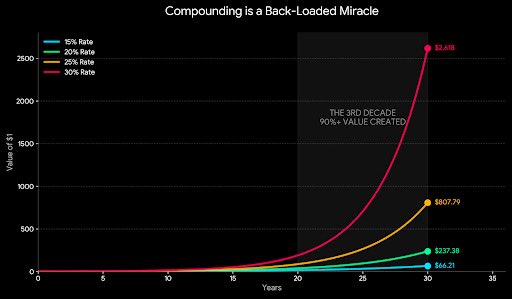
The power of compounding is widely understood. What’s underappreciated is when the value is actually created.
Compounding is continuous, but when you look at it in decade blocks, the pattern becomes obvious. Even moderate differences in the annual compounding rate are severely amplified over time. For instance, starting with $1:
At 15% annual compounding
10 years: $4.05
20 years: $16.37
30 years: $66.21
Last decade: 75.3% of the total value
At 20% annual compounding
10 years: $6.19
20 years: $38.34
30 years: $237.38
Last decade: 83.8% of the total value
At 25% annual compounding
10 years: $9.31
20 years: $86.74
30 years: $807.79
Last decade: 89.3% of the total value
At 30% annual compounding
30 years: $2,618
Last decade: 92.8% of the total value
A 2× difference in the rate (15% vs 30%) becomes nearly a 40× difference in outcomes over 30 years.
Compounding doesn’t add. It multiplies the entire base.
The first decade is impressive.
The second decade is extraordinary.
The last decade is unfathomable.
That’s when fortunes are made.
That’s why the ceiling matters. If the market size caps you early, compounding dies early. You need a category large enough to let it run for decades.
Once you see compounding this way, it permanently changes how you choose markets.
Health insurance, for instance, is roughly a $1.7T TAM in the U.S. alone. It may not be the sexiest space, but that’s one of the reasons I’m so excited about Curative Health long term.
What business today has a ceiling high enough to compound until 2056?
My Conversation with John Mackey (@iamjohnmackey), co-founder of Whole Foods Market.
0:00 Fanatical Entrepreneurs: Why Work Feels Like Play
2:18 The Missionary vs. Mercenary Co-Founder Conflict
6:16 The Shirtless Hitchhiking Hippie and Johnny Rockefeller
8:12 Entrepreneur Confidence: Solving Puzzles and Cracking the Code
10:19 Flying Under the Radar: How Supermarkets Ignored Whole Foods
10:52 Venture Capitalists Are Hitchhikers With Credit Cards
14:03 Builder Entrepreneurs vs. Serial Entrepreneurs
16:31 Time Is the Only Filter I Trust
20:52 How Walmart Accidentally Fueled Whole Foods' Success
24:01 The Jaw-Drop Effect: When Customers First Walked In
27:17 Growth Through Acquisition: Building Geographic Platforms
29:19 Secret Allies: The Natural Foods Network
33:17 Mrs. Gooch's and the Revelation of Scale
34:52 Missionaries Sharing Financial Statements and Building Friendships
38:10 Never Competing Head-On With Friends
41:22 Going Public and Creating Liquidity for the Network
42:00 Continuous Learning: The Michael Dell Principle
44:10 Steve Jobs and Spotting Markets With Second-Rate Products
46:50 The Joy of Watching Team Members Become Millionaires
48:09 Capitalism: The Greatest Thing Humans Ever Invented
55:59 Cult Brands Are Built by Evangelists
58:01 Passion Is Infectious: The Reality Distortion Field
1:00:08 From Busboy to CEO: The Resume of an Entrepreneur
1:02:57 Learning From Near-Death Experiences
1:04:05 Money Means Freedom: Early Work Ethic
1:05:25 Shoe Dog as the Benchmark: Belief Is Irresistible
1:09:16 Documenting Time: Why Chronology Matters in Memoirs
1:11:14 Rockefeller, Bezos, and Musk: The Master Strategists
1:14:39 Using Doubt as Fuel: The Slow Burn of Proving People Wrong
1:20:04 Daniel Ek and Having No Ceilings
1:23:09 How His Father Shaped His Ambition
1:25:52 Firing His Father From the Board: The Hardest Decision
1:28:01 His Mother's Deathbed Wish and Lasting Regret
1:34:47 The Ceremony of Forgiveness
1:36:17 MDMA Therapy and Breathwork: Accessing Deeper Consciousness
1:38:54 The Entrepreneurial Journey as a Spiritual Journey
1:40:45 Conclusion
Includes paid partnerships.
I don't know who needs to hear this, but most things in life are way more achievable than you think. If you decide what you want, and go after it with full effort and intensity, the world will bend to your will far more easily than you might think. You can just do things!
Agency > Intelligence
I had this intuitively wrong for decades, I think due to a pervasive cultural veneration of intelligence, various entertainment/media, obsession with IQ etc. Agency is significantly more powerful and significantly more scarce. Are you hiring for agency? Are we educating for agency? Are you acting as if you had 10X agency?
Grok explanation is ~close:
“Agency, as a personality trait, refers to an individual's capacity to take initiative, make decisions, and exert control over their actions and environment. It’s about being proactive rather than reactive—someone with high agency doesn’t just let life happen to them; they shape it. Think of it as a blend of self-efficacy, determination, and a sense of ownership over one’s path.
People with strong agency tend to set goals and pursue them with confidence, even in the face of obstacles. They’re the type to say, “I’ll figure it out,” and then actually do it. On the flip side, someone low in agency might feel more like a passenger in their own life, waiting for external forces—like luck, other people, or circumstances—to dictate what happens next.
It’s not quite the same as assertiveness or ambition, though it can overlap. Agency is quieter, more internal—it’s the belief that you *can* act, paired with the will to follow through. Psychologists often tie it to concepts like locus of control: high-agency folks lean toward an internal locus, feeling they steer their fate, while low-agency folks might lean external, seeing life as something that happens *to* them.”
Asked by the WSJ whether he spent $500 million renovating the 5th Avenue Tiffany flagship, Bernard Arnault replied:
“You cannot dream when you talk numbers. When you create desire, profits are a consequence.”
You need to be creating desire.