@BradRob23@Protestia@Jonathan_Howe I can see your perspective. It’s cool that a Baptist meeting is a little like an NFL game. But isn’t it also like saying, the letter from Acts 15 was the intellectual property of the Jerusalem church Luke had no right reproducing it, and commenting on it without permission.
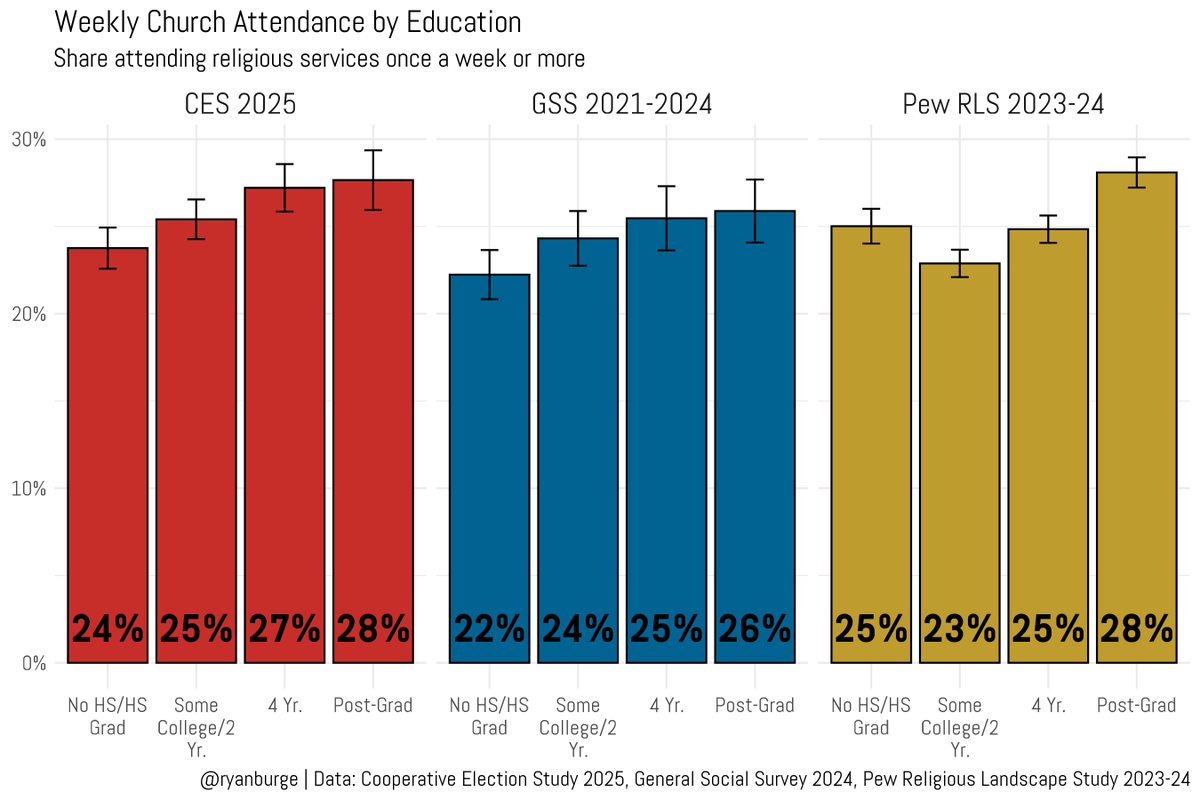
Here's the most widely misunderstood fact about religion in the United States.
Educated people are more likely to report weekly attendance at religious services than those with less education.
This is a highly replicable finding.
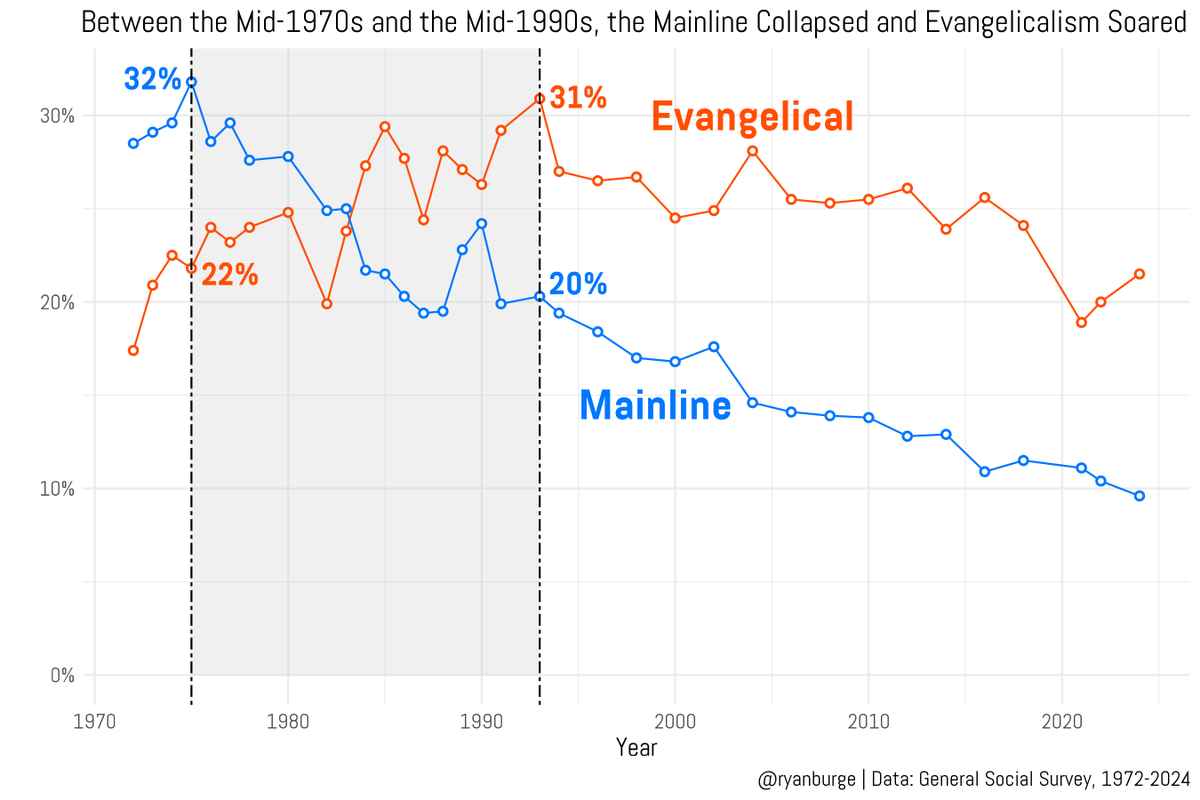
In the mid-1970s:
Mainline Protestants were 32% of the population
Evangelicals were 22%
Two decades later:
Mainlines had dropped to just 20%
Evangelicalism had risen to 31%.
A complete reversal in less than 20 years.
@FrankDucharme2@meetuatthefence I empathise with you. I’ve also been grieved when churches have left the association I’m part of. However, to demand that they leave without assets would make us less than Baptist, and if it forced them to stay, would make us less than unified in truth and love.
@FrankDucharme2@meetuatthefence Hey Frank. Surely, believing each local church is autonomous, and believing that any cooperation is by free will association, churches should be allowed to leave without reimbursement. That’s the Baptist way.
Church attendance in America is being propped up by one unusually large generation: the Baby Boomers. That is not conjecture. It is a demographic reality.
Boomers comprise roughly 40–50% of adult membership in many Protestant denominations, even though they represent only about 20% of the U.S. adult population. In other words, Boomers are about twice as prominent in churches as they are in society at large. This imbalance explains why many congregations feel relatively stable today. But it also explains why that stability is temporary.
The age distribution data is sobering. In several mainline Protestant denominations, roughly two-thirds of adult members are over 60. Evangelical denominations are not dramatically younger. Southern Baptists, for example, have only 6% of adults under age 30.
The future is not just about death rates. It is about replacement. Across denominations, the share of adults in “peak fertility years” (18–40) has declined sharply. For example, Southern Baptists fell from 28% in 2008–2010 to 19% in 2022–2024. Additionally, non-denominational evangelicals dropped from 39% to 27%. Similar trends appear across the mainline groups.
The bottom line is unavoidable:
-Birth rates are too low to offset losses.
-Transfer growth potential is largely exhausted as the median church size is half of what it was three decades ago.
-Many denominations are on pace to lose 30% of their adults in about 15 years and 50% in about 20 years.
A church without a full nursery is not merely missing a ministry opportunity. It is facing demographic contraction. https://t.co/xC3Pd48Noh
@ThapeloLdf@MorolongZA I love Nando’s. And their adverts are the best. I’ve not had Nando’s in maybe two years because I perceive them as being too expensive. Had KFC last week.
AoG churches are on average a lot younger than Baptist churches.
From my perspective it’s probably because AoG churches are more intentional. And more winsome. Something for Baptist churches to learn there.
Gen Z church goers (14-29) go church more than any other generation at the moment. They’re also more engaged.
Its not a stretch to say that healthier churches are normally younger churches.
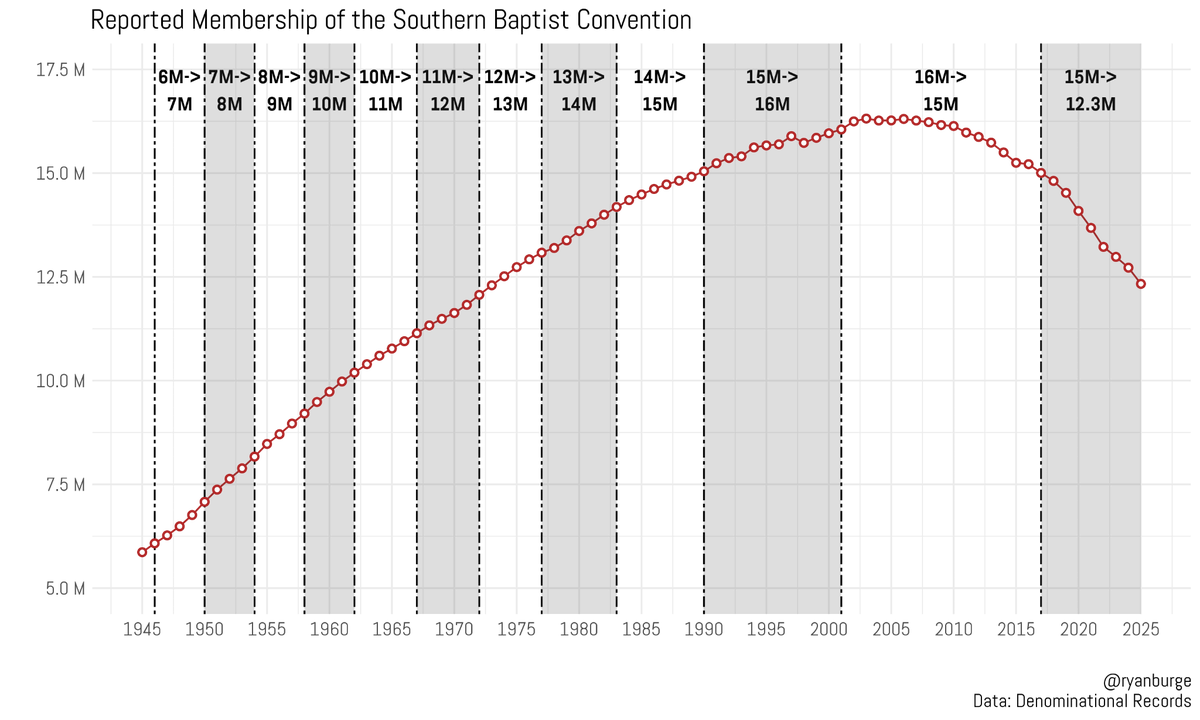
The Southern Baptist Convention's annual meeting is next week.
It's the largest denominational gathering in the United States.
But the denomination itself is shrinking rapidly.
Down nearly 4M members since 2006.
Back to membership levels last seen in 1971.