Really excited to share the most recent preprint from the @hollfelderlab, a new fluorescence assay for NAD(P)H quantification that helps to bridge the gap between plate and droplet screening for enzymes with @MaxGantz_ and Jamie Klein. (https://t.co/5ta0JYk813). When applying
Side note: We were excited to see that a recent preprint from @chang_c_liu lab (https://t.co/GeGJwP2IP2) aligns with our vision, emphasizing the need for systems with low mutation bias and the potential of studying long evolutionary walks. Very exciting future of the field ahead!
Check out our preprint on YeastIT, a new system for continuous evolution, addressing the challenge of biased mutational spectra and exploring the long-term evolutionary outcomes of different mutagenesis methods! https://t.co/U3u5RuBhkZ @hollfelderlab@mattpennerKY@LeDillingeur
We tested YeastIT in directed evolution of a DARPin and witnessed a 15-fold improvement in affinity. We also compared our system to existing methods, examining how differences in mutagenesis spectra affect long-term evolutionary outcomes and constrain potential trajectories.
Thrilled to share our recent paper describing a high-throughput microfluidic platform for optimizing recombinant protein production ☺️
https://t.co/womvNsef0y
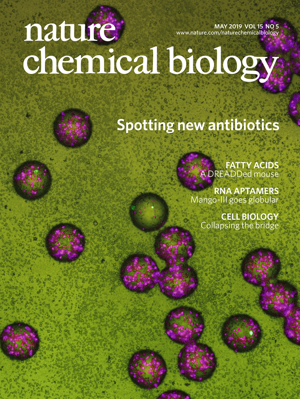
The May issue cover depicts work from Sven Panke's group at the ETH and colleagues that identified new bioactive lanthipeptides https://t.co/anPHpJEXIm (free, read-only copy at https://t.co/3WnycVmRYZ ) https://t.co/vJVnrulgoC
Work from Sven Panke’s group used combinatorial biosynthesis and a high-throughput inhibition assay together identify new bioactive lanthipeptides https://t.co/cPkhTXfkaW