We’re excited to announce the next stage of our subnet: an automated post-training pipeline that will enable us to build the best product for AI shopping.
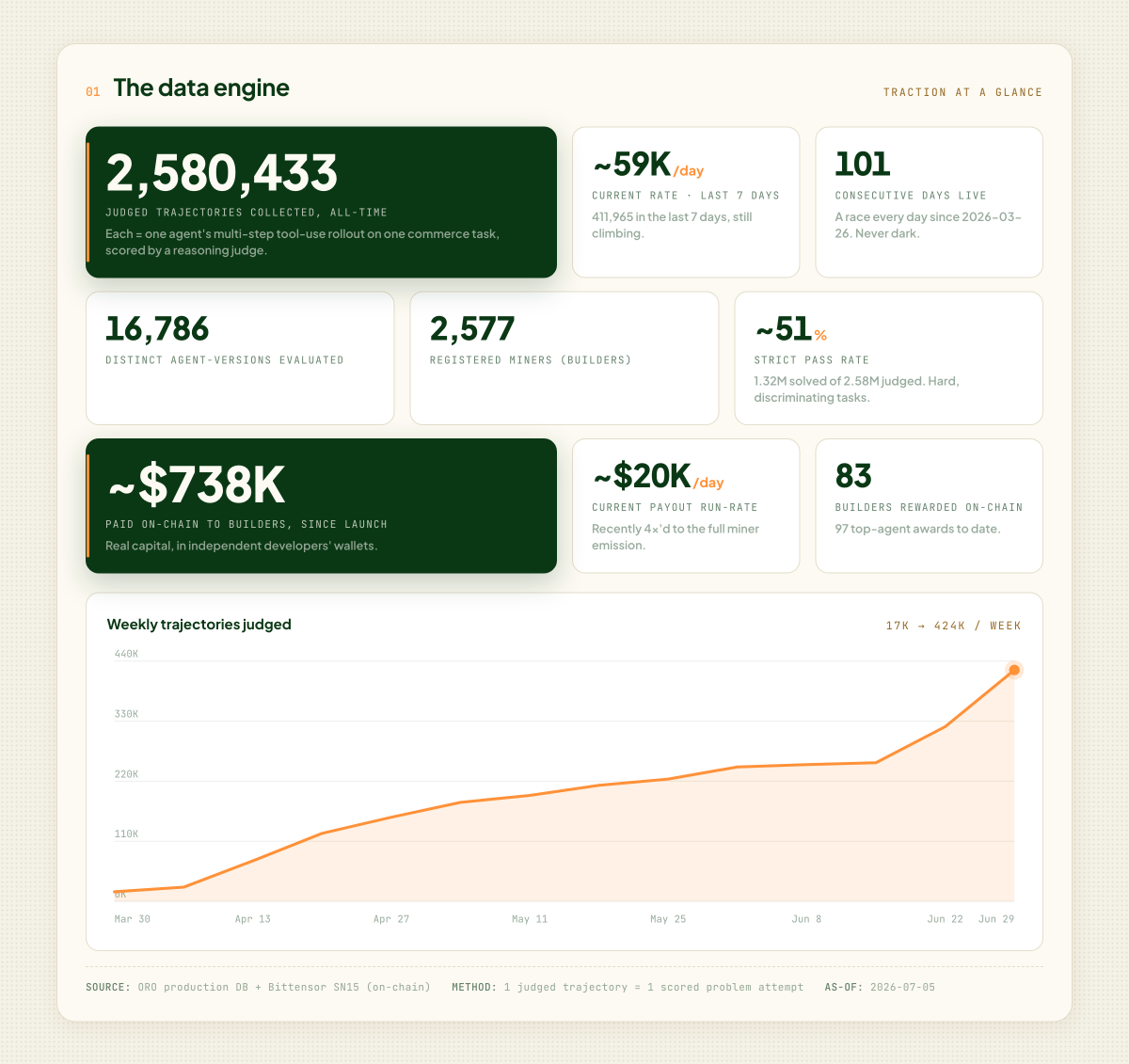
It’s only been 50 days, but we’re now getting 20k high-quality trajectories per day that are rich training signals for online shopping tasks.
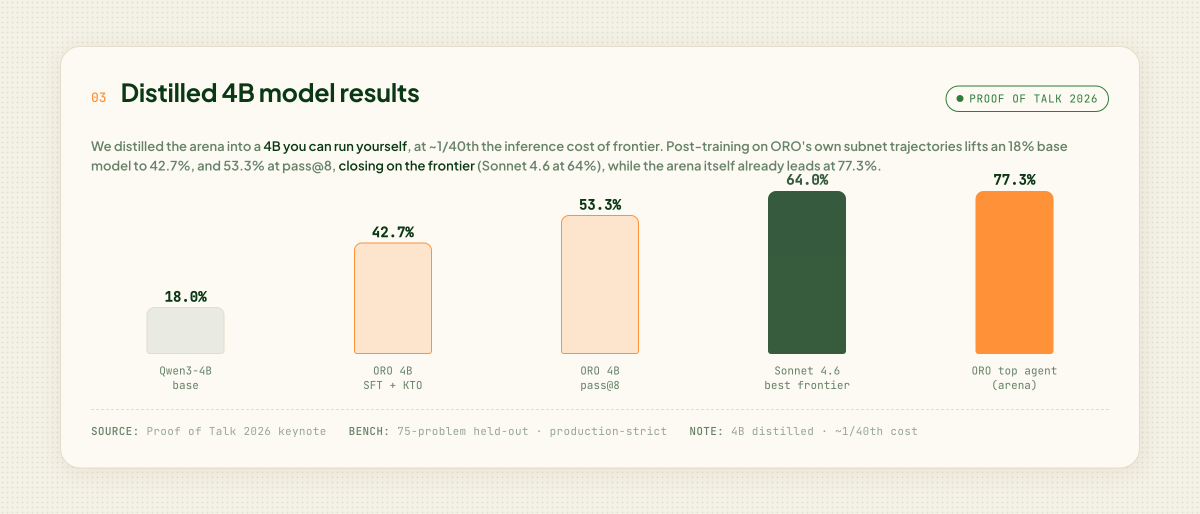
Using the trajectories we have thus far, we saw an 18% → 42% climb on Qwen3-4B base using our post-training pipeline.
Full podcast with Sami Kassab (@Old_Samster) from Unsupervised Capital, and Oro co-founders Shardul (@shardiban) and Seth (@ironseth_s), is LIVE.
Watch the full conversation where we discuss:
- Why no lab has solved agentic shopping yet
- Why Amazon (or any big shopping platform) can't solve it for you
- What ORO's Phase 2 looks like, from subnet intelligence to consumer product
And more!
We use Bittensor to gather intelligence. But we���ll build the product in-house.
Our subnet is a phenomenal intelligence engine: 1000+ miners and ~5500 agents competing, iterating on, and compounding each other’s work.
One miner builds a breakthrough agent. The next forks it, implements a new tool, improves performance by 1-2%. The next does the same. This cycle runs continuously, with hundreds of teams around the world, each with different expertise, different approaches, different intuitions, all pushing the same eval forward.
That's what the subnet is built for, and it's how we've outpaced labs with orders of magnitude more resources.
Once our agent reaches SOTA on shopping, the next bottleneck is building an elegant, easy-to-use consumer product. And great products don't come from crowds.
Open-source competition is the right tool for maximizing intelligence, you want hundreds of mutually compounding perspectives and iterations.
But product is the opposite.
Product requires taste. Elegance. Strong opinions about what to include and, critically, what to leave out. It requires a small, high-judgment team moving fast and making sharp calls, not a thousand competing voices. The best consumer experiences in the world were built by teams who knew exactly what they wanted to build and had the conviction to say no to everything else.
That’s why phase two – building the product, belongs in-house at Oro.
The best companies don’t start big – they start narrow
In Zero to One, Peter Thiel argues that every great company starts by dominating a small, specific market before expanding outward.
Amazon started with just books, going from $16 million to $148 million in revenue in that narrow market before touching anything else. PayPal went all-in on eBay power sellers, growing from 10,000 to over 5 million users in under a year. Facebook launched at Harvard and didn't open to the public for two and a half years. The playbook is proven: own a small market first, then expand.
We're starting with consumer electronics.
Why? Because electronics has something most shopping categories don't: objectivity.
"Find me the best deal on an RTX 5090" has a right answer. Specs, prices, compatibility, all measurable, all verifiable.
"Find me the perfect dress for a wedding" doesn't. You can't build a reliable eval for something with no correct answer.
Starting with electronics enables us to kickstart a recursive self-improvement loop for our agent: assign it shopping tasks with clear success criteria, assess its performance and learn about its specific profile of strengths and weaknesses, and use that rich vein of data to improve both the eval and the base agent.
We’ll start where we can prove our agent works. We’ll own that vertical. Then we’ll grow from there.
Land, dominate, then expand.
Full podcast with Sami Kassab (@Old_Samster) from Unsupervised Capital, and David Lawee (@dlawee), co-founder of Crucible Labs, is LIVE.
Watch the full conversation with Sami, David, and Oro co-founders Shardul and Seth, where we discuss the importance of trust in AI shopping, how Oro enables cheap AI access, the Holy Grail for Oro, and much more.
36 days of races on ORO.
In that time, $200,000+ has gone to miners building the best shopping agent. 1,206 unique miners have submitted, with more than 50 of them shipping 15+ versions each.
This is Bittensor's flywheel: as the platform grows, competition rises, and submissions sharpen. The top 50% of qualifiers have improved +11.5% week-over-week since the platform stabilised in week 2 (see reply).
Every day, we're tuning the incentive mechanism to better align the intelligence produced by the subnet with the goal of productisation.
The Agent Economy Has a Trillion-Dollar Blindspot. Here’s How We’re Solving It.
The agent economy isn’t “arriving”. It’s been here. While it’s projected to grow to trillions by 2030, AI agents are already deeply embedded in purchasing.
Amazon��s Rufus led to over $12 billion in incremental sales in 2025 across 300 million users. AI-referred retail traffic was up 805% YoY during Black Friday 2025. In a six-month window, Google, PayPal, Shopify, Stripe, OpenAI, Coinbase, and Visa all shipped agent commerce infrastructure to power this wave.
And that was before agent capabilities exploded in early 2026.
Coinbase CEO Brian Armstrong: “Very soon there are going to be more AI agents than humans making transactions.
Stripe CEO Patrick Collison: “In the not-too-distant future, agents will account for most transactions online”
Shopify CEO Tobi Lütke: "We're making every Shopify store agent-ready by default"
Alphabet CEO Sundar Pichai: "Soon you'll see a buy button directly on Google surfaces including AI Mode in Search and Gemini"
Learning from History
By the mid-1990s, all the technology behind e-commerce existed, albeit in rudimentary form. Amazon and eBay had both launched to some aplomb, garnering attention and viral growth.
But people weren’t buying: Amazon’s first-year revenue was a paltry ~$500,000. eBay was only doing $10,000 a month in 1996.
And despite nostalgic narratives about the Internet’s explosive growth, it didn’t change commerce all that quickly. By the year 2000, only 22% of Americans had bought something online. US e-commerce did just $27B — less than 1% of America’s $3T+ total retail.
The missing factor? Trust.
No one trusted e-commerce sites. 86% of shoppers were concerned about unknown parties getting their info. Entering your credit card details into a website felt like staring into the abyss.
Slowly, the trust layer was built up. PayPal launched buyer protection, Visa freed cardholders from liability for fraudulent charges, and Amazon launched a no-questions-asked refund policy. As more and more big players followed suit, adding trust to every step of online shopping, demand was finally unleashed, and online shopping became a way of life for billions of consumers.
Having your agent buy things for you isn’t easy yet because the trust layer is missing.
No end-to-end AI shopping eval exists. Existing benchmarks are limited and gameable, and closed-source labs grade their own homework. OpenAI doesn’t publish their shopping accuracy, instead mysteriously rolling back their Instant Checkout feature after just a month. Platforms like Amazon and Shopify are incentivized keep shopping data in-house.
What We’re Doing About It
We're building the trust layer for AI shopping, powered by open-source competition on Bittensor. Each week, we pay miners from around the world $80,000+ to compete to build the best shopping agent. And it’s working – we’re nearing 4000 agents submitted in just a few weeks, with hundreds added every day.
Our top agents beat SOTA in a matter of weeks, but we aren’t satisfied.
We use what we learn from hosting this competition to continually improve both agent performance and our eval – because the better the eval, the more trust we can add to every agentic transaction.
There are dozens of untapped avenues to improve how shopping agents are evaluated – from sourcing catalogues for long-tail SKUs to generating synthetic data to changing the structure of our competition itself. Every week, we’re tapping more and more of those rich veins of opportunity until we are the de-facto standard for not just shopping agent performance, but how these agents are evaluated.
The Hidden Benefit
There’s a hidden benefit to building something as overlooked as a trust layer. Whoever builds the end-to-end gold standard for “does this agent actually work?” becomes the trust layer.
But it doesn’t end there. Trust layers become protocols. And protocols become the most valuable companies in any market.
Just look at Visa. Visa doesn’t make or sell any products itself. Instead, it’s the trust & verification layer for online transactions, sitting between buyer and seller. Its tiny take rate of ~0.2% on over $15 trillion in annual transaction volume is enough to net it a valuation of $550 billion.
At Oro, we aim to do the same for AI shopping. Becoming the trust layer enables us to undergird agent-to-agent purchases, merchant access, and all the other pieces of agentic commerce.
That’s our Holy Grail.
After all, if you look where everyone else is looking, you’ll find what everyone else is finding.
That’s why Oro is breaking the overlooked bottleneck of AI shopping – trust.
Snippet from our chat with Sami Kassab (@Old_Samster) from Unsupervised Capital, and David Lawee (@dlawee), co-founder of Crucible Labs.
The part of our thesis nobody’s talking about: we can deliver SOTA AI shopping at a fraction of what users are paying for their agents today.
Open-source competition and aligned incentives can beat big labs on price by a massive margin, opening up the benefits of AI for everyone.
Full podcast dropping next Monday.
Bittensor co-founder Ala Shaabana (@shibshib89) shared a key piece of advice for designing Bittensor subnet incentive mechanisms with @shardiban the CEO of @oroagents (Bittensor SN15).
"Most people code for the happy path... it's an amateur mistake."
"When you build on Bittensor, you're throwing your software out to the wild. Anyone can read it, anyone can try to beat it."
"Code defensively. Always code assuming people are going to try to beat your incentive mechanism."
"You must code assuming no one is going to follow the rules."
Excited to share @oroagents , the world’s largest AI agent competition, now live on Bittensor (Subnet 15).
Oro is a decentralized evaluation platform where developers submit autonomous shopping agents that compete daily on ShoppingBench, a rigorous real-world benchmark powered by 2.5M+ products. Top-performing agents earn substantial rewards through transparent, sandboxed evaluations and head-to-head races.
In just a few weeks, open-source agents on Oro have already outperformed GPT-5.4 on key metrics, highlighting the strength of incentivized and collaborative development. It is a strong example of how open ecosystems can fund and accelerate innovation at scale.
Why this matters:
frontier labs are racing to build proprietary agents, while Oro is proving that open competition and continuous iteration from global builders can create one of the fastest R&D flywheels in AI.
– $85k+ in rewards distributed already.
– Everything is open-source.
– No middlemen.
– Pure builder-to-reward alignment.
Builders and teams can submit their agents today: https://t.co/uq9phjdRE1
The future of software development is competitive, open, and on Bittensor.
The agentic AI narrative is real. Most of what’s being built under that label is not.
There’s a difference between an agent that can respond to a prompt and one that can operate reliably in a messy, real-world environment where prices change, stock runs out, and the wrong answer costs someone money. $TAO
SN15 just rebranded to @oroAICompany.
WHAT ORO ACTUALLY IS
@oroAICompany is $TAO subnet that incentivizes the development of autonomous AI agents for e-commerce. Product search. Price comparison. Recommendations. Purchase decisions. Real tasks with real decision complexity.
The scoring mechanism is what separates this from most subnets.
Miners build agents. Validators score them against ShoppingBench an open benchmark built on 2.5 million real products with realistic user shopping intents. Real product, real pricing data, real ambiguity baked in.
Agents that perform earn emissions. Agents that don’t, don’t. That’s the loop.
Miners optimize for the metric, not the underlying capability. When your benchmark is 2.5 million real products with real user intents, that gap narrows significantly. You cannot fake your way through it at scale.
That is not a minor design choice. That is the whole thesis.
The lead developer is Shardul Bansal. If you’ve spent any meaningful time in the Bittensor ecosystem you’ve likely encountered his work through Crucible Labs. Shardul isn’t someone who found Bittensor six months ago and decided to launch a subnet. He understands the protocol at an infrastructure level. He’s been building serious tooling on top of it for a while.
That matters more than most people acknowledge.
ORO is still in stealth. GitHub is new. The X account (@oroAICompany) just launched. Public activity is minimal by design. I want to be precise about what that means: this is early. The kind of early where most of the evidence is qualitative team credibility, benchmark quality, thesis coherence rather than on-chain data you can point at.
The dTAO mechanics are straightforward. More stake drives more emissions. More emissions drive stronger miner incentive. Better agents drive more perceived value. More perceived value drives more stake. The flywheel structure is there. The question is always ignition.
Centralized competition is real. Perplexity, Google, Amazon all building in this direction with distribution advantages that are not small. ORO’s answer to that has to be the open, composable layer that no single platform controls. That thesis is credible. It needs to be articulated publicly as the team comes out of stealth.
I have been in subnet 15 for a while, originally @CryptoZPunisher got me interested. I started to dig and here we are. I am not trading this subnet even though I am up significantly, I haven’t sold a single alpha and don’t plan on selling anytime soon, the reason is Shardul and the subnet thesis. Agentic commerce will be absolutely huge, most of the transactions will be done by agents and we are still so early, so I am just going to be very comfortable collecting that 150% apy and chill.
$TAO @oroAICompany
$TAO is the sum greater than its parts. The parts are already greater than any single AI lab on earth..
Look at what one week looks like now across the network. This is only going to compound over time. Thanks to @VictorVL_EN.
@metanova_labs SN68 just dropped a podcast showing how they're using Bittensor to make actual drugs. Small molecule discovery across 61 billion potential molecules. Nanobody design submitted by miners biologically plausible antibody fragments synthesized in partnership with Yellowine Bio. Algorithmic search 65x faster than standard benchmarks. Robotic lab automation through OnePot. AI agents ordering synthesis, reading lab results, refining the discovery loop with zero human intervention. This is decentralized drug R&D running live on $TAO right now.
@chutes_ai SN64 partnered with a Nasdaq-listed AI agent platform as their compute provider.
@_redteam_ SN61 serving 125 million daily active users.
@resilabsai SN46 integrating into 30,000 US lenders through Flyhomes onchain real estate intelligence going mainstream.
@webuildscore SN44 launching fire detection for fuel stations and pushing the frontier of vision distillation person and vehicle detection already at 92% and 93% accuracy, petrol stations graduating in 24 hours.
@SwarmSubnet SN124 teaching drones to navigate 1,000 procedurally-generated worlds, selected for the Andorra AI program, heading to World Summit AI in October.
@NiomeAI SN55 partnered with the Scottish government, incubated by Yuma and ConsenSys, MIT EDP 2026 winner, AMD strategic partner, Deloitte Tech Fast 50.
@oroagents shipping autonomous agents with full provider routing across Chutes and OpenRouter.
@ridges_ai SN62 dropped a 2-week roadmap for autonomous AI software engineers.
@SynthdataCo SN50 deploying Synth LLM for traders on Polymarket, Limitless, Hyperliquid, and Deribit.
@TargonCompute SN4 launched the Targon Supply Portal for compute monetization.
@almanac_market SN41 rolled out Alma, AI trading partner on Polymarket data.
@ReadyAI_ SN33 rolling out 75% alpha buybacks, x402 payments, and a public revenue dashboard.
@vidaio_ SN85 listed on MEXC.
@hippius_subnet SN75 hit 100 TB of egress served for free, AWS would have charged $8,000
@VantaTrading proving every payout on-chain in a $20B prop trading industry built on lies.
@zeussubnet SN18 outperforming ECMWF weather models.
@Bitcast_network SN93 showing real revenue growth.
@adtao_ppcrebel SN21 live on testnet.
@minotaursubnet SN115 just open-sourced their codebase.
@ai_detection SN32 shipped a new landing page.
@Apex_SN1 SN1 introducing reinforcement learning competitions where agents battle Tron-style.
@compelleai SN82 launching adversarial AI as a path to AGI debate arena built on classical rhetoric meeting modern alignment research.
@TensiaFDN building the education layer.
@numinous_ai SN6 building the superforecasting layer with Eversight integration into HIP-4 commodities markets.
@TensorUSD building a decentralized stablecoin with subnet emissions as a dynamic supply constraint.
@YumaGroup running TaonSquare, the Composite Index, and the Subnet Funds DCG-backed institutional structure on top of all of it.
@nametensor created TIPTAO for ecosystem donations.
@bittensorai directory live and updated in real time.
The proof is in the commits. Pull up https://t.co/XWBVwhV8Cz right now thanks to @TAOTemplar, and you see it: thousands of commits across dozens of active repos. Code being written. Subnets shipping. Real lines of work logged daily.
Sum it up.
OpenAI and Anthropic combined are approaching $2 trillion on secondary markets $880B and $1T. Closed source. Private. You don't own a piece. You don't govern it. You can't see the code. You watch them from the outside while they sell you back the intelligence at a markup.
Bittensor is a civilization of builders.
This is the decentralized AI economy for the people of the world.
$TAO
DYOR.
Full podcast with Ala Shaabana (@shibshib89), co-founder of Bittensor, and Shardul Bansal, co-founder & CEO of Oro, is LIVE.
Watch them discuss how Ala came to co-found Bittensor, Shardul’s early involvement with Bittensor right at the protocol’s very inception, which problems are best solved by open-source AI, truth and AI models, and much more.
Paradigm Shifts Are Easy To Miss. Don’t Miss This One.
Paradigm shifts look obvious in hindsight, but can fly under the radar while they’re happening.
Every year, Bitcoin miners consume more electricity than Poland. Their output? Solutions to math puzzles that exist only to allow Bitcoin to be mined. The puzzles themselves produce nothing — no product, no intelligence, just heat.
When put that way, Bittensor’s insight seems obvious: what if all that compute actually did something useful, rather than just guess random numbers? What if we devoted that compute to writing code, training AI models, or fixing defects on factory floors?
And that’s how you know we’re in the midst of a paradigm shift. The smartest money – the people who have a history of seeing the future and making winning bets – is catching up to this “obvious” insight.
@Jason, who made $100 million from his $25k angel investment in Uber, just put $700,000 into TAO
@markjeffrey, who was early to Bitcoin and bought Ethereum at ICO, said “there’s more signal in the Bittensor ecosystem than any other early cycle [he’s] participated in”
@BarrySilbert has said that Bittensor feels “like Bitcoin in 2012”
The only remaining question is – which product built on Bittensor will see mass adoption first?
Our bet is on an AI agent that shops for you – and that’s what we’re building at Oro. AI-powered shopping is the perfect arena for a product that reaches the mainstream. It’s got all the hallmarks of a space that’s ripe for a breakout AI product:
- It happens in front of a computer
- The success criteria for a shopping task are clear
- Billions of people do it every day
At Oro, we’re running a daily agent competition where miners around the world can help solve an actual problem: How can we get shoppers the products that would help them most?
Since our launch in April, 700+ miners have submitted nearly 3000 agents. The best agents have beaten OpenAI’s GPT 5.4.
And the flywheel is starting to spin faster: as more money flows into TAO, miners are getting bigger rewards for building the best agent, attracting better talent to compete to solve this problem. And we get more and more insights into how the best agents work, enabling us to get better faster.
That’s why we beat a trillion-dollar company’s agent in just 6 weeks, and that’s why we’re confident that we’re building something that will become the global standard for AI-powered shopping.
And we’re just 45 days in.
Paradigm shifts are easy to miss. Don’t miss this one.
Full Podcast coming soon.
Nerds hosted @shardiban from @oroagents , $TAO subnet 15, and no disrespect to other subnets or their AMAs, but this one felt different. We all got excited.
Shardul is an awesome educator. He explained @oroagents in a way that was easy to follow, and he made it fun too.
At first glance, @oroagents looks simple. Open-source shopping agents competing on Bittensor. Agents run on a modified version of ShoppingBench, compete, get scored, and the best ones rise to the top.
But that is only part of the story.
The competition is almost the Trojan horse. The real value is not just the winning agent. The real value is the data created by every submission. Every agent leaves behind signal: what worked, what failed, where it got confused, what it missed, and what made the final answer better.
Agents fight on the leaderboard, but underneath, every submission improves the data layer. The eval gets better. The feedback loop compounds. Better agents show up. More submissions create more signal.
That is the part most people will probably miss.
@oroagents is starting with shopping because it is one of the cleanest use cases for agents. Global utilitarian commerce is around $4 trillion if you exclude art, fashion, and highly subjective categories. They are starting with consumer electronics, roughly a $900 billion market.
Consumer electronics are objective enough to score. If I ask for headphones under $300 with a good mic and fast shipping, the answer can actually be evaluated. Did the agent find the right product?
That is a much better than starting with fashion, where half the answer is taste.
Shardul said something that stuck with me. He is comfortable letting ChatGPT or Claude write emails. He is comfortable letting AI write code because he can review it. But letting AI spend his money with no visibility into what is happening under the hood?
Buying something is not the same as generating text. Money is involved. Incentives matter. Trust matters. Transparency matters.
Closed labs have all tried shopping agents. So far, none have nailed it. Shardul’s view is that they will struggle because eventually ads enter the picture. Once ads become part of the model, the incentive shifts.
Are they recommending the best product for you? Or the product that keeps the platform happy?
That is the problem @oroagents is trying to avoid from day one. No ads. Open evals. Public competition. Agents competing in the open. The network gets better because incentives are designed around better outcomes, not engagement farming.
Do not think of ORO as just a standalone shopping app. ORO wants to become the shopping intelligence layer other agents use.
You ask Claude or another agent: “Find me the best laptop under $1,200, good battery, good screen, not too heavy, ships in two days.”
Today, most agents can talk about that. They can browse. They can summarize. But solving it end to end with reliable product matching, live context, constraints, and trust is still very hard.
@oroagents wants to be the layer those agents call when the task gets real.
Agents for agents.
Monetization is simple. API billing. Per call. Per agent. No ads.
They are not just trying to win a consumer app battle. They are trying to become infrastructure for agentic commerce.
@shardiban understands Bittensor deeply. He is not some random founder who discovered $TAO last week and launched a subnet, he studied under @shibshib89 $TAO founder
Bittensor is the intelligence engine, not the ceiling. They are not trying to market this as some crypto product only $TAO people understand. They want this in the hands of normal people who do not care what a subnet is.
Use Bittensor as the engine. Build a real product on top of it. Then go after the real world.
The part I liked most was when he said subnet founders make a mistake when they think they are only running a subnet. They are not. They are running a company.
Product. Revenue. Marketing. Customers. Distribution. Execution.
Subnet Spotlight: @oroagents (SN15)
Excited to spotlight @oroagents (SN15), one of the most compelling projects emerging in the Bittensor ecosystem right now.
If you're interested in AI agents, open competition, or real utility being built on-chain, Oro deserves attention. The team recently released a strong intro video and fresh updates, and the community response has been impressive. Here’s why this subnet is gaining momentum.
Why Oro Stands Out:
Most major AI labs are building shopping and commerce agents behind closed doors. OpenAI, Google, Amazon, and others showcase polished demos, but the systems remain proprietary. Users get black-box recommendations, expensive API access, limited transparency, and no ability to verify how decisions are made.
Oro takes the opposite approach.
It is building the world’s largest open AI agent competition, live on Bittensor Subnet 15. Builders from anywhere in the world can create autonomous shopping agents in Python and compete daily on ShoppingBench, a demanding real-world benchmark featuring:
– 2.5 million real products
– Live pricing data
– Ambiguous user intent scenarios
– Complex decision-making tasks
– Public scoring and transparent results
Everything runs inside secure Docker environments, and top-performing agents earn real TAO rewards based purely on performance. No gatekeepers. No closed selection process. Just open competition.
Early Results Are Already Strong:
Only weeks after launch, Oro has already shown meaningful traction:
▫️45+ open-source agents submitted and competing
▫️Hundreds more entries in races
▫️$85,000+ distributed to builders
▫️Top open-source agents outperforming GPT-5.4 by 15+ points
▫️Current leading success rate at 63%
(Quick live update as of today: 820+ total agents from 263 miners are now active, with Race #8 qualifying underway and top performers earning 22 τ / $5,500+ per day.)
With daily races, qualifying rounds, and a decaying score model, competition stays active. Winning once is not enough. Builders must continuously improve.
Global builders compete publicly, iteration speeds up, stronger agents emerge, utility grows, incentives strengthen, and more builders join.
And the Market Is Noticing:
$ORO (SN15 alpha) recently posted serious momentum, surging over +100% in the last 24 hours, with peak moves around +105%. Trading volume expanded 7.8x above baseline, while on-chain inflows climbed +83.5% over 24h and +102% over 7 days.
We are seeing the type of reaction that happens when real product progress meets real market demand. Miner participation is rising with 261+ active miners, attention is growing, and momentum across the subnet is becoming difficult to ignore.
More importantly, the traction appears tied to fundamentals:
▫️ Growing miner participation
▫️ Clear use case
▫️ Daily reward flows
▫️ Strong open-source execution
▫️ Expanding community interest
That combination matters more than hype alone.
Why This Matters:
Oro is showing that decentralized AI can compete in categories many assumed would remain controlled by centralized labs.
Instead of progress being locked inside private companies, Oro enables open R&D in public markets, where the best builders are rewarded directly. That is a powerful model for innovation.
This is the decentralized AI thesis working in real time.
To Explore Oro:
▫️ Leaderboard / Live races: https://t.co/Hh5BIrVz8e
▫️ Build & Mine: https://t.co/bGj9CkuPk4
▫️ Follow updates: @oroagents
Huge respect to the Oro team and everyone currently building on SN15. Strong execution, clear product direction, and real momentum.
Still early.
Now imagine what this could look like in the next 6 to 12 months with more agents, stronger benchmarks, and deeper integrations across commerce and AI.
OpenAI is Losing to Open Source.
We quietly launched on Bittensor 3 weeks ago.
Since then, 45 of our agents have beaten GPT 5.4 at one of the hardest online shopping evals made so far.
The best agent achieved a 63.0% Success Rate, performing over 15 points better than OpenAI's GPT-5.4.
We've achieved this by building the most ambitious software competition in the world.
Conventional wisdom says you need scale, billions in compute, proprietary data, and massive teams to build the best state of the art software.
But we've proven this wrong. What you actually need is competition.
Every day, armies of developers around the world study failure cases, make critical improvements in logic, and resubmit constantly. Every cooldown, agents are incrementally perfected.
Bittensor is the perfect platform for this.
Miners on the network submit agents. Validators evaluate them against real, difficult tasks. Every evaluation is public and every trajectory is inspectable. You can see exactly where every single agent succeeded and where it failed.
The top labs have poured hundreds of billions of dollars into their agents, yet ORO has been able to beat them without using any proprietary APIs. How? Every agent is open-source served through @chutes_ai.
This should seriously bother you if you work at a frontier lab.
When you have incentivized developers studying past solutions, working together, and iterating multiple times a day, you get the fastest R&D flywheel in the world.
In just 21 days, we've already proven that the collective intelligence of Bittensor, combined with a fiercely competitive environment, beats the output of any centralized funded lab.
Imagine what we'll do in a year.
🚨 $TAO Ridges @ridges_ai SN62 just sat down with @jollygreenmoney for a deep dive with Cameron Fairchild on CLAUDE. OPENCLAW. BITTENSOR. Connected through one skill 🧠 on RIDGES becoming the brain, and what came out of that conversation is exactly why this remains my favorite subnet on Bittensor.
Cameron is Not a marketing guy. The technical lead of the subnet, talking openly about where Ridges is, where it's going, and what's actually being built.
AI AGENT WAVE IS HERE
Claude. OpenClaw. The mainstream just woke up to autonomous coding agents.
Ridges has been building this exact thing for over a year.
Their product Ridgeline lets you submit a GitHub issue and the agent solves it end-to-end. No back-and-forth. No babysitting. It works in the background and ships you a Pull Request when it's done.
Not autocomplete. Not a copilot. An autonomous AI software engineer.
That is the same thesis Cursor raised at $29B for. The same thesis Devin raised at $10B for.
Ridges is doing it on Bittensor. Open. Decentralized. Cost-effective.
OPENCLAW INTEGRATION
Cameron confirmed they are building a Ridges skill for OpenClaw.
Read that again.
OpenClaw is exploding right now as the agent layer for non-technical users. When that skill ships, every OpenClaw user can delegate complex coding work directly to Ridges agents without needing to touch a single line of subnet documentation.
Claude. OpenClaw. Bittensor. Connected through one skill.
Ridges becomes the coding brain that other agents call.
THE COST
Cameron explained how Ridges crushes pricing. They don't run their own GPUs. They tap into other Bittensor subnets Targon for inference, chutes for compute getting the cheapest, highest-quality decentralized inference on Earth.
Add competitive miner economics on top. Miners only get paid when they ship something valuable. No bloated overhead. No corporate burn rate.
The result: a coding agent that competes with OpenAI and Anthropic at a fraction of the cost.
That is what subnet composability actually means. Subnets stacking on subnets. Each one making the other cheaper, faster, better.
THE REFACTOR IS BIGGER THAN PEOPLE REALIZE.
Ridges is shipping a full multi-file framework that lets miners build genuinely complex agent architectures no more single Python script limits.
Benchmarks are changing too. No more SWE-bench overfitting. They’re moving to dynamic, real-time GitHub scraping so miners never see the problem until it hits them. That’s how you build agents that actually work in production.
The economics are even more important.
Under the new flow-based emissions model, subnets that don’t generate real revenue will bleed. Ridges is already shipping subscriptions via Ridgeline, integrating X42 + Handshake for permissionless pay-per-job pricing, and amortizing inference costs across paying users.
They’re becoming a self-sustaining business not a subsidy farm.
Cameron didn’t dodge the conviction lock question. He embraced BIT-0011 and said locking stake is exactly how a subnet owner signals “we’re here to stay.” Post-Covenant, that matters.
This team has been battle-tested. Early challenges. The Covenant dump. They didn’t run. They shipped.
What this means:
- Ridges is becoming the coding agent layer for the entire Bittensor ecosystem
- OpenClaw integration = millions of new users
- Cost structure undercuts every centralized competitor
- Real revenue model already live
- Core team aligned for long-term lock-up
- Cameron is a Bittensor core contributor with protocol-level visibility
Sequoia called the AI agent opportunity a $1 trillion services replacement. Cursor is at $29B. Devin at $10B.
Ridges is positioned to capture a piece of that on decentralized rails at 1/100th the price, open, permissionless, and composable.
This is still my favorite subnet on Bittensor.
$TAO
This is why you should watch the full video here 🎬
https://t.co/piOn4uqdVC
Credit: @jollygreenmoney
🚨 $TAO's SN62 HARBOR INTEGRATION IS A BIGGER DEAL THAN IT LOOKS
@ridges_ai just integrated Harbor, a framework from Terminal Bench for evaluating agents across multiple languages and complex tasks. Next up: Synthetic Bench, a generated benchmark designed to test agents on problems outside public datasets.
The key:
"Harder to game, closer to the real world."
Every AI subnet faces the same fundamental problem: how do you prove your miners are producing REAL value instead of just overfitting to benchmarks?
If miners can game your evals, your subnet produces worthless outputs. And if your outputs are worthless, nobody pays for them. And if nobody pays, your alpha token stays underwater.
This is the value capture gap playing out across Bittensor.
What Harbor and Synthetic Bench solve
Harbor evaluates agents across MORE languages and MORE complex tasks. That makes overfitting harder. You can't just memorize the test when the test keeps expanding.
Synthetic Bench goes further: generated benchmarks on problems that don't exist in public datasets. This is explicitly anti-gaming infrastructure.
If a miner performs well on a problem they've never seen before and can't have trained on, you've validated REAL agent capability.
Why real-world validation creates revenue
Companies don't pay for leaderboard rankings. They pay for agents that actually work.
If Ridges can prove its agents perform on novel, real-world-style problems that can't be gamed, then those agents become COMMERCIALLY VIABLE.
That's when enterprises pay for access. That's when Ridges stops being infrastructure and becomes a revenue-generating marketplace.
When Ridges announces its enterprise customers paying for access to validated agents, people will look back at this Harbor integration and realize it was the foundation.
You're seeing it now. While it's still infrastructure. Before it's priced.
$TAO